What Is Edge Computing for B2B IoT?
Edge computing for B2B IoT is the practice of deploying processing capability compute, storage, and intelligence at or near the physical source of IoT data, rather than routing all data to a centralized cloud for analysis. For B2B operations teams managing connected equipment, industrial sensors, logistics fleets, or smart facilities, bandwidth cost. And reliability dependency that make pure cloud architectures unsuitable for real-time IoT workloads.
Most B2B IoT architectures were designed for a world that no longer exists.
When early enterprise IoT deployments were built, the assumption was that data would be modest in volume, latency tolerance would be forgiving, and cloud connectivity would be reliable. None of those assumptions hold in 2026. IoT device counts are scaling into the billions globally. The data volumes generated by industrial sensors, manufacturing equipment, logistics trackers, and smart building systems have grown beyond what is practical or economical to route entirely to centralized cloud infrastructure. And for an increasing number of B2B use cases — autonomous quality inspection, real-time equipment control, safety-critical monitoring — the latency of a round trip to the cloud is simply too long.
Edge computing answers that question by distributing compute capability to the network edge — in industrial gateways, smart controllers, on-premise micro-data centers, or purpose-built edge nodes — so that data is processed, filtered, and acted upon before it travels anywhere. The result is lower latency, reduced bandwidth cost, improved reliability in disconnected or intermittent-connectivity environments, and stronger data sovereignty for organizations with regulatory constraints on cross-border data transfer.
Why Cloud-Only IoT Architectures Are Breaking Under IoT Scale
The limitations of cloud-only IoT architectures are not theoretical — they are operational realities that B2B teams are encountering at scale today.
Latency is non-negotiable for real-time control
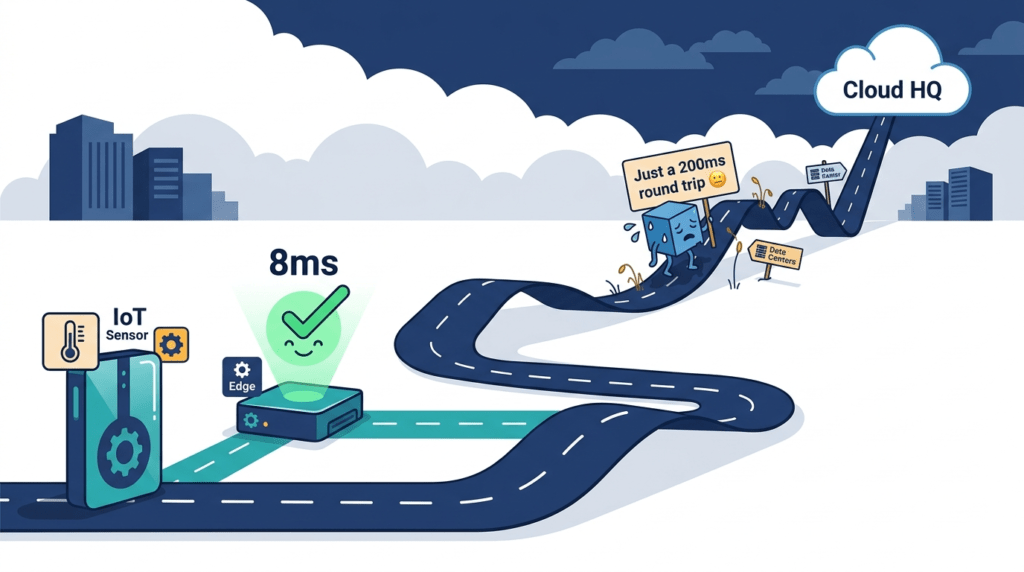
Round-trip latency from an IoT device to a cloud endpoint and back — even on a fast connection — is measured in tens to hundreds of milliseconds. For manufacturing quality inspection systems, robotic control loops, real-time safety monitoring, or automated logistics decisions, that latency window is too wide. A cloud-dependent architecture cannot support sub-10ms control loop requirements. Edge computing can.
Bandwidth costs scale with device counts
Streaming raw sensor data from thousands of devices to a cloud endpoint is expensive. A manufacturing facility with 10,000 sensors generating continuous telemetry can produce terabytes of data daily only a small fraction of which contains actionable signal. Edge processing filters, aggregates, and compresses data locally. Transmitting only meaningful events rather than raw data streams reducing cloud ingestion and storage costs by 60–80% in practice.
Connectivity is not guaranteed
Remote industrial sites, logistics vehicles, agricultural operations, and maritime deployments frequently operate in environments where cloud connectivity is intermittent or absent. An IoT architecture that depends on cloud connectivity for operational decisions cannot function reliably in these environments. Edge computing enables autonomous local operation — continuing to process, decide, and log — regardless of upstream connectivity status.
Data sovereignty and compliance require local processing
Regulations in India (PDPB), the EU (GDPR), and various sector-specific frameworks impose constraints on where data can be processed and stored. For B2B organizations generating sensitive operational data — patient monitoring, financial transactions, defense-adjacent manufacturing — edge processing within defined geographic or organizational boundaries is a compliance necessity, not a design preference.
Edge Computing Architecture Patterns for B2B IoT
Edge computing is not a single architecture. It is a spectrum of deployment patterns, each suited to different latency, reliability, and cost requirements.
Device Edge (On-Device Processing)
The most latency-sensitive compute occurs directly on the IoT device itself. Microcontrollers and edge-capable processors running embedded inference models. Or real-time control firmware can make decisions in microseconds without any network communication. For safety interlocks, actuator control, and anomaly detection on constrained hardware, device-edge processing is the appropriate pattern.
Near Edge (Industrial Gateway and Edge Node)
Industrial gateways purpose-built or ruggedized computing hardware positioned close to device clusters aggregate data from multiple sensors and devices. Apply filtering and preprocessing logic, run local machine learning inference models, and forward only relevant events upstream. This is the most common enterprise edge pattern for manufacturing, logistics, and smart building IoT deployments. Latency at this layer is typically in the low single-digit millisecond range.
Far Edge (On-Premise Micro-Data Center):-
For larger industrial facilities, on-premise data centers running edge cloud software stacks provide a more capable compute layer. These handle more complex analytics, local historian functions, integration with OT systems, and selective synchronization with cloud platforms. Latency at this layer is typically 5–20ms, with higher compute capacity than gateway-class hardware.
Cloud Edge (Regional Cloud Points of Presence)
Major cloud providers AWS, Microsoft Azure, Google Cloud have extended their infrastructure to regional edge nodes through services like AWS Outposts, Azure Stack Edge, and Google Distributed Cloud Edge. These extend cloud-native tooling to near-premise deployments, bridging the operational familiarity of cloud development with the latency and sovereignty benefits of on-premise compute.
Latency Benchmarks That Drive Edge Platform Selection
For IoT product managers evaluating edge platforms, latency benchmarks are the primary technical selection criterion — but the relevant latency metric depends on the use case.
Control loop latency (< 1ms to 10ms)
Required for real-time equipment control, safety interlocks, and robotic systems. Only device-edge or near-edge gateway deployments can meet this requirement. Cloud architectures are categorically unsuitable for sub-10ms control loops regardless of connectivity quality.
Event detection latency (10ms to 100ms)
Required for quality inspection, process anomaly detection, and real-time alerting. Near-edge gateway deployments with local ML inference typically achieve 10–50ms end-to-end event detection latency. Far-edge micro-data centers achieve 20–100ms depending on inference model complexity.
Operational decision latency (100ms to 1 second)
Required for logistics routing, supply chain event triggering, and facility management responses. Far-edge and cloud-edge deployments can meet this requirement reliably, with the advantage of more computational headroom for complex decision logic.
Analytics and reporting latency (seconds to minutes)
Suitable for cloud-based processing. Historical analysis, predictive maintenance model training, cross-facility benchmarking, and enterprise reporting workloads have no real-time constraint and are appropriately handled in centralized cloud environments.
The practical implication for IoT product managers: define the latency requirement for each workload category before selecting a platform. Deploying cloud-first and then attempting to retrofit edge processing for latency-sensitive workloads is expensive and operationally disruptive.
Edge Platforms for B2B IoT Deployments
The enterprise edge platform landscape has matured significantly. The platforms most relevant to B2B IoT product managers and operations engineers in 2026 are:
AWS IoT Greengrass
Amazon’s edge runtime for IoT devices and gateways. Greengrass extends AWS Lambda functions, containers, and managed components to edge hardware — enabling cloud-native development patterns for edge deployments. It handles local messaging, ML inference, and selective cloud synchronization. Best suited for organizations with existing AWS cloud investment and development teams familiar with AWS tooling.
Azure IoT Edge
Microsoft’s containerized edge runtime, built on Docker and Kubernetes primitives. Azure IoT Edge runs Azure-managed modules (Stream Analytics, Machine Learning, Functions) on edge hardware with a consistent deployment and monitoring interface from Azure IoT Hub. Strong integration with Azure Digital Twins for digital-physical synchronization. Best suited for organizations with Microsoft enterprise agreements and mixed Windows/Linux edge hardware environments.
Google Distributed Cloud Edge
Google’s hardware and software stack for extending Google Cloud to on-premise and near-edge environments. Particularly strong for organizations running Google Kubernetes Engine workloads who need to extend container orchestration to edge deployments with consistent tooling.
NVIDIA Jetson Platform
For B2B IoT deployments where edge AI inference is the primary workload — visual quality inspection, video analytics, predictive maintenance from sensor fusion — the NVIDIA Jetson family provides GPU-accelerated edge compute with a robust ML toolchain (TensorRT, DeepStream, Triton Inference Server). Widely used in manufacturing, logistics, and smart infrastructure deployments.
Eclipse Mosquitto + Edge Kubernetes (Open-Source Stack)
For operations engineers who prefer an open-source, vendor-neutral approach, a combination of lightweight MQTT broker (Eclipse Mosquitto), edge Kubernetes distribution (K3s or MicroK8s), and time-series database (InfluxDB or TimescaleDB) provides a highly configurable edge stack without cloud vendor lock-in. Higher operational complexity but maximum flexibility.
Building an Edge IoT Deployment: A Practical Framework
For IoT product managers approaching edge deployment for the first time, a structured planning approach prevents the most costly architecture mistakes.
Step 1 — Workload latency classification
Categorize every IoT workload by its latency requirement. Assign each workload to the appropriate edge tier: device-edge, near-edge gateway, far-edge micro-data center, or cloud. This workload map becomes the foundation of the edge architecture design.
Step 2 — Connectivity and resilience mapping
Document the connectivity characteristics of every deployment environment — bandwidth, reliability, intermittency, and cost. Identify workloads that must operate autonomously during connectivity loss and design edge nodes with appropriate local storage and offline operational logic.
Step 3 — Hardware and platform selection
Select edge hardware and software platform based on workload requirements. Connectivity environment, organizational toolchain preferences, and total cost of ownership. Avoid selecting platforms based on vendor relationships alone — benchmark actual latency and reliability against your specific workloads.
Step 4 — Security architecture for distributed edge
Edge deployments introduce new attack surfaces compared to cloud-centric architectures. Each edge node is a physical computing asset that may be in an insecure physical environment. Edge security architecture must cover: device identity and attestation, encrypted communication between edge and cloud tiers, physical tamper detection. Remote management and patching capability, and network segmentation between OT and IT domains.
Step 5 — Observability and fleet management
Operating a fleet of distributed edge nodes requires centralized observability monitoring device health, software version, connectivity status, inference model versions. And anomaly alerts across all nodes from a single management plane. Edge platforms like AWS Greengrass, Azure IoT Edge, and open-source tools like Portainer provide fleet management capabilities that reduce operational overhead as edge node counts scale.
FAQ
1. What is edge computing for B2B IoT and why does it matter now?
Edge computing for B2B IoT deploys processing capability at or near the source of IoT data, rather than routing all data to centralized cloud infrastructure. It matters now because IoT device volumes, data throughput requirements. And latency-sensitive use cases have scaled beyond what cloud-only architectures can support economically or reliably for enterprise B2B operations.
2. What latency is achievable with near-edge gateway deployments?
Near-edge industrial gateway deployments typically achieve 10–50ms end-to-end event detection latency for workloads including local ML inference, sensor data aggregation, and real-time alerting. Control-loop latency at the device-edge tier can achieve sub-1ms for embedded real-time firmware applications.
3. Which edge platform is best for B2B IoT deployments?
Platform selection depends on organizational cloud investment, development toolchain preferences, workload characteristics, and hardware environment. AWS IoT Greengrass suits AWS-native organizations; Azure IoT Edge suits Microsoft enterprise environments. NVIDIA Jetson suits AI inference-heavy workloads; open-source K3s stacks suit teams prioritizing vendor neutrality. There is no universally best platform — there is the most appropriate platform for a specific deployment context.
4. How does edge computing reduce cloud costs for IoT operations?
Edge computing reduces cloud costs by filtering, aggregating, and compressing data locally before transmission — sending only meaningful events rather than raw data streams. In practice, this reduces cloud ingestion and storage volumes by 60–80% for high-throughput sensor environments. While simultaneously reducing bandwidth costs for remote or metered connectivity deployments.
5. How should operations engineers approach security for distributed edge deployments?
Edge security requires layered controls across physical security (tamper detection, secured hardware), device identity (X.509 certificates, TPM-based attestation), encrypted communications (TLS between edge and cloud tiers), network segmentation (OT/IT domain separation), and centralized remote management for patching and configuration enforcement. Edge nodes in physically insecure environments require additional hardware security module (HSM) protection for cryptographic key material.
Deploy Your Edge IoT Infrastructure With the Right Specialists
Edge computing for B2B IoT spans hardware selection, platform deployment, security architecture, OT integration, connectivity management. And fleet operations a cross-functional challenge that most in-house IoT product and engineering teams cannot own entirely without specialist support.
If your product team or operations engineering function needs support selecting edge platforms, designing edge IoT architecture. Deploying industrial gateways, or integrating edge compute with existing OT and enterprise systems. MyB2BNetwork connects you with vetted IoT infrastructure, edge computing, and industrial technology specialists who have delivered these deployments.
Submit one requirement. Receive competitive quotations from pre-screened providers. We scope your project, validate offers, schedule meetings, support negotiations, and protect every payment through secure escrow. So your edge computing investment delivers real operational performance, not just infrastructure complexity.
[Submit your IoT infrastructure or edge computing requirement on MyB2BNetwork →]