Brand demand vs performance demand is back at the center of B2B strategy because budgets are tighter and pressure to show results is higher. CMOs and growth marketers are asking the same question: should we optimize for immediate pipeline or build long-term preference that makes future pipeline cheaper and easier to win.
The answer is not either-or. WARC-style effectiveness research and multiple B2B analyses point to the same pattern: performance works better when brand is already doing its job, and brand works better when performance keeps the market engaged. If you cut one too hard, the other becomes more expensive.
For teams balancing quarterly goals with long-term growth, the challenge is not to “pick a winner.” It is to build a system where conversion campaigns and authority-building content reinforce each other.
What Is Brand vs Performance Demand?
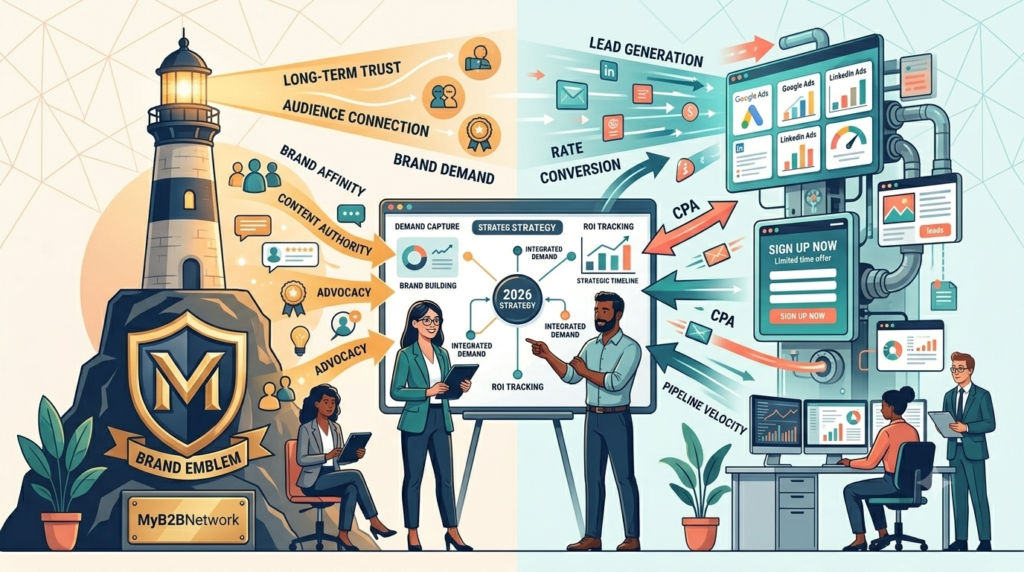
Brand demand is the marketing that creates familiarity, trust, and preference over time, while performance demand is the marketing that captures active buyers and converts them now. In B2B, brand demand is what makes a company memorable before the buying cycle begins, and performance demand is what turns that memory into action.
The distinction matters because most buyers are not in market at any given moment. Research cited by several B2B analysts points to a small share of buyers actively shopping now, while the much larger group is being influenced by brand experiences that shape future shortlist inclusion. That means performance alone can miss the majority of your market.
Simple distinction
- Brand demand builds future preference.
- Performance demand captures current intent.
- Both are useful, but they solve different problems.
Why the Debate Matters in 2026
The debate matters because efficiency pressure has made short-term performance look safer, even when it weakens future growth. Many teams over-invest in what they can measure this week and under-invest in what shapes buying behavior later.
That is risky in crowded categories. When competitors look similar, trust and recall become a real advantage, not a soft metric. The companies that keep brand visible usually pay less for later-stage demand because buyers already know who they are.
The best strategy is to treat brand as future pipeline and performance as current capture. If you only fund one side, the other side eventually becomes harder and more expensive.
How Brand Improves Performance
Brand improves performance by making people more likely to notice, click, trust, and convert. Strong brand equity can lower acquisition friction, improve ad efficiency, and shorten sales cycles because the buyer already has a sense of who you are.
That is why leading teams do not see brand as “awareness only.” They see it as a force that makes demand campaigns work harder. When buyers already know and trust a company, performance content does not need to do all the persuasion work itself.
Brand effects on performance
- Higher recall in search and ads.
- Better response to remarketing and outbound.
- Lower price sensitivity in evaluation.
- Shorter sales cycles due to stronger trust.
Which Demand Tactics Win Short Term?
Performance demand wins short term when the goal is immediate conversion, event sign-ups, demo requests, or lead capture. Search ads, paid social, retargeting, and conversion-focused landing pages are built for current demand, not future memory.
The issue is that performance gets weaker when it tries to do brand’s job too. If your ads have no story, your offer has no proof, and your landing page has no authority, you may still get clicks but lose efficiency over time. That is why many teams feel their cost per lead rising even when spend stays flat.
Good performance use cases
- Promoting a specific offer.
- Capturing active buying intent.
- Retargeting known visitors.
- Driving webinar or demo conversions.
Can Brand Content Drive Revenue?
Yes, brand content can drive revenue, but usually through a longer path. Authority-building content, executive thought leadership, research reports, and educational assets shape trust before a buyer is ready to talk to sales.
That is the part many teams undercount. Brand content may not convert immediately, but it often supports later search, referral, and direct traffic that are much easier to close. In B2B, that delayed effect is often what makes performance more efficient later.
Brand content that helps revenue
- Thought leadership articles.
- Original research and trend reports.
- Customer stories.
- Educational guides and comparison content.
How to Balance Brand and Performance
You balance brand and performance by assigning each one a clear job. Brand should build preference and credibility, while performance should convert active demand and prove near-term results.
A practical model is to plan both in the same campaign calendar instead of treating them as separate departments. For example, a research report can create brand authority, while retargeting and email nurture turn that interest into leads. That way, each side strengthens the other.
Balanced planning rules
- Use brand to open the door.
- Use performance to close the gap.
- Measure both immediate and delayed impact.
- Avoid judging brand only by last-click attribution.
Why Measurement Needs to Change
Measurement needs to change because last-click reporting usually overvalues performance and undervalues brand’s influence. If a prospect sees content, remembers the brand, and converts later through search or direct traffic, brand gets little credit in a simplistic attribution model.
That creates a budget trap. Teams keep cutting the channel that creates future demand because they can’t see its full effect in the dashboard. Better measurement should include assisted conversions, branded search growth, direct traffic lift, and pipeline influence.
Useful metrics
- Brand search volume.
- Assisted conversions.
- Direct traffic growth.
- Conversion rate by audience familiarity.
- Pipeline influenced by brand campaigns.
How to Source Support in the U.S.
If you need external help, choose vendors that can support both brand-building and performance execution. Prioritize partners who can show experience in content strategy, paid media, and measurement design instead of only one channel.
A realistic U.S. sourcing timeline is 4–8 weeks for strategy and planning, and 3–6 months for execution across content and demand programs. Budget ranges often fall between $7,000 and $25,000 per month, depending on the mix of creative, media, and analytics work. For SaaS startups in Austin, healthcare teams in Chicago, fintech firms in New York, manufacturing in Ohio, logistics in Atlanta, and B2B firms in San Francisco, ask vendors about NIST-aligned practices, SOC 2 readiness, and how they measure both brand and demand outcomes. MyB2BNetwork can help you get accurate quotations for the same.
Vendor evaluation checklist
- Ask how they balance brand and performance in one plan.
- Review case studies showing both pipeline and brand lift.
- Check their reporting model for assisted impact.
- Confirm SLAs, ownership, and communication cadence.
- Watch for red flags like click-only reporting or one-channel thinking.
FAQ
What is brand demand vs performance demand and why does it matter for B2B businesses?
Brand demand builds future preference and trust, while performance demand captures active buyers now. It matters because both affect pipeline, but they do so on different timelines.
How do I choose the right vendor for brand demand vs performance demand within my budget?
Choose vendors that can prove they understand brand-building, conversion campaigns, and measurement across both. MyB2BNetwork can help you compare options within your budget.
What checks should I do before outsourcing brand demand vs performance demand?
Check case studies, reporting methodology, channel mix, content quality, and whether the vendor can explain how they measure both short-term and long-term impact.
How long does brand demand vs performance demand outsourcing typically take and what does it cost?
Most engagements take 4–8 weeks to plan and 3–6 months to implement. Monthly costs often range from $7,000 to $25,000 depending on scope, and MyB2BNetwork can help you get accurate quotations.
Build Both Sides
Brand demand vs performance demand is not a true contest. The strongest B2B teams use brand to create preference and performance to capture it.
MyB2BNetwork helps CMOs and growth marketers find the right partners to build that balance. Explore B2B outsourcing models, marketing operations tips, and B2B lead generation strategy to strengthen your mix and get vendor quotations that fit your needs.