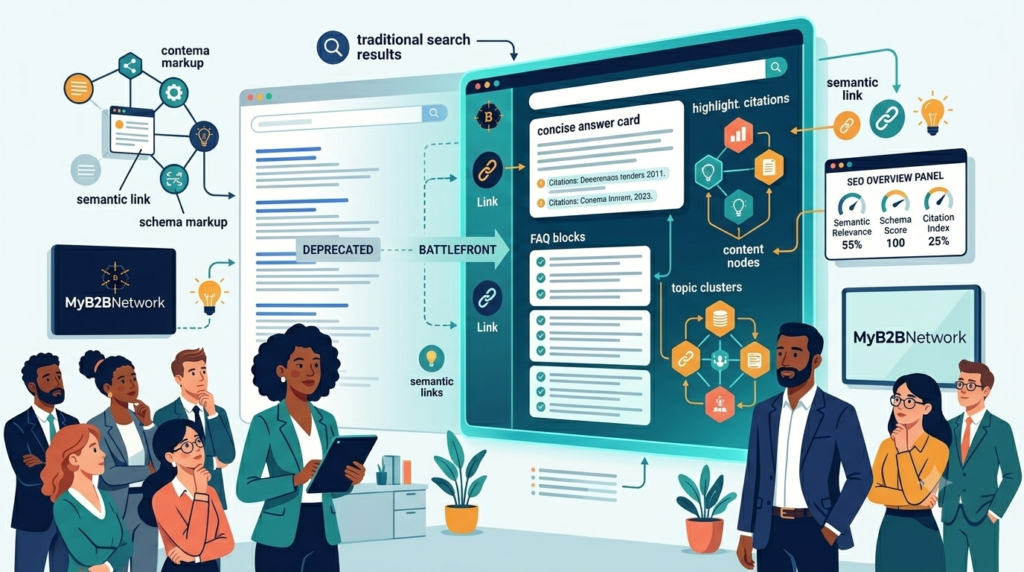
AI search is becoming the new SEO battlefront because search engines are no longer only ranking pages; they are synthesizing answers. That means your content has to be useful to both humans and answer engines if you want visibility to keep paying off.
This matters because the old SEO model rewarded pages that matched keywords and earned clicks. The new model rewards content that is easy to quote, easy to trust, and easy to summarize, especially in AI-generated snippets and overviews. If your page is thin, vague, or buried in long paragraphs, it is less likely to surface.
For SEO leads and content teams, this is not the end of SEO. It is a reset. The brands that adapt fastest will build pages that answer clearly, organize knowledge into clusters, and prove expertise with structure and original insight.
What Is AI Search?
AI search is the use of generative models and answer engines to interpret queries and return synthesized responses, not just a list of links. In practice, this includes AI overviews, conversational search, and systems that pull from structured, trusted content to answer the user directly.
That changes how content is evaluated. Instead of asking only whether a page can rank, teams now need to ask whether a page can be selected, summarized, and cited by AI systems. That is why concise answers and machine-friendly formatting matter more than ever.
Core traits of AI search
- It prioritizes answer quality over keyword repetition.
- It rewards clear structure and semantic relevance.
- It favors pages that resolve intent quickly.
Why AI Search Matters for Businesses
AI search matters because it reshapes how buyers discover brands, compare options, and build trust. If answer engines summarize your content well, they can influence decisions even before a user clicks through to your site.
That creates both a risk and an opportunity. The risk is lower click-through on basic informational queries. The opportunity is stronger authority if your content becomes a source that AI systems consistently reference.
For B2B companies, this is especially important because buyers often research extensively before contacting sales. If your pages do not answer well, you may be invisible at the exact moment influence is being formed.
How to Write for Answer Engines
You should write for answer engines by putting the answer first, then expanding with context, proof, and next steps. Short, direct answers are easier for AI systems to parse and easier for readers to trust.
This does not mean writing shallow content. It means front-loading clarity and then adding the detail needed to show expertise. The best-performing pages are often the ones that are both concise and complete.
Answer-engine writing checklist
- Start each section with a direct answer sentence.
- Keep paragraphs short, usually 2–4 sentences.
- Use bullet points and numbered lists where appropriate.
- Include original examples, data, or frameworks.
- Add clear subheadings that match real questions.
Which Content Structures Work Best?
Content structures that work best are the ones that make it easy for AI to map questions to answers. That includes FAQs, topic clusters, comparison tables, and tightly organized hub-and-spoke content.
A single page can still rank, but a cluster performs better when it supports one core topic with related subtopics. For example, a pillar page on AI search can link to supporting pages on schema, FAQs, content refreshes, and topical authority. That creates a stronger signal for both search engines and users.
| Structure | Best For | Why It Helps |
|---|---|---|
| FAQ blocks | Direct answers and snippets | Matches question-based search behavior |
| Topic clusters | Authority and coverage | Shows depth around one subject |
| Comparison tables | Evaluation and decision-making | Makes information easy to extract |
Can Structured FAQs Improve Visibility?
Yes, structured FAQs can improve visibility because they mirror the way users ask questions and the way AI systems extract answers. Short question-and-answer blocks are especially useful for featured snippets and AI overviews.
The key is to make the FAQ useful, not decorative. Each answer should be concise, factual, and relevant to the page topic. If the FAQ repeats the main article without adding clarity, it will not help much.
FAQ best practices
- Write the question in natural language.
- Answer in 40–60 words when possible.
- Use one idea per answer.
- Keep language plain and specific.
Why Topic Clusters Now Matter More
Topic clusters matter more because AI search values topical completeness and context. When your content hub covers a subject from multiple angles, it is easier for answer engines to understand that your site has depth.
This is also good for human readers. Clustered content helps them move from a broad question to a detailed buying or action page without getting lost. In B2B, that means your content can support awareness, evaluation, and conversion in one connected system.
Cluster planning tips
- Build one pillar page for the main topic.
- Add 4–6 supporting articles for subtopics.
- Interlink every related page naturally.
- Update the cluster regularly with fresh examples.
How to Source SEO Help in the U.S.
If you need outside help, choose vendors that understand AI search, structured content, and answer-engine optimization, not just old-school keyword ranking. Prioritize partners that can show structured FAQ work, topic cluster planning, and measurable visibility improvements beyond traffic alone.
A realistic U.S. sourcing timeline is 4–8 weeks for an audit and roadmap, and 3–6 months for implementation across content clusters and technical updates. Budget ranges often fall between $5,000 and $18,000 per month, depending on site size and content production needs. For SaaS startups in Austin, healthcare in Chicago, fintech in New York, manufacturing in Ohio, logistics in Atlanta, and B2B firms in San Francisco, ask about NIST-aligned practices, SOC 2 readiness, and content governance. MyB2BNetwork can help you get accurate quotations for the same.
Vendor evaluation checklist
- Ask how they optimize content for AI search and answer engines.
- Review sample FAQ blocks and topic clusters.
- Confirm reporting on citations, visibility, and assisted traffic.
- Check references, SLAs, and implementation timelines.
- Watch for red flags like traffic-only reporting or template content.
FAQ
What is AI search and why does it matter for B2B businesses?
AI search is when search engines synthesize answers instead of only listing pages, and it matters because it changes how buyers discover and trust content.
How do I choose the right vendor for AI search within my budget?
Choose a vendor that can show experience with answer-engine optimization, structured FAQs, and topic clusters, then compare their scope and reporting model before signing.
What checks should I do before outsourcing AI search?
Check case studies, content structure methods, technical SEO depth, reporting clarity, and whether they understand how AI systems read and cite content.
How long does AI search outsourcing typically take and what does it cost?
Most audits and roadmaps take 4–8 weeks, while implementation can take 3–6 months. Monthly costs often range from $5,000 to $18,000 depending on scope, and MyB2BNetwork can help you get accurate quotations.
Build for AI Search
AI search is not replacing SEO, but it is redefining what good SEO looks like. The teams that win will be the ones that combine concise answers, structured FAQs, and topic clusters with real expertise.
MyB2BNetwork helps SEO leads and content teams find the right partners to build that kind of visibility. Explore B2B outsourcing models, marketing operations tips, and B2B lead generation strategy to strengthen your search program and get vendor quotations that fit your needs.