Agentic AI in B2B vendor selection is moving fast in 2026, but most teams are still stuck between pilots and real production value. Forrester reports that three-quarters of enterprises are adopting agentic AI, yet only a small minority have scaled it beyond lightweight “agentish” chatbots.
That gap matters because procurement leaders are under pressure to do more than test new technology. They need tools that can identify suppliers, analyze bids, surface risk, and support compliance without adding more manual work. The challenge is not whether agentic AI can help; the challenge is whether it can deliver reliable ROI in real sourcing workflows.
This research-style blog is designed for procurement, legal, and operations teams evaluating where agentic AI actually fits in the vendor selection process. It also shows how MyB2BNetwork aligns with this shift by helping teams summarize, compare, and evaluate vendor quotations more efficiently.
What Is Agentic AI in Vendor Selection?
Agentic AI in vendor selection is the use of autonomous or semi-autonomous systems to help identify suppliers, compare bids, flag compliance issues, and recommend next actions during procurement. Unlike simple automation, these systems can interpret context, follow workflows, and trigger actions across multiple steps.
In theory, that should make sourcing faster and more consistent. In practice, most organizations are still testing whether the technology can be trusted beyond narrow use cases like bid summarization or supplier triage. The current market is less about full autonomy and more about controlled delegation.
Core use cases
- Supplier identification.
- Bid and quotation comparison.
- Compliance and risk screening.
- Contract review support.
- Sourcing workflow orchestration.
Why It Matters for Procurement Teams
Agentic AI matters because procurement is still full of repetitive work that consumes time without improving decisions. Bid reviews, supplier comparisons, and intake triage are exactly the kinds of tasks agentic systems are designed to assist with.
For teams under pressure, even modest gains matter. The Hackett Group reports that early adopters have seen productivity improvements of up to 10%, with leading organizations seeing gains above 25% in effectiveness and cost efficiency. That is enough to justify pilots, but not enough to justify blind trust.
The real business impact comes when agentic AI reduces cycle time while keeping human judgment in the loop. That is where ROI begins to move from promise to proof.
How Pilot Programs Usually Work
Pilot programs usually start with one narrow task, such as bid summarization or supplier scoring, because that limits risk and makes results easier to measure. Most companies use pilots to test accuracy, workflow fit, and user trust before expanding to more autonomous actions.
That approach is sensible, but it also creates a trap. A pilot can look successful if it saves time on a simple task, even if the same system breaks down when it faces messy documents, incomplete data, or compliance exceptions.
Common pilot design
- Pick a contained use case.
- Define human approval points.
- Measure time saved and error rate.
- Test exception handling.
- Expand only if the workflow remains reliable.
Which ROI Signals Actually Matter?
The ROI signals that matter most are not hype metrics like number of prompts or number of tasks touched. The important signals are cycle time reduction, accuracy of bid comparison, compliance detection rate, and procurement labor saved.
Forrester says ROI uncertainty is one of the biggest reasons enterprises stay in pilot mode. That is a strong reminder that an impressive demo is not the same as operational value. The best programs measure whether the agent helps buyers make better decisions faster, not whether it simply automates more clicks.
ROI metrics to track
- Time saved per sourcing event.
- Reduction in manual review hours.
- Bid comparison accuracy.
- Compliance issue detection.
- Percentage of tasks requiring human correction.
Can Agentic AI Be Trusted With Vendor Bids?
Yes, but only with guardrails. Agentic AI can help review bids, highlight risks, and surface patterns, but final selection should still require human review, especially when contracts, compliance, or spend thresholds are involved.
Forrester warns that governance gaps remain one of the biggest blockers to scaling agentic systems. That means trust should be earned through auditability, explainability , and clear decision checkpoints. If the system cannot show why it ranked one vendor above another, it should not be making final recommendations.
Trust controls
- Human approval before award.
- Source traceability for every score.
- Logged reasoning for ranking changes.
- Exception handling for compliance or legal issues.
- Periodic model review and recalibration.
Why Compliance Still Sets the Ceiling
Compliance still sets the ceiling because procurement decisions often involve contractual, privacy, financial, and security obligations. A system can be efficient and still be risky if it misses a regulatory condition or misreads a vendor’s certification status.
That is why the most successful deployments keep the agent inside a governed workflow rather than letting it run freely. Agentic AI is strongest when it supports review, not when it replaces it.
Typical compliance checks
- Security certifications and policy validation.
- Contract term and SLA checks.
- Regional privacy requirements.
- Financial and supplier risk screening.
- Audit trail retention.
How MyB2BNetwork Fits the Workflow
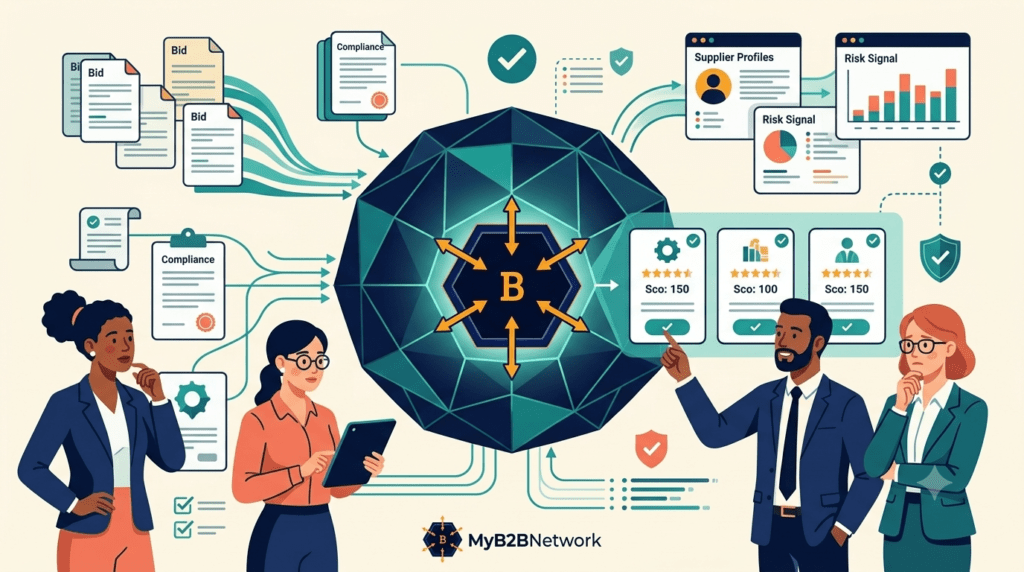
MyB2BNetwork fits this workflow because it already operates like a smart sourcing layer for B2B buyers. Instead of forcing teams to manually sort through every vendor option, the platform can help summarize, compare, and organize quotations so buyers can move faster with better context.
That makes it a natural complement to agentic AI rather than a replacement for it. For procurement teams, MyB2BNetwork can serve as the human-friendly layer that turns sourced options into clear, reviewable choices.
How to Source Support in the U.S.
For U.S. teams exploring agentic AI in procurement, the best vendors are the ones that can demonstrate narrow-use-case ROI, strong governance, and integration with existing sourcing systems. Prioritize firms that can show results in bid analysis, supplier triage, and compliance workflows instead of generic “AI transformation” claims.
A realistic timeline is 4–8 weeks for a pilot and 3–6 months for a controlled rollout. Budget ranges often start around $10,000–$30,000 per month for consulting, implementation, and workflow support, with enterprise programs costing more depending on scale. In regulated industries such as healthcare, fintech, SaaS, manufacturing, and logistics across cities like Austin, Chicago, New York, Ohio, Atlanta, and San Francisco, governance and auditability matter as much as speed. MyB2BNetwork can help you get accurate quotations for the same.
Vendor evaluation checklist
- Ask what tasks the agent can perform autonomously.
- Review pilot-to-production success rates.
- Confirm auditability and human approval points.
- Verify references from comparable procurement teams.
- Watch for red flags like vague ROI claims or no governance model.
FAQ
What is agentic AI in B2B vendor selection and why does it matter?It is the use of autonomous AI systems to support supplier identification, bid review, and procurement workflows, and it matters because it can save time and improve consistency if governed properly.
How do I choose the right vendor for agentic AI in vendor selection within my budget?Choose vendors that can prove narrow-use-case ROI, explain their governance model, and show how they handle human review and exceptions. MyB2BNetwork can help you compare qualified options within budget.
What checks should I do before outsourcing agentic AI in vendor selection?Check compliance coverage, audit trails, integration depth, reference clients, SLAs, and whether the vendor can explain why the agent made a recommendation.=
How long does agentic AI in vendor selection outsourcing typically take and what does it cost?A pilot usually takes 4–8 weeks, while a controlled rollout can take 3–6 months. Costs often begin around $10,000–$30,000 per month depending on complexity, and MyB2BNetwork can help you get accurate quotations.
Build Smarter Sourcing
Agentic AI is no longer just a buzzword, but it is also not a finished answer. The organizations seeing real ROI are the ones using it for focused procurement tasks with strong human oversight.
MyB2BNetwork helps procurement and operations teams make that shift with less friction. Explore B2B outsourcing models, marketing operations tips, and B2B lead generation strategy to see how our platform supports smarter vendor discovery and quotation comparison.