What Is Quantum‑Safe Encryption for B2B?
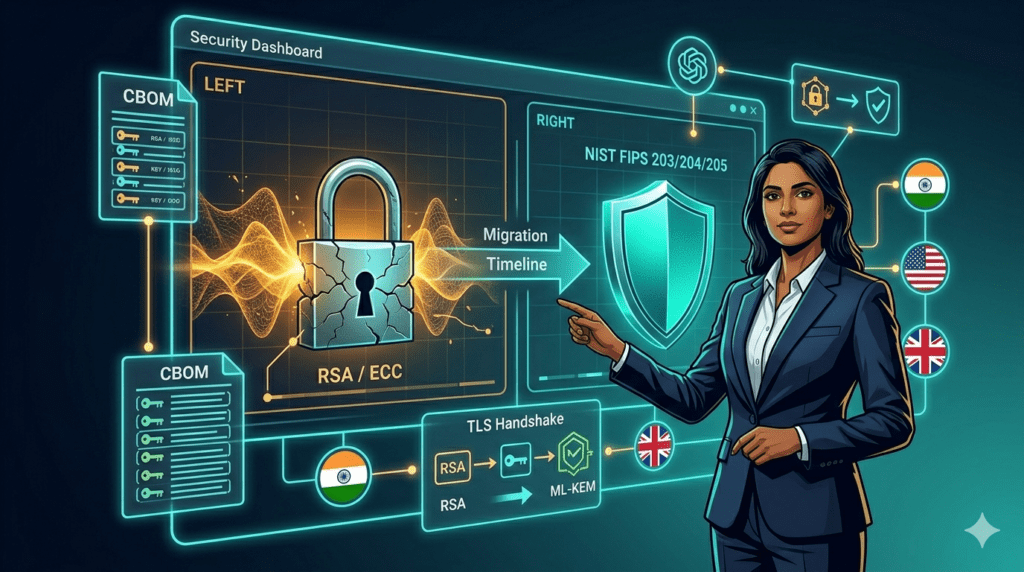
Quantum‑safe encryption — also called post‑quantum cryptography (PQC) — is the practice of migrating enterprise security infrastructure away from classical encryption algorithms (RSA, ECC, Diffie‑Hellman) that quantum computers will be able to break, toward quantum‑resistant algorithms standardized by bodies like NIST that remain secure even against quantum‑level computational attacks. For B2B CISOs and security architects, it is not a future concern. It is a migration programme that needs to start now.
Most B2B security teams are protecting today’s data with algorithms that will be broken within three years.
That is not an alarmist projection. It is the consensus position of NIST, CISA, the UK NCSC, and the European Union Agency for Cybersecurity (ENISA). All of which have published formal guidance urging organizations to begin post‑quantum cryptography migration immediately. The threat has a name: “Harvest Now, Decrypt Later” (HNDL). Nation‑state actors and sophisticated threat groups are already exfiltrating encrypted B2B data today — not to decrypt it now. But to hold it until quantum computing capability makes decryption trivial.
For B2B organizations handling long‑lived sensitive data — financial records, intellectual property, regulated healthcare data, legal contracts, or strategic communications — the HNDL threat means that data encrypted today under RSA‑2048 or ECC‑256 may already be in an adversary’s possession, waiting for the quantum decryption window to open.
Quantum‑safe encryption preparation is the process of auditing cryptographic dependencies, selecting NIST‑standardized post‑quantum algorithms, migrating systems through a phased rollout. And maintaining cryptographic agility so that future algorithm updates can be deployed without full infrastructure re‑engineering.
The Quantum Threat Timeline Every CISO Needs to Know
The quantum computing timeline is no longer speculative. Multiple credible technical and governmental sources have converged on a consistent risk window.
2025–2026 — Harvest Now, Decrypt Later is active
Nation‑state actors with long‑term strategic interests are already collecting encrypted data at scale. Any B2B data encrypted today under classical algorithms is a future decryption target. The threat is not hypothetical — it is a present‑tense data exfiltration risk with a delayed decryption payoff.
2027–2029 — Cryptographically Relevant Quantum Computers (CRQCs) approach viability
Multiple credible technical assessments — including those from IBM, Google. And government intelligence bodies project that quantum computers capable of breaking RSA‑2048 in practical timeframes will reach viability within this window. The exact date is uncertain, but the direction is not.
2030 and beyond — Classical encryption becomes untenable for sensitive B2B data
Organizations that have not completed their post‑quantum migration by this point face either a catastrophic security exposure or an emergency re‑engineering programme under active threat conditions — neither of which is an acceptable risk posture for enterprise B2B security.
The implication for B2B CISOs is clear:
a quantum migration programme that begins in 2028 is too late for data that is already being harvested today.
NIST Post‑Quantum Cryptography Standards: What Matters for B2B
In August 2024, NIST finalized the first three post‑quantum cryptography standards the most significant cryptographic standardization event since AES was standardized in 2001. These are the algorithms that B2B security teams should be migrating toward.
ML‑KEM (CRYSTALS‑Kyber) — FIPS 203
ML‑KEM is the primary standard for key encapsulation mechanisms the cryptographic process of securely exchanging encryption keys. It replaces RSA and Diffie‑Hellman key exchange in TLS, VPN, and secure communication protocols. For B2B teams, ML‑KEM is the most immediately relevant standard because TLS‑protected API communications and partner integrations are among the highest-exposure cryptographic surfaces.
ML‑DSA (CRYSTALS‑Dilithium) — FIPS 204
ML‑DSA is the primary standard for digital signatures the cryptographic mechanism used to verify the authenticity and integrity of documents, code, certificates, and communications. It replaces RSA and ECDSA signatures across code signing, certificate infrastructure, and document authentication workflows.
SLH‑DSA (SPHINCS+) — FIPS 205
SLH‑DSA is a hash‑based digital signature scheme that provides a stateless, conservative alternative to ML‑DSA. It is larger and slower than Dilithium but relies on more mathematically conservative assumptions making it an appropriate choice for high‑assurance signing use cases where algorithm longevity is the priority.
A fourth standard — FN‑DSA (FALCON) — is expected to be finalized as FIPS 206 and will provide a more compact digital signature scheme for constrained environments.
For B2B security architects, the migration priority should be:
TLS/key exchange first (ML‑KEM), code signing and certificates second (ML‑DSA), document. And contract authentication third (SLH‑DSA for high‑assurance, ML‑DSA for standard).
Auditing Your Cryptographic Exposure: Where to Start
Before migrating anything, B2B security teams need a complete picture of their current cryptographic landscape. Most enterprise environments have cryptographic dependencies in places that security teams have never systematically catalogued.
A B2B cryptographic audit covers five key surfaces:
1. TLS and Network Communications
Every external API endpoint, partner integration, web application, and internal service‑to‑service communication that uses TLS is a cryptographic surface. Audit tools like SSL Labs, testssl.sh, and CryptoScan can enumerate TLS configurations across external surfaces. Internal network traffic requires packet capture analysis or dedicated cryptographic discovery tools.
2. Certificate Infrastructure (PKI)
Every certificate in your PKI — server certificates, client certificates, code signing certificates. Device certificates — uses classical key types that will need to be replaced. Certificate management platforms like Venafi and Keyfactor provide cryptographic inventory capabilities that enumerate certificates by algorithm, key length, and expiry, giving security architects a comprehensive view of PKI exposure.
3. Code Signing and Software Supply Chain
Build pipelines, container image signing, firmware updates, and software distribution mechanisms that rely on classical digital signatures are quantum‑vulnerable surfaces that often receive less attention than network communications but carry significant exposure — particularly for B2B software vendors whose customers depend on signature verification for supply chain security.
4. Data at Rest Encryption
Symmetric encryption algorithms (AES‑256) used for data‑at‑rest protection are quantum‑resistant at current key lengths — Grover’s algorithm reduces AES‑256 effective security to roughly 128 bits under quantum attack, which remains acceptable. However, the key exchange mechanisms used to protect symmetric keys in transit may use classical algorithms that are quantum‑vulnerable.
5. Application‑Level Cryptography
Custom cryptographic implementations — JWT signing, API authentication tokens, data encryption in application code — often use classical libraries that will require dependency updates and code changes as part of the migration.
Building a Phased Quantum‑Safe encryption Migration Roadmap
A phased migration approach prevents the operational disruption of trying to replace all cryptographic dependencies simultaneously while ensuring that the highest‑risk surfaces are addressed first.
Phase 1 — Cryptographic Discovery and Inventory (Months 1–3)
Deploy cryptographic discovery tooling across the environment to enumerate all algorithms, key types, and certificate configurations in use. Build a comprehensive cryptographic bill of materials (CBOM) — a structured inventory of every cryptographic dependency, its location, its owner, and its quantum‑vulnerability status. CBOM tooling is emerging from vendors including IBM, Cryptosense (now part of Quantum‑Safe encryption Security), and open‑source projects aligned with the CISA Post‑Quantum Cryptography Initiative.
Phase 2 — Risk Prioritization (Months 3–4)
Score each cryptographic surface by three criteria: sensitivity of the data or communication it protects, duration of sensitivity (how long does this data need to remain confidential?), and migration complexity. Surfaces protecting long‑lived sensitive data with manageable migration complexity should be prioritized for early migration regardless of their size.
Phase 3 — Cryptographic Agility Foundation (Months 4–8)
Before migrating to specific PQC algorithms, establish cryptographic agility. The architectural capability to swap cryptographic algorithms without re‑engineering the systems that use them. This means abstracting cryptographic operations behind well‑defined interfaces, eliminating hard‑coded algorithm dependencies in application code. And updating cryptographic libraries to versions that support PQC algorithms (OpenSSL 3.x, BoringSSL, liboqs).
Phase 4 — Hybrid Classical/PQC Deployment (Months 8–18)
Deploy hybrid cryptographic configurations that combine classical and post‑quantum algorithms simultaneously — for example, X25519 + ML‑KEM in TLS key exchange. Hybrid deployment provides immediate quantum resilience for HNDL threats while maintaining backward compatibility with partners and systems that have not yet migrated. NIST and major TLS library maintainers support hybrid key exchange as the recommended transition approach.
Phase 5 — Progressive PQC‑Only Migration (Months 18–36)
As partner ecosystem and supply chain dependencies complete their own migrations. Progressively retire classical algorithm support in favour of PQC‑only configurations. Maintain a migration dashboard tracking completion percentage by surface, partner dependency status, and residual classical algorithm exposure.
Cryptographic Agility: The Strategic Investment That Outlasts Any Algorithm
The NIST standards finalized in 2024 will not be the last word in post‑quantum cryptography. Algorithm research is ongoing, and it is plausible that future cryptanalytic advances will require another migration cycle within the next decade.
Cryptographic agility — the architectural principle of building systems so that their underlying cryptographic algorithms can be changed without structural re‑engineering is therefore the most durable investment a B2B security architecture team can make during a quantum migration programme.
Concrete cryptographic agility principles include:
- Centralizing cryptographic operations in a dedicated library or service rather than implementing them inline across application code
- Using algorithm‑agnostic key management systems (like HashiCorp Vault or AWS KMS) that support algorithm rotation without application changes
- Parameterizing algorithm selections in configuration rather than hard‑coding them in application logic
- Maintaining automated regression testing for cryptographic functionality so that algorithm swaps can be validated efficiently
- Documenting every cryptographic dependency in the CBOM and maintaining it as a living record updated with every system change
For security architects building quantum migration programmes, cryptographic agility is not a separate initiative — it is the foundation that makes every subsequent migration faster, cheaper, and less risky.
FAQ
1. What is quantum‑safe encryption and why does it matter for B2B now?
Quantum‑safe encryption uses post‑quantum cryptographic algorithms that remain secure against attacks from quantum computers. It matters for B2B now because nation‑state actors are already harvesting encrypted data under “Harvest Now, Decrypt Later” strategies meaning that data encrypted today under classical algorithms may be decrypted within three to five years when quantum computing reaches cryptographically relevant capability.
2. Which NIST post‑quantum algorithms should B2B security teams prioritize?
B2B security teams should prioritize ML‑KEM (FIPS 203) for key exchange and TLS migration, ML‑DSA (FIPS 204) for digital signatures and code signing. And SLH‑DSA (FIPS 205) for high‑assurance signing use cases.
The migration priority order should be:
TLS and API communications first, certificate infrastructure second, code signing and software supply chain third, and application‑level cryptography fourth.
3. How long does a post‑quantum cryptography migration typically take for a B2B organization?
A comprehensive post‑quantum migration for a mid‑market to enterprise B2B organization typically takes 24 to 36 months from initial cryptographic inventory to progressive PQC‑only deployment. The timeline varies significantly based on the complexity of the cryptographic landscape. The number of partner dependencies requiring coordinated migration, and the maturity of the organization’s existing cryptographic agility foundation.
4. What is a cryptographic bill of materials (CBOM) and how is it used in quantum migration planning?
A CBOM is a structured inventory of every cryptographic dependency in an organization’s environment — including algorithms, key types, certificate configurations, library versions, and ownership information. It is the foundational artifact for quantum migration planning. Enabling security architects to prioritize migration by risk, track completion progress. And maintain an ongoing record of cryptographic posture as systems evolve.
5. What is cryptographic agility and why is it essential for quantum migration?
Cryptographic agility is the architectural principle of designing systems so that their underlying cryptographic algorithms can be updated without structural re‑engineering. It is essential for quantum migration because NIST standards will continue to evolve. And organizations without cryptographic agility face repeated full‑scale re‑engineering cycles each time an algorithm change is required. Building agility during the current migration cycle is the most durable long‑term investment a security architecture team can make.
Build Your Quantum Migration Programme With the Right Security Specialists
Post‑quantum cryptography migration is one of the most technically complex security programmes B2B organizations will undertake in this decade — spanning cryptographic discovery tooling, algorithm selection, library migration, partner ecosystem coordination, and regulatory compliance alignment.
If your CISO or security architecture team needs support with cryptographic inventory, PQC migration planning, hybrid deployment architecture, or quantum‑readiness assessments. MyB2BNetwork connects you with vetted cybersecurity, cryptography, and compliance specialists who have delivered quantum migration programmes for B2B organizations.
Submit one requirement. Receive competitive quotations from pre‑screened providers. We scope your project, validate offers, schedule meetings, support negotiations. And protect every payment through secure escrow so your quantum‑safe encryption migration investment builds genuine long‑term security resilience, not just compliance checkboxes.
[Submit your cybersecurity or quantum migration requirement on MyB2BNetwork →]