That’s a good problem to have, but it’s also where a lot of AI budgets quietly go sideways. Vendors have an incentive to recommend whichever approach they’re best equipped to sell. A RAG vs fine-tuning decision made on vendor preference rather than workload fit tends to show up later as either an overbuilt system or an underperforming one sometimes both, in different parts of the same deployment.
The good news is this decision is more tractable than it looks from the outside. RAG and fine-tuning solve different problems, cost money in different places. And fail in predictable ways when applied to the wrong workload. A chatbot answering questions from a constantly changing policy document has almost nothing in common, cost-wise. With a classification model processing millions of structured records a day yet both get lumped into the same “AI project” conversation more often than they should.
What Is the RAG vs Fine-Tuning Decision?
The RAG vs fine-tuning decision is the technical and budget choice between two ways of customizing a large language model for enterprise use: retrieval-augmented generation. Which pulls relevant information from an external knowledge base at the moment of a query, and fine-tuning. Which adjusts the model’s internal weights through additional training on domain-specific examples. Both aim to make a general-purpose model behave like it knows your business — they just get there through different mechanisms.
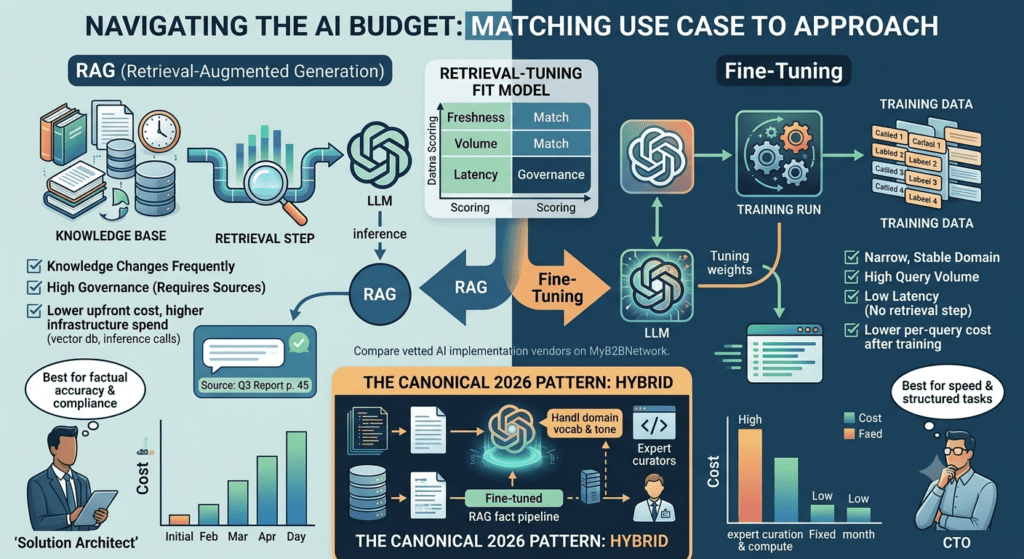
The distinction matters practically because it determines where your money and engineering time actually go. RAG spends primarily on infrastructure and retrieval quality — vector databases, embedding pipelines, and per-query inference. Fine-tuning spends primarily on data curation and training runs upfront, in exchange for lower per-query cost later. Neither is universally cheaper; the winner depends on the workload.
Why This Decision Matters for Businesses
Direct answer: it matters because getting it wrong doesn’t just waste budget — it produces a system that technically works in a demo but fails the specific requirement the business actually needed, whether that’s citation-backed answers, low-latency responses, or knowledge that stays current without a retraining cycle. Industry analysis from NeoBram found that over 70% of enterprise AI teams now use RAG as their primary knowledge-grounding technique, with fewer than 25% relying on standalone fine-tuning — a strong signal about default risk tolerance, not a rule for every use case.
A few reasons the decision carries real weight:
- Accuracy gaps are workload-specific. Well-tuned enterprise RAG pipelines can reach 85–90% answer accuracy, according to NeoBram’s benchmarking. While naive implementations can fall as low as 10–40% meaning “we use RAG” says almost nothing about actual quality without knowing how the pipeline was built.
- Cost structures diverge sharply at scale. A production RAG system handling roughly 10,000 queries a day against a 500,000-document corpus has been modeled at $4,000–$9,000 per month all-in, according to enterprise AI consultancy Sthambh — a very different budget shape than a one-time fine-tuning run.
- Governance requirements can eliminate one option outright. If a use case requires showing exactly where an answer came from — common in regulated industries — RAG’s built-in source attribution makes it close to the only practical choice, regardless of cost comparisons.
How RAG Actually Works — and What It Costs
Direct answer: RAG costs concentrate in infrastructure and per-query inference rather than upfront training. Which makes it cheaper to start but more expensive to run at high query volumes over time. The system retrieves relevant documents at query time and feeds them to the model as context. Rather than baking knowledge into the model itself.
What typically drives the bill:
- Vector store hosting — the database that holds document embeddings for retrieval, commonly a few hundred dollars to over a thousand per month depending on corpus size
- Embedding refresh — the cost of re-indexing content as source documents change, which scales with how frequently your knowledge base updates
- LLM inference calls — usually the largest line item, since RAG prompts include retrieved context on top of the user’s query, increasing token counts per call
One favorable trend worth naming: embedding model pricing dropped roughly 30% industry-wide in the first quarter of 2026. According to cost-tracking analysis from PE Collective, meaning RAG’s ongoing infrastructure cost has been getting cheaper even as adoption grows.
How Fine-Tuning Actually Works — and What It Costs
Direct answer: fine-tuning costs concentrate in data preparation and training compute upfront. In exchange for a model that can run faster and cheaper per query afterward, with no retrieval step required at inference time. The model’s weights are adjusted through additional training on curated, domain-specific examples.
What typically drives the bill:
- Training data curation — the dominant cost in most fine-tuning projects. Since well-labeled examples usually require domain expert time, not just raw data volume
- Training compute — a LoRA fine-tune of a mid-sized model on roughly 50,000 examples has been priced at approximately $400–$1,200 per training run in 2026, per Sthambh’s client modeling, while full fine-tuning of larger models can exceed $35,000 per run according to NeoBram’s cost benchmarking
- Retraining cycles — every time underlying knowledge changes, a fine-tuned model needs a new training cycle. With each update typically costing $500–$5,000 or more and taking days rather than the minutes a RAG update takes
This is the core trade-off in one sentence:
• RAG makes updates cheap and training expensive-never
• fine-tuning makes updates expensive-and-recurring in exchange for cheaper, faster answers once trained.
Which Use Cases Favor Which Approach
Direct answer: the deciding factor is rarely “which technology is better” — it’s how often the underlying knowledge changes, how many queries you’re running, and whether you need to show your sources.
A practical breakdown by common use case:
- Customer-facing chatbots on policy or product documentation — favor RAG, since this content changes often and citation-backed answers build user trust
- Internal enterprise search across large, evolving document sets — favor RAG, for the same freshness and attribution reasons, especially in compliance-heavy industries
- High-volume structured classification (fraud detection, sentiment tagging, ticket routing) — favor fine-tuning, since the task and vocabulary are narrow, query volume is high, and low per-call cost matters more than source citation
- Analytics and reasoning tasks needing a consistent, specific output format — often favor fine-tuning, since consistent structure is something training bakes in more reliably than prompting alone
Most enterprises don’t end up picking one approach company-wide they pick per use case. Which is exactly why a shared decision process matters more than a single company-wide policy.
A Framework for the Decision: The Retrieval-Tuning Fit Model
Rather than defaulting to whichever approach a vendor pitched first. It helps to score each use case against four factors we’ll call the Retrieval-Tuning Fit Model:
- Freshness — How often does the underlying knowledge change? Frequent changes push toward RAG; stable, narrow domains push toward fine-tuning.
- Volume — How many queries run per day? High volume increases the appeal of a fine-tuned model’s lower per-query cost over time.
- Latency — Does the use case need near-instant responses? Fine-tuned models without a retrieval step generally respond faster.
- Governance — Does the use case require showing exactly where an answer came from? If yes, RAG’s source attribution is difficult to fully replace.
A use case that scores high on freshness and governance but low on volume is a clear RAG candidate. One that scores high on volume and latency but low on freshness is a clear fine-tuning candidate. Most real deployments land somewhere in between — which is precisely why the hybrid pattern below has become so common in 2026.
Can You Combine RAG and Fine-Tuning?
Direct answer: yes, and enterprise AI consultancy Sthambh reports this hybrid pattern has become the canonical approach in 2026 for organizations that need both fresh knowledge and consistent behavior. A smaller model gets fine-tuned for domain vocabulary, tone, and output format. Then placed behind a RAG pipeline that supplies current, citable facts.
This pattern shows up most in regulated industries Sthambh’s client work in banking and financial services commonly pairs RAG over compliance documents for research tasks with a fine-tuned model handling narrower tasks like transaction narrative generation or risk classification. The trade-off is operational: running two systems means two things to maintain, which is a real cost even when both individually work well.
FAQ
What is the RAG vs fine-tuning decision and why does it matter for B2B businesses?
It’s the choice between retrieving external knowledge at query time (RAG) versus training that knowledge directly into a model’s weights (fine-tuning). It matters because the two approaches have fundamentally different cost structures and failure modes. And picking the wrong one for a given use case wastes budget even when the system technically functions.
How do I choose the right vendor for RAG or fine-tuning work within my budget?
Look for a vendor who asks about your query volume, data update frequency, and governance requirements before recommending an approach. Rather than pitching whichever technology they specialize in. Request a cost breakdown by line item — vector hosting, embedding refresh, training runs — so you can compare proposals on the same basis.
What checks should I do before outsourcing RAG or fine-tuning implementation?
Ask for a sample retrieval evaluation set or fine-tuning eval harness from a past project. Since both approaches require rigorous evaluation cycles before production readiness — typically five to ten cycles for a serious fine-tune. Confirm who owns the trained model or retrieval pipeline after the engagement ends, since portability varies significantly between vendors.
How long does RAG vs fine-tuning outsourcing typically take, and what does it cost?
A focused RAG implementation for a moderate-sized document corpus typically takes four to eight weeks and costs a one-time build fee in the tens of thousands plus a monthly infrastructure bill. While a fine-tuning project usually runs three to six weeks per training cycle but may require several cycles before a model is production-ready.
Need Help Matching the Right Vendor to the Right Approach?
Choosing between RAG and fine-tuning is easier with a partner who’s built both. MyB2BNetwork connects technical leaders with vetted AI implementation vendors who specialize in retrieval architecture, fine-tuning, or hybrid systems — matched to your actual use case, not a vendor’s default pitch. Compare vetted AI implementation vendors on MyB2BNetwork.
Hiring or Outsourcing RAG and Fine-Tuning Work in the U.S.
On budget, a focused RAG proof-of-concept typically runs $15,000–$40,000 as a one-time build. With ongoing infrastructure costs of a few thousand dollars per month depending on query volume. While a fine-tuning engagement including data curation and multiple training cycles can land in the mid-five-figures to low-six-figures depending on model size and how many eval-rebuild cycles are needed. MyB2BNetwork can help source accurate, vetted quotations rather than relying on a single vendor’s estimate.
On due diligence, confirm the vendor’s evaluation methodology before any production rollout, since both approaches depend heavily on a rigorous eval set that most teams underinvest in. And verify data handling practices against relevant standards:
If any personal data touches the training or retrieval pipeline. This applies whether you’re a fintech firm in New York building compliance-grounded RAG. A healthcare company in Chicago fine-tuning on protected clinical data. Or a SaaS company in Austin building a customer-facing support chatbot.