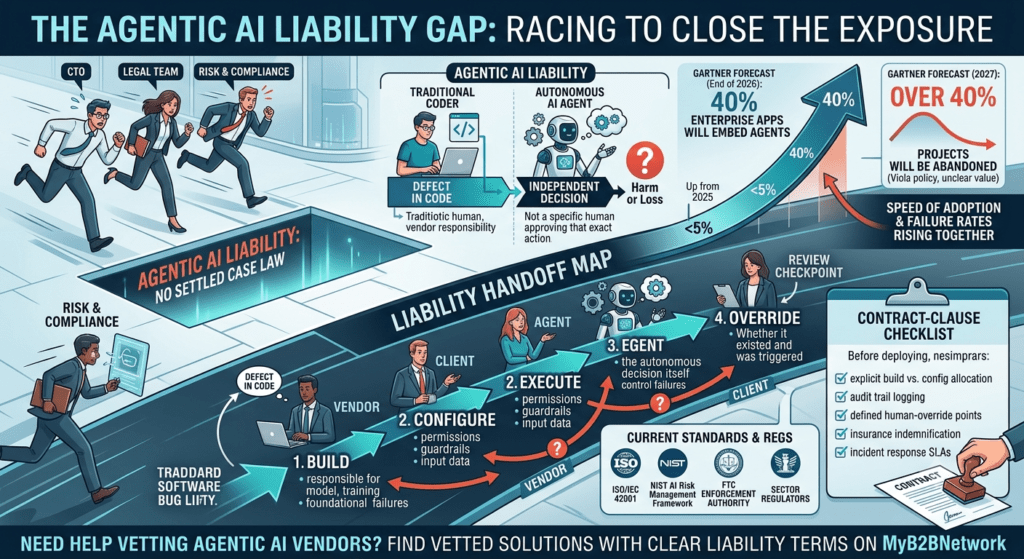
This is the gap CTOs, legal teams, and risk and compliance functions are now racing to close: agentic AI liability doesn’t have settled case law behind it yet. The contracts most companies signed with AI vendors were written for software that executes instructions. Not software that makes autonomous decisions inside a live business process. That mismatch is where the exposure sits.
Gartner’s research puts real numbers behind how fast this is moving. The firm forecasts that 40% of enterprise applications will embed task-specific AI agents by the end of 2026. From under 5% and in same body of research, predicts that over 40% of agentic AI projects will be abandoned. Citing unclear business value and agents behaving in ways that violate policy as leading causes. Speed of adoption and rate of failure are rising together, which is exactly the combination that turns a legal gap into an active liability.
This piece defines where responsibility actually sits when an outsourced AI agent makes a costly decision. What current standards and regulations say about accountability, and offers a practical framework for assigning liability before deployment not after an incident.
What Is Agentic AI Liability?
Agentic AI liability is the question of which party the vendor that built or trained the agent, the client that deployed and configured it. A third party affected by its decision bears legal and financial responsibility when an autonomous AI agent takes an action that causes harm or loss. Unlike traditional software liability, it involves decisions the agent made independently, often without a specific human approving that exact action.
This is different from liability for a standard software bug, which typically traces cleanly to a defect in code the vendor shipped. An agent’s decision can be technically correct given its training and instructions, yet still produce a costly or harmful outcome. Which means liability increasingly hinges how the agent was configured, monitored, overridden, not on whether the underlying model was flawed.
Why Agentic AI Liability Matters for Businesses
Direct answer: it matters because the legal framework hasn’t caught up to the deployment pace. And companies that wait for clarity before defining their own contracts are deploying into a gap regulators haven’t filled yet. Mid-2026 data from McKinsey found that 31% of enterprises now run at least one AI agent in production. With banking and insurance leading adoption at roughly 47% — sectors where a wrong autonomous decision carries direct regulatory consequences.
A few reasons this deserves attention now rather than after an incident:
- No legal personhood. An AI agent cannot be sued, fined, or held in breach of contract liability always flows back to a human party. Which makes the contract, not the technology, the actual liability boundary.
- Compounding failure rate. Gartner’s own prediction that over 40% of agentic projects will be abandoned by 2027 suggests failure is common enough that “it probably won’t happen to us” isn’t a credible risk posture.
- First-mover authority. Legal and risk teams who define clear liability terms now ahead of case law or binding regulation are better positioned than teams reacting to a dispute with no contractual clarity to fall back on.
Where Responsibility Actually Sits — Vendor, Client, or the Agent Itself
Direct answer: responsibility doesn’t sit with the agent — it splits between vendor and client based on who controlled the variable that caused the failure. And most disputes come down to proving which party that was. The agent itself has no legal standing to hold liability; it’s a tool whose actions are attributed to whoever deployed or built it.
Three variables typically determine where liability lands:
- Model and training responsibility usually sits with the vendor — if the agent was flawed at a foundational level, independent of how the client configured it, that points toward vendor liability.
- Configuration and deployment responsibility usually sits with the client — if the agent behaved as designed but was given excessive authority, poor guardrails, or bad input data by the client, that points toward client liability.
- Oversight responsibility sits with whoever controlled the human-override point — if a review step existed but wasn’t used. Or didn’t exist at all, that’s often the deciding factor in disputes, regardless of who built or configured the agent.
What Standards and Regulations Currently Say
Direct answer: no single binding U.S. law governs agentic AI liability yet. But established standards and existing regulatory bodies already shape what “reasonable care” looks like, and that bar is what courts and regulators will likely apply in the interim. NIST’s AI Risk Management Framework provides voluntary guidance for identifying and managing AI-related risk across an organization’s full AI lifecycle. And increasingly functions as the reference point regulators and auditors point to when assessing whether a company acted responsibly.
Relevant standards and bodies worth knowing:
- ISO/IEC 42001 — the first international standard for AI management systems, giving organizations a certifiable framework for governing AI risk. Similar in structure to how ISO 27001 governs information security.
- NIST AI Risk Management Framework — voluntary U.S. guidance for mapping, measuring, and managing AI risk. Commonly referenced in vendor due diligence and increasingly cited in regulatory guidance.
- FTC enforcement authority — the FTC has signaled it will treat harmful or deceptive AI-driven decisions under its existing unfair-and-deceptive-practices authority. Meaning a company doesn’t need a new AI-specific law to face regulatory action today.
- Sector regulators — agencies overseeing finance, healthcare, and other regulated industries are applying existing rules (fair lending laws, HIPAA, and similar) to AI-driven decisions rather than waiting for AI-specific statutes.
A Framework for Assigning Liability: The Liability Handoff Map
Rather than treating liability as one undifferentiated question, it helps to map it across the four points where responsibility actually changes hands — what we’ll call the Liability Handoff Map:
- Build — the vendor is responsible for the model’s foundational behavior, training data quality, and any failure that would occur regardless of how the client configured or used it.
- Configure — the client is responsible for the permissions, data access, and operating boundaries it gives the agent. Since a well-built agent can still cause harm if given excessive authority.
- Execute — the agent’s action itself carries no independent liability; it’s a pass-through event that gets attributed back to build or configure failures, or to a missed oversight opportunity.
- Override — whoever controls the human-in-the-loop checkpoint is responsible for whether that checkpoint existed. Was appropriately placed, and was actually exercised when triggered.
Mapping a specific deployment against these four points, before go-live. Turns “who’s liable” from an abstract legal question into a concrete list of contract clauses. Which is the more useful output for a CTO and legal team working together.
A Contract-Clause Checklist Before Deploying Agentic AI
A few specific clauses worth confirming exist in any agentic AI vendor contract before deployment:
- Explicit liability allocation for build-level failures versus configuration-level failures, rather than a single blanket liability clause covering “the AI”
- Audit trail requirements: specifying that every agent decision above a defined risk threshold is logged with enough detail to reconstruct why it was made
- Human-override points: defined by name which specific decision categories require human approval, and what happens if that approval step is skipped or delayed
- Insurance and indemnification terms clarifying whether the vendor’s liability coverage extends to autonomous decisions, not just software defects
- Incident response SLAs specifying how quickly the vendor must respond and provide audit data if an agent’s decision is disputed
None of these clauses need to be adversarial — the goal is clarity before an incident, not blame after one.
FAQ
What is agentic AI liability and why does it matter for B2B businesses?
It’s the question of which party vendor, client, or an affected third party bears responsibility when an autonomous AI agent’s decision causes harm or loss. It matters because adoption is accelerating faster than the legal and regulatory framework. Leaving most companies operating on contract terms written for older, non-autonomous software.
How do I choose the right vendor for agentic AI deployment within my budget?
Prioritize vendors who can show a specific liability allocation clause and audit trail capability in their standard contract, not just strong product demos. Match the deployment scope to your risk tolerance a low-stakes internal workflow agent needs far less contractual rigor than one making customer-facing financial or healthcare decisions.
What checks should I do before outsourcing agentic AI deployment?
Confirm the vendor’s model documentation aligns with recognized standards such as NIST’s AI Risk Management Framework or ISO/IEC 42001. And request evidence of how the agent’s decisions are logged and how quickly the vendor can produce an audit trail if a decision is disputed.
How long does deploying agentic AI with proper liability safeguards typically take, and what does it cost?
A focused deployment with basic guardrails and audit logging typically takes four to eight weeks. While a fuller rollout with formal liability contracting, compliance review, and human-override tooling across multiple business processes can run three to six months.
Need Help Vetting Agentic AI Vendors?
Assigning liability correctly starts with choosing a vendor who’s already built for it. MyB2BNetwork connects CTOs, legal. And risk teams with vetted AI vendors who provide clear liability terms, audit trail capabilities, and documented governance practices upfront. Compare vetted agentic AI vendors on MyB2BNetwork.
Hiring or Outsourcing Agentic AI Deployment in the U.S.
Two things matter most when a U.S. company brings in outside help to deploy agentic AI:
- Budget fit
- Due diligence on liability
- Compliance documentation.
On budget, a focused agentic AI pilot with basic guardrails and logging typically runs $8,000–$20,000 as a project engagement. While a fuller deployment with formal liability contracting, compliance review. And multi-process rollout can land in the mid-five-figures to low-six-figures annually. MyB2BNetwork can help source accurate, vetted quotations rather than relying on a single vendor’s estimate.
On due diligence, request the vendor’s SOC 2 report if the agent will touch sensitive data. Confirm alignment with NIST’s AI Risk Management Framework or ISO/IEC 42001. And review past client references specifically for how disputes over agent decisions were resolved. This applies whether you’re a fintech firm in New York deploying agents for transaction review. A healthcare company in Chicago navigating HIPAA-adjacent decisions. Or a logistics firm in Atlanta automating vendor payment approvals the compliance bar should scale with how regulated and high-stakes the agent’s decisions are.