None of these posts were malicious. Each one was trying to do exactly what social media is supposed to do for a B2B brand: build trust, show personality, and make the company feel real. But business social media oversharing doesn’t usually look like a scandal. It looks like enthusiasm that outran a policy nobody had written down yet.
Marketing managers are under real pressure to post often and post authentically, because audiences respond to brands that feel human rather than corporate. Legal teams are under equally real pressure to prevent disclosures that create competitive, contractual, or regulatory exposure. Those two pressures aren’t automatically in conflict — but without a shared definition of the line, they collide constantly, usually after the post is already public.
This piece defines where authentic transparency ends and risky oversharing begins, looks at what current data says about the cost of getting it wrong, and offers a framework marketing and legal teams can use together to build an actual content policy instead of relying on individual judgment calls.
What Is Business Social Media Oversharing?
Business social media oversharing is the publication of company information — financial details, client relationships, internal operations, employee data, or strategic plans — that exceeds what’s necessary for authentic marketing and creates legal, competitive, or reputational exposure. It’s distinct from transparency itself, which is a deliberate, reviewed choice to share specific information for a specific purpose.
The distinction matters because “be more authentic” and “share less” are not opposing instructions. A behind-the-scenes video can be authentic without showing a client’s logo on an active whiteboard. The problem isn’t sharing — it’s sharing without a filter for what the specific piece of content might reveal to a competitor, a regulator, or a plaintiff’s attorney.
Why Oversharing Matters for Businesses
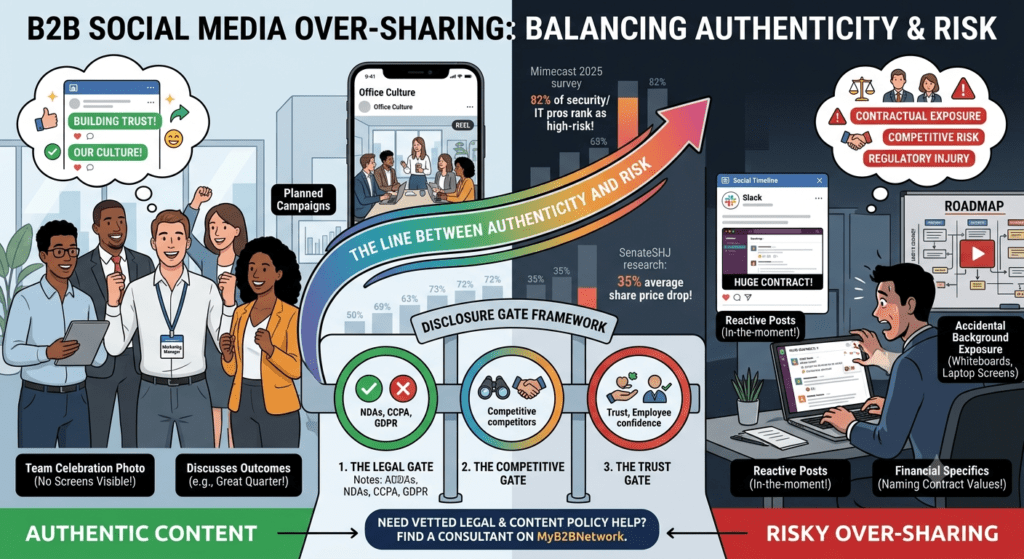
Direct answer: it matters because the downside isn’t hypothetical — industry data shows both the frequency of the risk and the measurable cost of reputational damage when it materializes. A 2025 Mimecast survey of security and IT professionals found that 82% consider employees oversharing company information on social media a high-risk area, ranking it just behind inadvertent data leaks as an organizational risk.
The cost compounds when oversharing turns into an actual reputational incident:
- Share price impact. Reputational crisis research from SenateSHJ found that a major reputational incident hits affected companies’ share prices by an average of over 35%, with earnings-per-share impact reaching 68%.
- Slow recovery. The same research found average recovery time to pre-crisis share price levels runs 427 days, and roughly a third of affected companies never fully recover.
- Trust deficit going in. Edelman’s 2026 Trust Barometer found a majority of people describe themselves as hesitant to engage with parties they perceive as different from them or untrustworthy — meaning brands are starting from a skepticism baseline before any incident even occurs.
The Line Between Authentic Marketing and Risky Transparency
Direct answer: the line sits at whether a piece of content reveals information a competitor, regulator, or opposing party could use against the company — not at how personal or informal the content feels. Tone and risk are separate axes, and treating them as the same thing is where most policies go wrong.
A few patterns distinguish the two reliably:
- Authentic content shows people; risky content shows data. A team celebration photo is authentic. A photo where a laptop screen displays a client dashboard in the background is a data exposure, regardless of the caption’s tone.
- Authentic content is planned; risky content is reactive. Content shared in the moment, without a second set of eyes, is where most unintentional disclosures happen — not in scheduled, reviewed campaigns.
- Authentic content discusses outcomes; risky content discusses specifics. “We closed a great quarter” is safe. Naming exact contract values or an unannounced client relationship usually isn’t.
What the Data Shows About Where the Risk Concentrates
Direct answer: the highest-risk content categories are financial specifics, unannounced client or partner relationships, and internal operational details captured accidentally in the background of otherwise normal posts.
Categories that most often cross from authentic into risky:
- Financial specifics — exact contract values, unreleased revenue figures, or funding details ahead of an official announcement
- Unannounced relationships — naming a client, partner, or acquisition target before both parties have agreed to disclosure
- Accidental background exposure — whiteboards, open laptop screens, or visible documents captured in office culture content
- Employee-generated posts — individual employees sharing company information on personal accounts, outside any review process entirely
That last category is where the Mimecast research is most pointed: oversharing risk isn’t concentrated in the official brand account. It’s distributed across every employee with a phone and a reason to post about work.
Building a Content Policy: The Disclosure Gate Framework
Rather than relying on a single reviewer’s judgment call, it helps to run every piece of outward-facing content through what we’ll call the Disclosure Gate — three checks a post has to clear before it publishes:
- The Legal Gate — Does this content include information covered by an NDA, an unannounced deal, or data subject to a privacy regulation such as CCPA or GDPR? If yes, it stops here regardless of how the content performs creatively.
- The Competitive Gate — Could a competitor use this specific detail — a client name, a pricing structure, a strategic direction — to act against the company? If yes, the underlying idea can often still be used, just without the specific.
- The Trust Gate — Would a customer or employee feel the company overstepped if they saw this content, even if nothing here is technically confidential? This gate catches content that’s legal but still damages trust, such as posting about a client relationship the client hasn’t agreed to have publicized.
A policy built on these three gates gives marketing teams a clear, repeatable filter instead of a vague instruction to “be careful,” and gives legal teams a specific set of questions to train marketing on rather than reviewing every post individually.
FAQ
What is business social media oversharing and why does it matter for B2B businesses? It’s the publication of company information that exceeds what’s needed for authentic marketing and creates legal, competitive, or reputational exposure. It matters because industry research ranks it among the top human-risk categories organizations face, and reputational incidents carry measurable financial recovery costs that can take well over a year to resolve.
How do I choose the right vendor to help build a business social media content policy within my budget? Look for a vendor or consultant with direct experience drafting content policies that involve both marketing and legal stakeholders, not just a marketing agency writing brand voice guidelines. Match the scope to your risk level — a startup with no regulated data needs a lighter policy than a healthcare or fintech company handling protected information.
What checks should I do before outsourcing content policy development? Confirm the vendor understands the specific regulations relevant to your industry, such as HIPAA for healthcare or FTC endorsement guidelines for any sponsored or influencer content, and ask for a sample policy or redacted case study from a similar-risk client.
How long does building a content policy typically take, and what does it cost? A focused content policy — covering the core disclosure rules and a review workflow — typically takes four to six weeks to draft and get sign-off from both legal and marketing stakeholders, while a fuller program including employee training can extend to two to three months.
Need Vetted Legal or Content Policy Help?
Building a content policy that satisfies both marketing and legal takes the right specialist, not a generic template. MyB2BNetwork connects marketing and legal teams with vetted consultants who’ve built disclosure policies across regulated and unregulated industries alike. Find a vetted content policy consultant on MyB2BNetwork.
Hiring or Outsourcing Content Policy Development in the U.S.
Two things matter most when a U.S. company brings in outside help to build a social media content policy: budget fit and due diligence on regulatory familiarity.
On budget, a focused content policy engagement — covering disclosure rules, a review workflow, and initial training materials — typically runs $4,000–$10,000 as a project fee, while an ongoing program with ongoing legal review and employee training can land in the mid-five-figures annually. MyB2BNetwork can help source accurate, vetted quotations rather than relying on a single firm’s rate card.
On due diligence, confirm the consultant’s familiarity with FTC endorsement and disclosure rules if influencer or sponsored content is involved, and with sector-specific rules like HIPAA for healthcare content or CCPA for any policy touching customer data mentioned in posts. This applies whether you’re a fintech firm in New York managing regulator scrutiny, a healthcare company in Chicago handling HIPAA-adjacent content, or a SaaS startup in Austin simply trying to avoid an accidental product-roadmap leak in a culture video.