Procurement sits at the center of this sprawl in a way most departments don’t. A single purchase can touch sourcing tools, communication tools, comparison spreadsheets, contract tools, and payment tools — often four or five categories for one decision. B2B tool fatigue isn’t a vague complaint about “too many apps.” It’s a measurable, cumulative cost in time, money. And errors that compounds every time a team runs a new procurement cycle.
A small business owner sourcing a new vendor this year will likely open LinkedIn to find candidates. Switch to email to request quotes, paste numbers into a spreadsheet to compare them, jump on a video call to ask follow-up questions. Sign the contract in a separate e-signature tool, and finally set up payment in yet another system. Six tools. One vendor. That’s before anyone mentions the calendar app used to schedule all of it.
This isn’t an edge case — it’s close to the median experience, and the data on software sprawl backs it up. Zylo’s 2026 SaaS Management Index found that the average enterprise software portfolio has grown to 305 distinct applications. While BetterCloud’s mid-market-weighted data puts the average company closer to 106. Even small businesses under 200 employees are running around 44 separate tools, according to the same body of 2026 research.
This piece breaks down what tool fatigue actually looks like inside a single procurement cycle, what the current research says about its cost. And where consolidation — not another point solution — is the more honest fix.
What Is B2B Tool Fatigue?
B2B tool fatigue is the cumulative friction, cost, and cognitive load that comes from using multiple disconnected software tools to complete a single business process, such as sourcing and closing one vendor relationship. It shows up as duplicated data entry, context-switching between apps, and subscription costs for tools whose functions overlap.
B2B Tool Fatigue differs from general “SaaS sprawl,” which describes an organization’s total software footprint. Tool fatigue is process-specific — it’s the number of separate logins, exports. And manual handoffs required to move one task, like a single vendor procurement, from start to finish.
Why Tool Fatigue Matters for Businesses
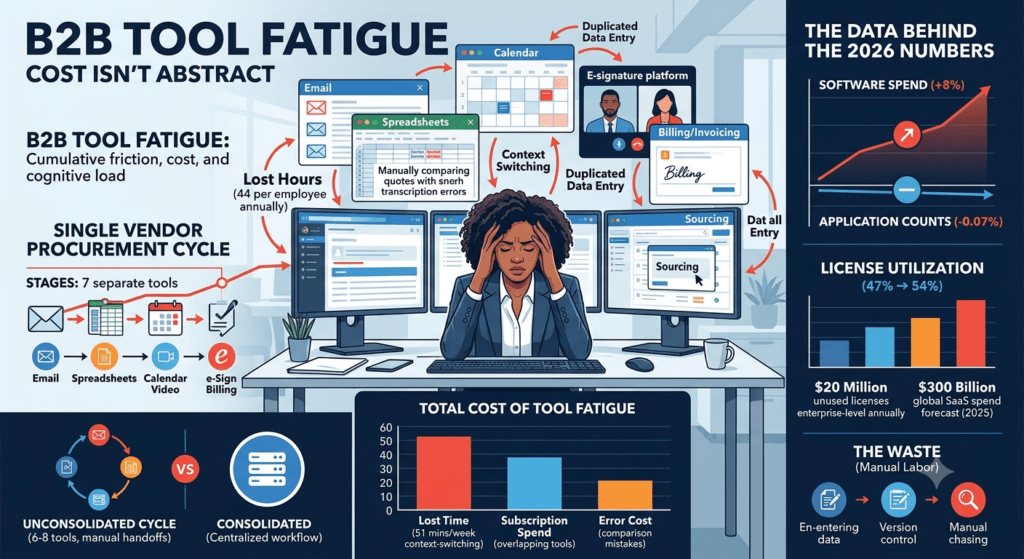
Direct answer: it matters because the cost isn’t abstract — it’s measured in lost hours, duplicate spend. And decisions that stall because information is scattered across five different tools instead of one. Lokalise-backed research on context switching found that workers lose an average of 51 minutes per week specifically to tool fatigue. Which totals more than 44 hours per employee annually, a full work week lost to nothing but managing the tool stack itself.
A few reasons this hits procurement especially hard:
- Comparison errors. Manually copying quotes from emails or PDFs into a spreadsheet introduces transcription mistakes that a centralized comparison view would avoid entirely.
- Slower decisions. Gartner forecasts businesses will spend roughly $300 billion on SaaS in 2025, and a meaningful share of that spend sits in tools whose job is simply to move information from one system to another — time that could otherwise go toward the decision itself.
- Duplicate subscriptions. Research on workplace tool sprawl has found organizations often carry multiple overlapping subscriptions in the same category without realizing it, which is a direct, avoidable procurement cost.
The Data Behind the 2026 Tool Fatigue Numbers
Direct answer: the data shows tool counts are finally leveling off. But the financial and time costs of the tools already in place keep rising, which is the real story behind “fatigue” in 2026.
A few figures worth naming directly:
- Zylo’s 2026 index found application counts declined only 0.07% year-over-year even as total software spend rose 8% in the same period flat portfolios, rising bills.
- License utilization has improved from 47% in 2024 to 54% in 2025 by Zylo’s tracking. But organizations are still estimated to leave nearly $20 million in unused licenses on the table annually at the enterprise level.
- Cornell University research cited alongside Lokalise’s workplace study found that each context switch between applications requires roughly 23 minutes to fully refocus. A cost that compounds every time a procurement task bounces between a sourcing tool, an inbox, and a spreadsheet.
Mapping One Procurement Cycle: How Many Tools Does It Actually Take?
To put a number on the concept rather than leave it abstract, we looked at typical vendor procurement workflows reported by buyers using MyB2BNetwork’s marketplace before consolidation. This is a directional internal review, not a large-panel academic study. But the pattern was consistent enough to be worth naming: the Procurement Stack Count.
A typical unconsolidated procurement cycle touches roughly six to eight separate tools across its stages:
- Sourcing — a professional network or search engine to find candidate vendors
- Outreach and communication — email or messaging tools to request information
- Comparison — a spreadsheet to manually line up pricing and capabilities
- Scheduling — a calendar tool to coordinate calls across multiple vendors
- Video or calls — a separate conferencing tool for discovery conversations
- Contracting — an e-signature platform to finalize terms
- Payment or invoicing — a billing tool disconnected from everything above it
Every handoff between these tools is a place where information gets re-typed, a quote gets misread. Or a decision gets delayed waiting for someone to consolidate updates manually. None of these tools is individually a bad choice. The fatigue comes from the number of handoffs between them, not any single tool’s quality.
Where the Waste Actually Hides
Direct answer: the waste isn’t mainly in subscription fees — it’s in the manual labor of moving information between tools that were never designed to talk to each other.
The most common failure points procurement teams report:
- Re-entering the same vendor or quote data into a spreadsheet after receiving it by email
- Losing track of which version of a quote is current across multiple email threads
- Manually chasing signature or payment status because the contracting tool doesn’t connect to the billing tool
- Comparing vendors on inconsistent formats, since each vendor sends pricing and terms differently
None of these require a new point solution to fix they require fewer handoffs between the tools already in use. Which is a consolidation problem more than a tooling gap.
FAQ
What is B2B tool fatigue and why does it matter for B2B businesses? It’s the cumulative cost — in time, errors, and duplicate spend — of using multiple disconnected tools to complete one business process, like sourcing and closing a vendor. It matters because research shows the average worker loses over 40 hours a year specifically to tool-switching friction, on top of any subscription costs.
How do I choose the right vendor or platform to reduce procurement tool fatigue within my budget? Prioritize platforms that consolidate sourcing, comparison, and communication into one workflow rather than adding another single-purpose tool to an already fragmented stack. Weigh the cost of a consolidated platform against the hidden labor cost of your current manual handoffs, not just the subscription price alone.
What checks should I do before outsourcing or adopting a new procurement tool? Confirm the tool actually reduces the number of separate logins and manual exports in your workflow rather than simply adding a new one. And check how it handles data security given the vendor and pricing information that will pass through it.
How long does consolidating a fragmented procurement tool stack typically take, and what does it cost? A focused consolidation effort auditing current tools and migrating to a centralized workflow typically takes four to eight weeks for a small team. While a full procurement process overhaul across departments can take three to six months depending on how many legacy tools are involved.
One Form Instead of Six Tools
MyB2BNetwork was built around exactly this problem:
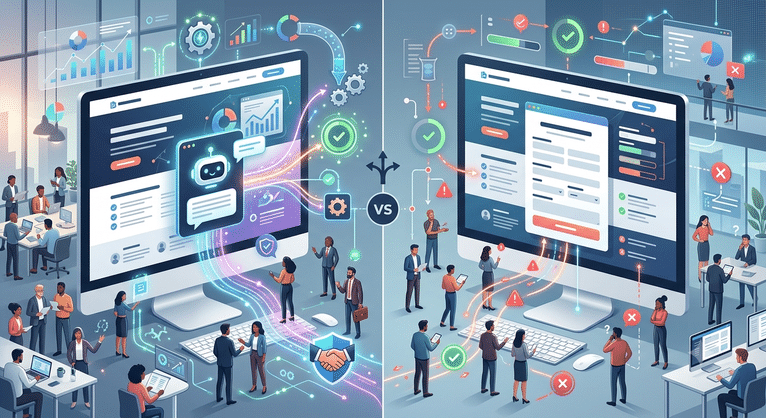
• A single form submission replaces the sourcing, comparison, and communication tools most procurement cycles currently juggle separately.
Instead of exporting quotes from email into a spreadsheet, buyers get vetted vendor quotes in one centralized dashboard. See how the centralized dashboard reduces procurement tool sprawl on MyB2BNetwork.
Hiring or Outsourcing Procurement Tool Consolidation in the U.S.
Two things matter most when a U.S. company brings in outside help to consolidate a fragmented procurement stack: budget fit and due diligence on data handling across tools.
On budget, a focused procurement workflow audit and consolidation plan typically runs $3,000–$8,000 as a short project engagement. While a fuller procurement systems overhaul with integration work across sourcing, contracting, payment tools can land in the mid-five-figures annually. MyB2BNetwork can help source accurate, vetted quotations rather than relying on a single consultant’s estimate.
On due diligence, confirm how any consolidation vendor handles data security across the tools it connects. Particularly around SOC 2 controls for data in transit between systems and CCPA compliance if vendor or customer contact data is involved. This applies whether you’re a SaaS startup in Austin consolidating a sourcing-to-contract workflow. A manufacturing firm in Ohio trying to cut duplicate subscriptions, or a logistics company in Atlanta managing procurement across multiple regional teams.