What is self-serve B2B buying?
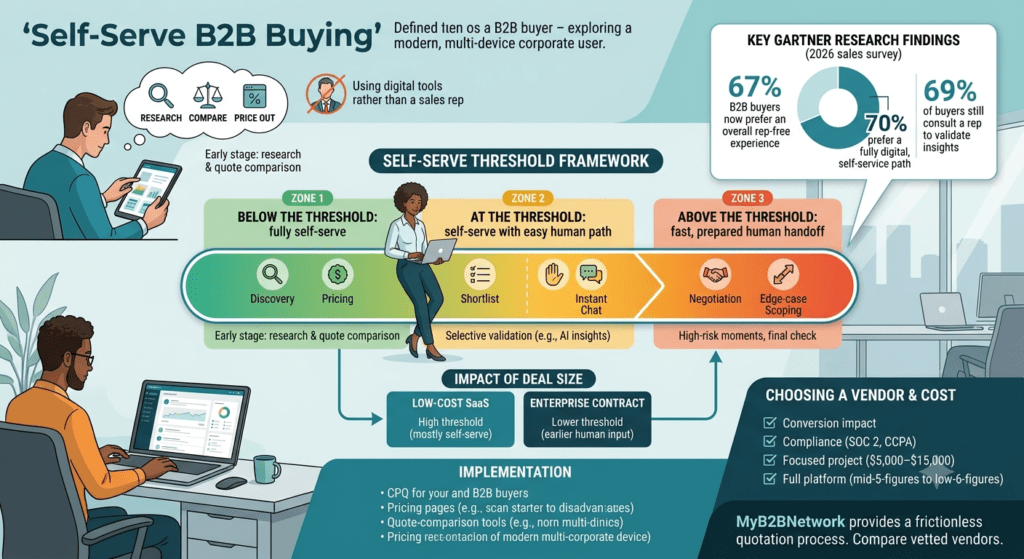
Self-serve B2B buying is a purchasing model where a buyer can research, compare, and often price out a solution independently — using digital tools rather than a sales rep — before deciding whether to talk to anyone. The buyer controls when a human enters the process, instead of a sales team gating access to pricing or product information.
Is cold calling or gated pricing still effective in a self-serve buying environment?
Gated pricing is losing effectiveness as a lead-qualification tactic, because buyers increasingly abandon vendors who withhold basic information behind a form or a call. It doesn’t need to disappear entirely, but treating it as the default for every buyer segment now works against most B2B companies rather than for them.
Do B2B buyers still want to talk to sales reps at all?
Yes, but selectively, not by default. Gartner’s 2026 sales research found that while a majority of buyers prefer an overall rep-free experience, a similar majority still turn to a sales rep specifically to validate information — especially AI-generated research — before finalizing a decision.
At what stage of the buying journey do B2B buyers most want a human?
Buyers most want a human during final negotiation and edge-case scoping, not during initial discovery or pricing comparison. Early-stage research and quote comparison are the stages buyers most consistently prefer to complete independently, according to both Gartner’s findings and directional patterns observed across B2B marketplace activity.
What percentage of B2B buyers prefer a rep-free buying experience?
Gartner’s 2026 sales survey found 67% of B2B buyers now prefer an overall rep-free buying experience, up from 61% the year before, and 70% prefer a fully digital, self-service path when one is available.
Does self-serve buying mean sales reps become unnecessary?
No — it means the sales rep’s role shifts from delivering information to providing validation and reassurance at higher-risk moments. Gartner’s research specifically found that 69% of buyers still consult a rep to validate insights they gathered on their own, meaning the role changes rather than disappears.
What is the “Self-Serve Threshold” framework?
The Self-Serve Threshold is a model for deciding where in a buying journey self-service should end and a human handoff should begin. It splits the journey into three zones: below the threshold (discovery, pricing — fully self-serve), at the threshold (shortlisting, quote comparison — self-serve with an easy path to a human), and above the threshold (negotiation, scoping — a fast, prepared human handoff).
How does deal size affect where the self-serve threshold sits?
Higher-complexity, higher-price purchases generally push the threshold earlier, meaning buyers want human involvement sooner. A low-cost SaaS subscription and a seven-figure enterprise contract will not share the same threshold point, so the line should be set per product line rather than applied uniformly across a company.
What tools support a self-serve B2B buying experience?
Common tools include CPQ (configure-price-quote) platforms such as PandaDoc, DealHub, and Zoho CPQ, along with pricing pages designed for transparency and quote-comparison tools that let buyers evaluate multiple vendors side by side. These tools reduce the manual, rep-dependent steps that used to gate pricing and comparison information.
What risks come with moving too far toward self-serve, too fast?
The main risk is removing human contact from moments where buyers actually want reassurance, particularly negotiation and edge-case scoping, which can lower deal confidence and close rates even as top-of-funnel friction drops. A secondary risk is exposing pricing or specs without proper compliance review in regulated industries.
How do I choose a vendor to help build a self-serve buying experience within budget?
Prioritize vendors with direct experience building pricing pages, CPQ workflows, or quote-comparison tools for B2B companies specifically, not general web design experience. Match the project scope — a pricing-page refresh versus a full quoting platform — to your budget tier before evaluating vendors.
What should I check before outsourcing self-serve buying experience work?
Review past projects for measurable conversion impact, not just visual samples, and confirm the vendor’s approach to handling buyer data complies with relevant rules such as CCPA and, where applicable, SOC 2 data-handling controls.
How long does it take to build a self-serve buying experience?
A focused project covering pricing transparency and basic quote comparison typically takes four to eight weeks. A full self-serve buying platform with CPQ logic and system integrations typically takes three to six months.
What does it cost to build a self-serve B2B buying experience in the U.S.?
A focused pricing-transparency and quote-comparison project typically costs $5,000–$15,000. A full self-serve platform with CPQ logic, integrations, and ongoing optimization typically runs in the mid-five-figures to low-six-figures annually. Costs vary by vendor and region, so getting a specific quotation is recommended over relying on general ranges.
Where can I compare vendors who build self-serve buying experiences?
MyB2BNetwork provides a self-serve, frictionless quotation process that lets buyers compare vendor pricing and capabilities upfront, so they only get on a call with vendors they’ve already vetted. Compare vetted vendors on MyB2BNetwork.