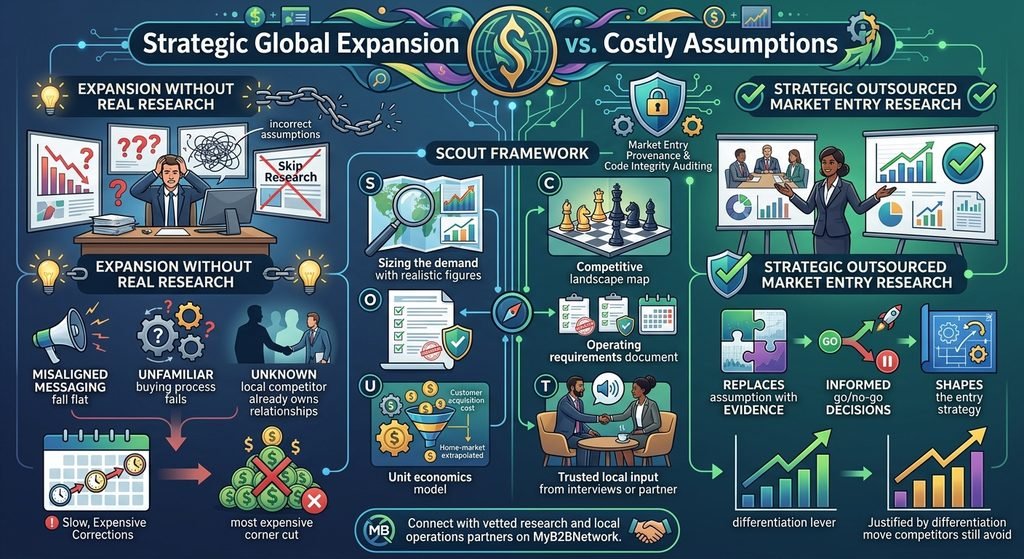
The pitch deck said the new market was “similar enough” to the home market to skip the deep research phase. Six months and a country office later, the local sales lead is still explaining why the messaging that worked at home falls flat, why the assumed buying process doesn’t match reality, and why a competitor nobody had heard of during planning already owns the relationships that matter. This is what expansion without real research usually looks like — not a dramatic failure, just a slow, expensive series of corrections that proper research would have caught upfront. Outsourced market entry research exists precisely to prevent this. Done well, it replaces assumption with evidence before a single hire is made or a lease is signed in the new country. Done poorly — or skipped entirely — it becomes the most expensive corner a founder or BD lead ever cut.
This piece covers what market entry research should actually include before you outsource local operations, the risks of getting it wrong, and the five questions any market entry report needs to answer clearly before you commit budget to the country.
If your expansion plan currently rests on “it worked in our home market, so it should work here too,” this is worth reading before the next board conversation about international growth.
What Is Market Entry Research?
Market entry research is the structured process of evaluating a new geography’s demand, competitive landscape, regulatory environment, and buying behavior before a company commits resources to operating there. It goes beyond a market-sizing estimate — it includes understanding how local buyers actually make purchase decisions, which competitors already hold relationships, and what regulatory or cultural factors could block or slow entry. The output is typically a report or briefing that informs go/no-go decisions and shapes the entry strategy itself.
Why Market Entry Research Matters for Founders and BD Leads
Expansion decisions made on assumption rather than evidence carry real financial risk, and the pattern shows up repeatedly across company-stage and industry. Government resources like the U.S. Department of Commerce’s Country Commercial Guides exist specifically because so many companies underestimate how different buying behavior, regulation, and competitive dynamics are outside their home market. For founders, the stakes are direct: a mistimed or misjudged entry burns runway that’s hard to recover. For BD and expansion leads, it’s often their credibility on the line when a confidently pitched market underperforms.
What Good Market Entry Research Actually Covers
Solid research goes well beyond a market-size number pulled from a single report. It should build a layered picture across several dimensions.
- Demand and market sizing — realistic addressable market figures, not just total population or GDP-based estimates
- Buyer behavior and decision-making — who’s actually involved in a purchase decision locally, and how that differs from the home market
- Competitive landscape — both direct competitors and the local incumbents who may not show up in a home-market competitor list
- Regulatory and compliance requirements — licensing, data residency, employment law, and industry-specific rules
- Go-to-market fit — which channels, partnerships, or sales motions actually work in that geography versus what worked at home
Skipping any one of these tends to surface as a costly surprise 6–12 months into the expansion, once the cost of correcting course is much higher than the cost of research would have been.
Common Mistakes That Turn Expansion Into an Expensive Lesson
Most failed market entries don’t fail because the market itself was wrong — they fail because the research phase skipped something specific.
- Treating the new geography as a smaller version of the home market instead of researching its actual buying dynamics
- Relying on desk research alone, without local interviews or on-the-ground validation of assumptions
- Underestimating regulatory timelines, especially around data protection, licensing, or employment requirements
- Assuming the competitive landscape mirrors the home market, when local incumbents may hold relationships that take years to displace
- Skipping a genuine go/no-go decision point, so the company proceeds on momentum rather than evidence
None of these mistakes require an expensive research program to avoid — they require a deliberate process that asks the right questions before committing.
The 5 Questions Every Market Entry Report Must Answer
A market entry report that doesn’t answer these five questions clearly isn’t finished, regardless of how much data it contains:
- What is the realistic addressable demand in this market, and how confident is that estimate? Vague TAM figures without a stated confidence level or methodology aren’t actionable.
- Who are the actual decision-makers in a typical local purchase, and how does that buying committee differ from the home market?
- Which competitors — including local players unfamiliar at home — already hold the relationships or market share that matter?
- What regulatory, compliance, or licensing requirements must be met before or during entry, and what’s the realistic timeline for each?
- What would make this a “no-go,” and has that threshold been defined before the research started, not after the results came in?
That last question matters more than founders often expect — research commissioned without a predefined no-go threshold tends to get interpreted to support whatever decision leadership already wanted to make.
A Simple Way to Structure the Research: The SCOUT Framework
We use a short framework called SCOUT to keep market entry research from turning into an unfocused data dump:
- S — Size the demand: Get a realistic, methodology-backed estimate of addressable market, not a top-down guess
- C — Competitive landscape: Map both global and local competitors, including who already owns key relationships
- O — Operating requirements: Document regulatory, licensing, and compliance requirements with realistic timelines
- U — Unit economics: Model what customer acquisition and delivery actually cost in the local market, not extrapolated home-market numbers
- T — Trusted local input: Validate findings with local interviews or a local partner, not desk research alone
A report that covers all five SCOUT elements gives a founder or BD lead an evidence-based go/no-go decision — not just a confidence-boosting slide deck.
FAQ
What is market entry research and why does it matter for B2B businesses?
It’s the structured evaluation of a new geography’s demand, competition, regulations, and buyer behavior before a company commits resources there. It matters because expansion decisions made on assumption rather than evidence are a leading cause of costly, avoidable missteps.
How do I choose the right vendor for market entry research within my budget?
Filter vendors by whether they combine desk research with actual local interviews or on-the-ground validation, not desk research alone. Prioritize firms with direct experience in your specific target country and industry over generalist research agencies.
What checks should I do before outsourcing market entry research?
Ask for a sample report or redacted past deliverable, confirm the vendor’s local network and language capability in the target market, and clarify in the contract exactly which of the five report questions above will be addressed.
How long does market entry research typically take, and what does it cost?
A focused research engagement for one geography typically takes 4–8 weeks; a fuller study including local interviews and a go-to-market recommendation can take 3–4 months. Costs commonly range from $8,000–$20,000 for a single-market report, up to mid-five-figures for multi-market comparative studies.
Considering Expansion? Get Research Before You Commit
Committing to a new geography without evidence is one of the costliest mistakes a growing company can make. MyB2BNetwork connects founders and expansion leads with vetted market entry research and local operations partners, so the go/no-go decision is based on real data, not optimism.
How to Hire or Outsource Market Entry Research in the U.S.
Many founders and BD teams outsource market entry research to specialized firms rather than assigning it internally, since it requires local language, network, and regulatory expertise that’s hard to build in-house for a single expansion decision.
Choosing a vendor within budget: Filter research firms by direct experience in your specific target country and industry rather than general market research capability — a firm that’s studied SaaS buyer behavior in Germany brings more relevant insight than a generalist agency running the same playbook everywhere. Costs typically range from $8,000–$20,000 for a focused single-market report to mid-five-figures for multi-market or highly regulated industries requiring deeper compliance review. Prioritize vendors who include local interviews as a core deliverable, not an optional add-on, since desk research alone tends to miss the assumptions that cause the most expensive mistakes.
Checks before outsourcing: Request a redacted sample report, confirm the firm’s data-handling practices align with relevant standards like ISO 27001 or SOC 2 if proprietary business data will be shared, and get contract terms in writing covering deliverable timelines, revision rounds, and confidentiality. This diligence applies whether you’re a SaaS startup in Austin evaluating a European launch, a manufacturing company in Ohio assessing Southeast Asia, or a fintech firm in New York navigating GDPR/UK-GDPR requirements before entering the UK market. MyB2BNetwork can source pre-vetted vendors and provide accurate quotations based on your target geography and industry.