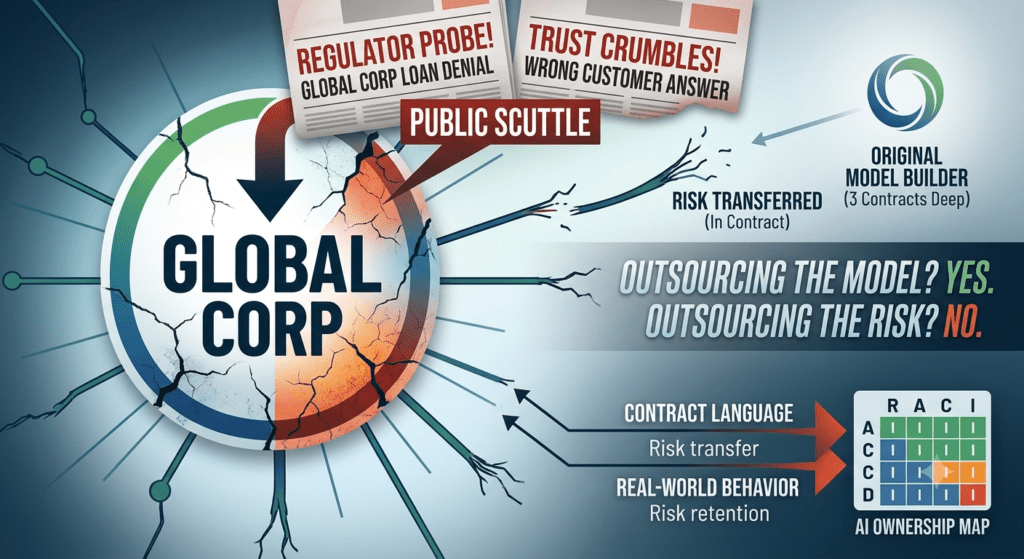
This is the question keeping CISOs, and general counsel up at night when a business outsources the model, does it also outsource the risk? The honest answer is almost always no liability for bias, drift, and compliance failure tends to follow the company closest to the customer. Regardless of who wrote the code. AI governance outsourcing without a clear ownership structure is a contract that looks like risk transfer and behaves like risk retention.
This isn’t an argument against using third-party AI. Almost no company builds every model it uses in-house, and that’s not going to change. It’s an argument for treating AI vendor contracts the way mature organizations already treat cybersecurity vendor contracts with named owners. Defined escalation paths, and documented accountability before something goes wrong, not after.
This piece defines what AI governance outsourcing actually means, walks through the regulatory landscape tightening around it. And offers a framework for mapping who owns what when the model itself sits outside your walls.
What Is AI Governance Outsourcing?
AI governance outsourcing is the practice of relying on a third-party vendor, platform, or partner to manage some or all of the oversight, monitoring. And compliance work required to responsibly operate an AI system while the company deploying that system remains accountable for its outputs. It is not the same as outsourcing liability, which regulators and courts have consistently treated as non-transferable by default.
The distinction matters legally and operationally. A company can outsource model training, bias testing, drift monitoring, or documentation work to a specialist vendor. What it generally cannot outsource is the underlying obligation to ensure the AI system. It deploys doesn’t discriminate, mislead, or violate a regulation that obligation typically follows the deploying organization regardless of contract language.
Why This Matters for Businesses
Direct answer: it matters because the regulatory environment around AI accountability is tightening fast. And “we didn’t build the model” is proving to be a weak defense in practice. The NIST AI Risk Management Framework, while voluntary. Has become a de facto baseline it’s referenced in federal procurement requirements and increasingly used by enterprise customers to evaluate vendor governance maturity, which means a company without a NIST-aligned governance posture is already at a disadvantage in vendor selection and audits alike.
The regulatory pressure is compounding across multiple fronts at once:
- Sector-specific frameworks are emerging fast. The U.S. Treasury Department released a Financial Services AI Risk Management Framework in February 2026. Built directly on NIST’s structure, with 230 control objectives that explicitly address third-party AI risk.
- Certification is becoming a market signal. ISO/IEC 42001 is a certifiable international standard for AI management systems. Meaning a vendor can now be independently audited and certified a level of verifiable accountability buyers increasingly expect rather than accept on a vendor’s word.
- The EU AI Act adds mandatory teeth. For high-risk AI systems, the EU AI Act requires a formal conformity assessment. And that obligation applies to any company deploying the system in the EU market, regardless of where the model was built.
Where Model Risk Actually Lives
Direct answer: model risk concentrates in three places bias in outputs, drift in performance over time. And gaps in documentation and each one requires a different kind of ongoing attention, not a one-time vendor audit.
A short breakdown of each:
- Bias — a model can produce systematically unfair outputs across protected categories even when it performed acceptably during initial testing. Because training data and real-world usage patterns diverge over time.
- Drift — a model’s accuracy and behavior change as the data it encounters in production shifts away from its original training distribution. Which is why one-time validation isn’t sufficient governance.
- Documentation gaps — many compliance failures aren’t caused by the model behaving badly. They’re caused by no one being able to produce evidence of how the model was tested, monitored. Or governed when a regulator or plaintiff’s attorney asks.
Recent incident reporting reinforces why vendor-side risk needs explicit ownership rather than assumed goodwill: industry guides on third-party AI risk have pointed to a widely reported April 2026 breach in which a single AI productivity tool with overly broad account permissions became an entry point for a larger security incident. A reminder that AI risk isn’t limited to model outputs. It extends to how AI tools are integrated and permissioned in the first place.
Who Owns What: The AI Ownership Map
Rather than leaving accountability to assumption, it helps to build what we’ll call the AI Ownership Map. A documented, RACI-style breakdown (Responsible, Accountable, Consulted, Informed) of who owns each governance function across the vendor and client relationship. Rather than rendering this as a static chart here, the roles break down as follows:
- Model training and initial bias testing — typically Responsible sits with the vendor, but the deploying company should remain Accountable for confirming that testing actually occurred and meets an agreed standard.
- Ongoing drift monitoring — Responsible can sit with either party depending on the contract, but it must be explicitly assigned. “Someone is probably watching this” is the most common governance failure point.
- Regulatory documentation and audit response — Accountable almost always sits with the deploying company. Since regulators generally pursue the company closest to the affected customer. Making it essential that the contract requires the vendor to supply documentation on demand, not just store it.
- Incident response and disclosure — both parties should be Responsible for their piece, but one party needs to be named Accountable for coordinating the overall response, or a real incident will surface exactly when contract ambiguity is most costly.
- Contract and compliance updates as regulations change — Consulted and Informed roles matter most here. Legal and compliance teams need a defined update cadence with the vendor, not a one-time contract signed and forgotten.
A written version of this map ideally an actual RACI chart specific to each vendor relationship. Should exist before a contract is signed, not drafted retroactively after an incident forces the question.
Tools and Practices for Managing Third-Party AI Risk
Direct answer: managing this risk in practice usually combines a governance framework (NIST AI RMF or ISO 42001). A third-party risk management process, and ongoing monitoring tools rather than any single piece of software.
Commonly used approaches include:
- Governance frameworks as contract baselines — requiring vendors to demonstrate NIST AI RMF alignment or ISO 42001 certification as a condition of the relationship, not just a nice-to-have
- Third-party risk management (TPRM) platforms — GRC tools built for vendor risk, several of which now include AI-specific control libraries mapped across NIST, ISO 42001, and the EU AI Act
- Model monitoring tools — platforms that track drift and output patterns over time, ideally with alerting thresholds defined jointly by the vendor and the deploying company’s compliance team
- Contractual audit rights — the ability to request documentation, testing evidence, or an independent audit on a defined schedule. Written into the vendor agreement rather than assumed as a courtesy
FAQ
What is AI governance outsourcing and why does it matter for B2B businesses? It’s the practice of relying on a third-party vendor to help manage AI oversight and compliance work. While accountability for the AI system’s outputs typically remains with the deploying company. It matters because regulators and enterprise customers increasingly expect documented. NIST or ISO 42001-aligned governance, and “the vendor built it” is not treated as sufficient defense when something goes wrong.
How do I choose the right AI governance partner within my budget? Prioritize vendors who can demonstrate actual framework alignment — NIST AI RMF documentation or ISO 42001 certification — rather than marketing language about “responsible AI.” Match the engagement scope to your regulatory exposure; a company deploying AI in the EU. Or in financial services needs deeper support than one running low-risk internal tools.
What checks should I do before outsourcing AI governance work? Confirm the vendor’s audit rights, documentation obligations, and incident response responsibilities are written explicitly into the contract, not implied. Review whether the vendor has experience with your specific regulatory exposure, such as the EU AI Act for European operations or the Treasury Department’s Financial Services AI Risk Management Framework for regulated finance.
How long does outsourcing AI governance typically take to set up, and what does it cost? A focused engagement — building an ownership map and baseline documentation for one or two AI vendor relationships — typically takes four to eight weeks, while a full governance program covering a company’s entire AI vendor portfolio can run three to six months depending on how many systems are involved.
The Safe Choice, Not Just the Cheap One
Choosing an AI vendor on price alone is how ownership gaps happen in the first place. MyB2BNetwork helps compliance and security teams compare AI and technology vendors on governance maturity, not just cost, so the vendor you choose is one that can actually document its side of the Ownership Map. Compare vetted, compliance-ready vendors on MyB2BNetwork.
Hiring or Outsourcing AI Governance Work in the U.S.
Two things matter most when a U.S. company brings in outside help to build AI governance around outsourced models: budget fit and due diligence on framework alignment.
On budget, a focused AI governance engagement — building an ownership map and baseline documentation for a handful of vendor relationships — typically runs $8,000–$20,000 as a project fee, while an ongoing governance program with ISO 42001 preparation and continuous monitoring can land in the mid-five-figures to low-six-figures annually. MyB2BNetwork can help source accurate, vetted quotations rather than relying on a single consultant’s estimate.
On due diligence, confirm the consultant or vendor’s direct experience with NIST AI RMF documentation and, where relevant, ISO 27001 or SOC 2 controls covering the systems the AI touches, since AI governance overlaps heavily with existing information security compliance work. This applies whether you’re a fintech firm in New York navigating the Treasury Department’s new AI framework, a healthcare company in Chicago managing HIPAA-adjacent AI tools, or a SaaS company in Austin preparing for enterprise customers who now require AI governance documentation as part of procurement.