What is AI vendor due diligence, and how is it different from regular vendor vetting?
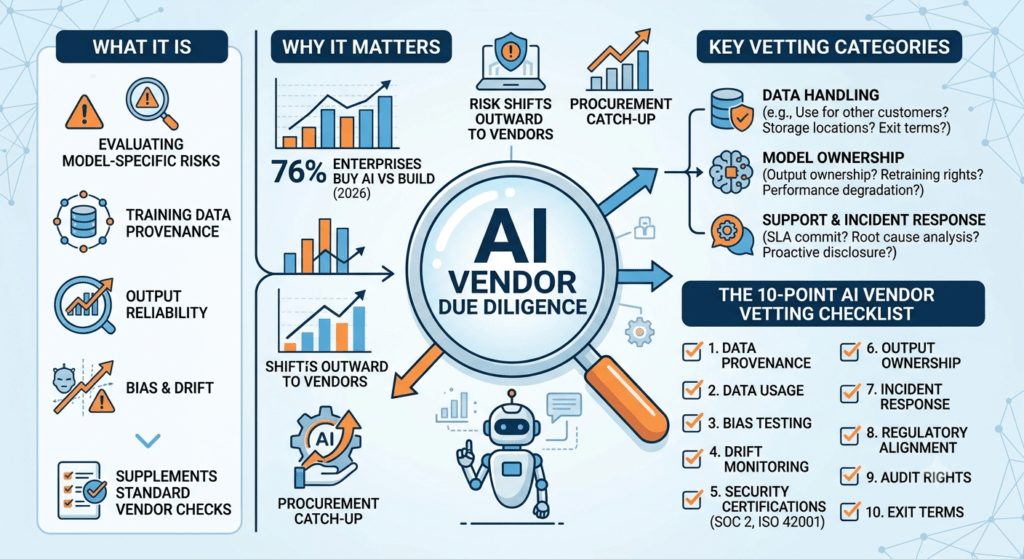
AI vendor due diligence is the process of evaluating a third-party AI provider on model-specific risks. Training data provenance, output reliability, bias, and drift in addition to standard vendor checks like security and financial stability. It differs from traditional software vendor vetting because a working demo doesn’t confirm the system will behave consistently or explainably once it’s handling real, production data.
Why does AI vendor due diligence matter more in 2026 than it used to?
It matters because most companies are now buying AI rather than building it. Which shifts risk outward to vendors procurement teams may not be fully equipped to evaluate. Trilateral Research found that 76% of enterprises are purchasing AI solutions rather than building them internally in 2026. Up from 53% in 2024 a shift many procurement processes haven’t caught up to yet.
What happens if I skip AI-specific vendor vetting and something goes wrong?
The company deploying the AI system generally bears the consequences, not just the vendor. IBM’s 2025 Cost of a Data Breach Report found that 13% of organizations reported a breach involving AI models or applications, and 97% of those organizations lacked proper AI access controls at the time.
Who should be involved in vetting an outsourced AI vendor?
CTOs, procurement, and legal counsel should all be involved, since no single function can evaluate every risk category alone. CTOs assess technical fit and integration risk, procurement assesses cost structure and contract terms. And legal assesses liability, IP ownership, and regulatory exposure skipping any one of the three leaves a gap.
What questions should I ask about data handling before signing?
Ask whether your data will be used to train the vendor’s models for other customers, where data is stored and processed geographically, and what happens to your data if the contract ends. Some AI platforms have changed data-training terms for lower-tier customers without clearly flagging it. So this needs to be confirmed in writing, not assumed from a general privacy policy.
What questions should I ask about model ownership before signing?
Ask who owns the outputs the model generates, whether the vendor can modify or retrain the model in ways that change its behavior without notice, and what recourse exists if the model’s performance degrades. Ownership of outputs and liability for outputs are two different questions — a contract needs to answer both.
What questions should I ask about support and incident response?
Ask what the vendor’s response time commitment is for a production-impacting issue. Who is responsible for investigating whether an incorrect output was a model error versus a data or integration error. And whether the vendor will disclose known issues proactively or only when asked. Vague SLA language (“best effort support”) is a common way this obligation gets left undefined.
Is SOC 2 or ISO certification required for an AI vendor?
Neither is legally required in most cases, but both function as strong market signals of vendor maturity. GLACIS’s 2026 research found that 66% of B2B buyers already require SOC 2 certification before signing SaaS contracts. And ISO/IEC 42001 is emerging as the equivalent certifiable standard specifically for AI management systems.
What’s the biggest AI-specific risk that traditional vendor questionnaires miss?
Traditional questionnaires focus on security and uptime but often miss training data provenance, bias testing. And model drift risks specific to how AI systems behave rather than whether they’re online. Supply chain and third-party compromises are also a growing concern industry-wide. Secureframe’s research found third-party and supply chain attacks accounted for 47% of affected individuals in breaches during the first half of 2025.
Can I hold an AI vendor liable if their model causes a compliance violation?
It depends entirely on the contract terms negotiated before signing, not on general principle. Regulatory frameworks like the EU AI Act place explicit due diligence obligations on the company deploying a high-risk AI system, with penalties that can reach €35 million or 7% of global annual revenue — exposure that exists for the deploying company regardless of what the vendor contract says, unless liability and indemnification terms are negotiated up front.
When should AI vendor vetting happen in the buying process?
Vetting should happen before a contract is signed, not after a pilot has already gone well. Since pilot performance doesn’t reliably predict production behavior at scale. Cost, data handling, and exit terms are far easier to negotiate before signing than after a company’s workflows already depend on the vendor.
The 10-Point AI Vendor Vetting Checklist
Use this checklist before signing any outsourced AI vendor contract. Each point should be answered in writing, not verbally, and kept on file for future audits.
- Training data provenance — Where did the model’s training data come from, and does the vendor have the rights to use it?
- Data usage terms — Will our data be used to train the vendor’s models for other customers, and can we opt out in writing?
- Bias and fairness testing — What bias testing has been performed, on what protected categories, and how recently?
- Drift monitoring — Who is responsible for monitoring model performance over time, and what triggers a re-evaluation?
- Security certifications — Does the vendor hold SOC 2, ISO 27001, or ISO/IEC 42001 certification, and can they provide current audit reports?
- Output ownership — Who legally owns the outputs the model generates, and can the vendor use them for any other purpose?
- Incident response terms — What is the vendor’s committed response time for a production-impacting issue, and who investigates root cause?
- Regulatory alignment — Has the vendor documented alignment with NIST AI RMF, and — if applicable — completed an EU AI Act conformity assessment?
- Audit rights — Does the contract grant the right to request documentation or an independent audit on a defined schedule?
- Exit and data deletion terms — What happens to our data, prompts, and configurations if the contract ends, and how is deletion verified?
A vendor unwilling to answer any of these ten points in writing is itself a red flag worth weighing before moving forward.
Where can I compare vendors who build self-serve buying experiences?
MyB2BNetwork provides a self-serve, frictionless quotation process that lets buyers compare vendor pricing and capabilities upfront, so they only get on a call with vendors they’ve already vetted. Compare vetted vendors on MyB2BNetwork.