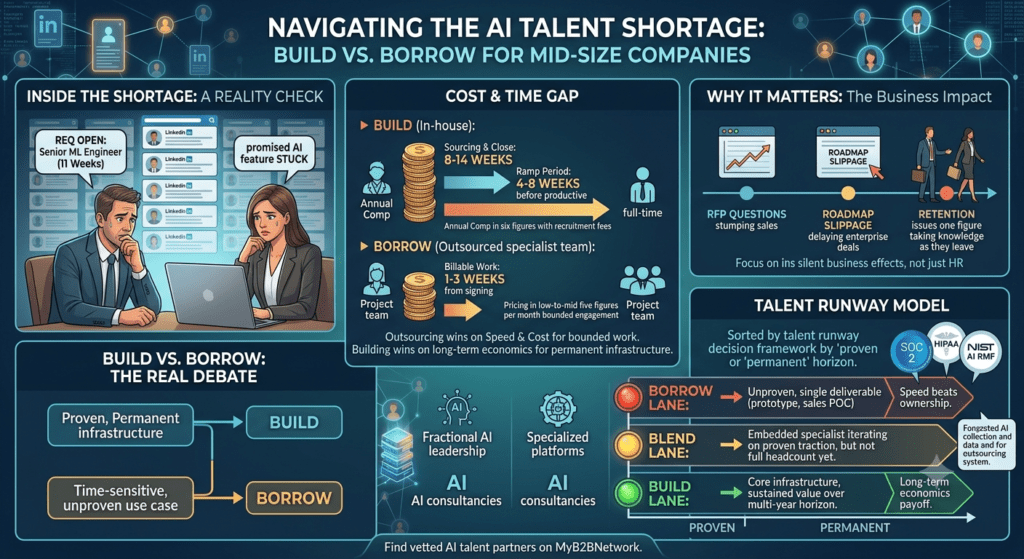
A mid-size SaaS company opens one req for a senior machine learning engineer. Eleven weeks later, the recruiter has resurfaced the same twelve LinkedIn profiles twice. CTO has personally taken three comp calls that went nowhere, and the AI feature that role was supposed to unblock. The one already promised in two enterprise deals, hasn’t moved. That’s what the AI talent shortage actually looks like from inside a company. It’s not a labor-market statistic on a slide somewhere. It’s a specific roadmap item stuck behind a hiring process that was never designed for how scarce this particular skill set has gotten. “Just hire someone good” runs headfirst into a market where the good candidates already have three offers on the table.
So the build-versus-borrow question stops being theoretical pretty fast. Build means a full-time hire (or a small internal team) with all the ramp time, comp negotiation, and retention risk attached. Borrow means bringing in an outside specialist or team to do work without taking on long-term hiring problem right now. Neither is the obviously correct answer in every case. But for a lot of mid-size companies with a deadline already attached to the need, borrowing first and building later. Once the use case has actually proven itself, tends to work out better than the reverse.
Here’s what the shortage looks like in the hiring data, what an in-house AI hire actually costs against an outsourced specialist team once you count the ramp time. And what to check before bringing in outside AI talent if that ends up being the faster path for you.
What Is the AI Talent Shortage?
It’s the gap between how many companies want people with applied AI and machine learning skills and how many qualified candidates are actually available at a pay level most companies can sustainably offer. The problem isn’t really a shortage of AI graduates it’s that a fairly small pool of experienced practitioners is being chased simultaneously by hyperscalers. Well-funded AI labs, and every mid-size company trying to ship an AI feature at the same time.
For companies outside the top comp bracket, that creates a specific kind of squeeze. Someone with two years of applied LLM experience can often pick between a large tech company’s total comp package and a mid-size company’s more modest offer. Or a fractional arrangement that lets them work with several companies at once instead of committing to one. Increasingly, they’re not picking the mid-size offer.
Why It Matters for Businesses
Because AI capability now shows up in what buyers expect, not just what’s on the internal roadmap. Sales teams field RFP questions about AI features. Product teams get asked to ship AI-assisted workflows on the same timeline as everything else. A hiring gap in one skill area can stall commitments the rest of the company has already made to customers.
A few ways that plays out in practice:
- Roadmap slippage, when AI features tied to sales deals or renewals get delayed because the team building them is understaffed
- Comp inflation that ripples outward, since competing for scarce AI talent pulls adjacent engineering comp bands up and creates internal equity headaches
- Retention that’s more fragile than it looks, because a single AI hire leaving can take disproportionate institutional knowledge with them these roles are rarely deep-bench staffed at mid-size companies
Build vs. Borrow: The Real Debate
Building means hiring full-time AI talent to own the work long-term. Borrowing means bringing in an outside specialist or team for a defined engagement. Most companies underestimate how long building actually takes before it starts paying for itself.
Build makes the most sense when AI is turning into core, ongoing infrastructure. Something the company needs to keep owning and defending competitively for years. Borrow makes more sense when what you need right now is a specific deliverable: a working prototype, a proof of concept for a sales deal, one defined integration, where speed matters more than long-term ownership.
Where I see companies get this wrong most often: they treat every AI need as a build decision by default and eat months of an unfilled req without weighing what that costs them. Or they go the other direction and treat everything as a borrow decision. Never build any internal capability, and end up permanently dependent on a vendor. There’s also a third mistake worth naming — never revisiting the decision. A borrowed engagement that proves the use case out is often the strongest argument for eventually building a permanent hire, not a reason to keep outsourcing indefinitely.
The Cost and Time-to-Hire Gap
An in-house senior AI hire usually costs more and takes longer to become productive than an outsourced specialist team though outsourcing carries its own ongoing cost that a full-time hire doesn’t have.
On time: a full-time senior AI or ML hire in the U.S. commonly takes eight to fourteen weeks to source, interview, and close right now. Based on hiring-velocity data tracked through LinkedIn’s Economic Graph and echoed by recruiting firms that specialize in technical roles. That’s before the four-to-eight-week ramp period most new hires need before they’re actually productive. An outsourced specialist team, by comparison, can often start billable work within one to three weeks of signing. Since the vendor has already done the hiring and onboarding on their end.
On cost: a senior AI engineer in a major U.S. tech hub commonly commands total comp well into six figures a year, before recruiting fees, benefits, or equity are even added in. An outsourced engagement for a defined project is often priced in the low-to-mid five figures per month for the length of the engagement. Cheaper for a bounded piece of work, though if that engagement drags on indefinitely without ever converting to an internal hire, the monthly cost can end up exceeding what a full-time salary would have run.
The short version: outsourcing tends to win on speed and cost for defined-scope work. Building tends to win on long-term economics once you know the need is permanent and not just situational.
Tools and Models Powering the Outsourced AI Talent Shortage Market
This market runs through a mix of specialized staffing platforms, fractional leadership arrangements. And project-based AI consultancies and which one fits depends entirely on what kind of gap you’re actually trying to close.
- Specialized technical talent platforms like Toptal focus specifically on vetted senior technical talent. AI and ML specialists included, for project-based work
- Fractional AI leadership — some companies bring on a fractional CTO or Head of AI part-time to set strategy without committing to a full-time executive hire
- AI-focused consultancies and dev shops, useful when what you need is a finished deliverable rather than extra headcount
- Staff augmentation firms that embed one or more AI specialists directly into your existing team for the length of a project
IDC’s research on enterprise AI adoption keeps landing on the same finding: skills gaps, not access to technology, are the barrier companies cite most often when AI initiatives stall. That’s a big part of why this outsourced market has grown as fast as it has.
A Framework for Deciding: The Talent Runway Model
Instead of treating build-versus-borrow as one company-wide policy. It’s more useful to run each AI initiative through what I’ll call the Talent Runway Model three lanes. Sorted by how proven and how permanent the need actually is.
Borrow Lane is for anything unproven, time-sensitive, or tied to one deliverable — a prototype, a sales POC, a single integration. Speed beats ownership here, full stop.
Blend Lane fits work that’s shown early traction and needs sustained iteration. But where you’re not ready to commit to full-time headcount yet. An embedded outsourced specialist working alongside an internal owner belongs in this lane.
Build Lane is for anything proven, ongoing, and core to the product’s competitive position. This is where a full-time hire’s higher cost and slower ramp actually pay off, over a multi-year horizon.
Most companies dealing with an acute AI talent shortage right now have a Borrow or Blend Lane problem, even when the instinct is to open a full-time req anyway. Running the specific initiative through this before posting a job can save months.
FAQ
What is the AI talent shortage and why does it matter for B2B businesses?
It’s the gap between demand for applied AI and machine learning skills and the supply of candidates available at pay levels most companies can sustain. It matters because AI capability is now tied to sales commitments and product roadmaps. So a hiring gap in this one area can stall business outcomes well past engineering.
How do I choose the right outsourcing partner for AI talent within my budget?
Match the engagement to the actual need. A fractional leader for strategy, a staff augmentation firm for embedded headcount, a consultancy for a full deliverable. Ask for a fixed-scope proposal on defined projects rather than an open-ended monthly rate. So cost stays predictable against whatever deadline is driving the decision.
What checks should I do before outsourcing AI talent?
Look at the vendor’s past work for something comparable to your use case. Ask directly how they’ll handle your data and model access during the engagement. And get clear terms on IP ownership and knowledge transfer if you might bring the capability in-house down the line.
How long does AI talent outsourcing typically take, and what does it cost?
Most engagements can start within one to three weeks of signing. Defined projects commonly run three to six months and land in the low-to-mid five figures per month. Depending on scope and how senior the specialist needs to be.
Need Help Finding Vetted AI Talent shortage Fast?
Weighing build versus borrow is a lot easier with real quotes in hand instead of guesswork. MyB2BNetwork connects founders, HR directors, and CTOs with vetted AI specialists, fractional leaders, and outsourced teams who can start fast on a defined engagement. Find vetted AI talent partners on MyB2BNetwork.
Hiring or Outsourcing AI Talent in the U.S.
Two things matter most when a U.S. company outsources AI talent: getting the budget fit right for the actual deliverable, and doing real due diligence on data handling.
On budget, a fractional AI advisor or Head of AI engagement typically runs $4,000–$10,000 a month for a part-time commitment. A fuller embedded specialist or small project team lands more in the mid-five-figures per month, or low-to-mid six-figures annually for something sustained. MyB2BNetwork can help source accurate, vetted quotations instead of relying on whatever rate card a single vendor hands you first.
On due diligence, confirm the vendor’s data handling lines up with whatever framework matters for your industry — SOC 2 for general data security posture, HIPAA if the work touches patient data, NIST’s AI Risk Management Framework if you need a defensible standard for evaluating AI systems internally. That bar should scale with how sensitive the data is, whether you’re a SaaS startup in Austin shipping a first AI feature, a healthcare company in Chicago handling patient records, or a fintech firm in New York where model decisions carry real regulatory exposure.