Every sales kickoff deck in 2026 has a slide about AI sales agents. Some show them as a threat — leaner teams, fewer reps, agents doing the qualifying work. Others show them as a tool that frees up time for actual selling. Both slides describe the same technology and land on opposite conclusions.
The anxiety is fair. Agentic tools can now research an account, draft outreach, qualify a lead, and update a CRM record without a human touching any of it. If you’re a sales leader watching quota and cost-per-rep at once, that raises an obvious question. How many reps does a team actually need going forward?
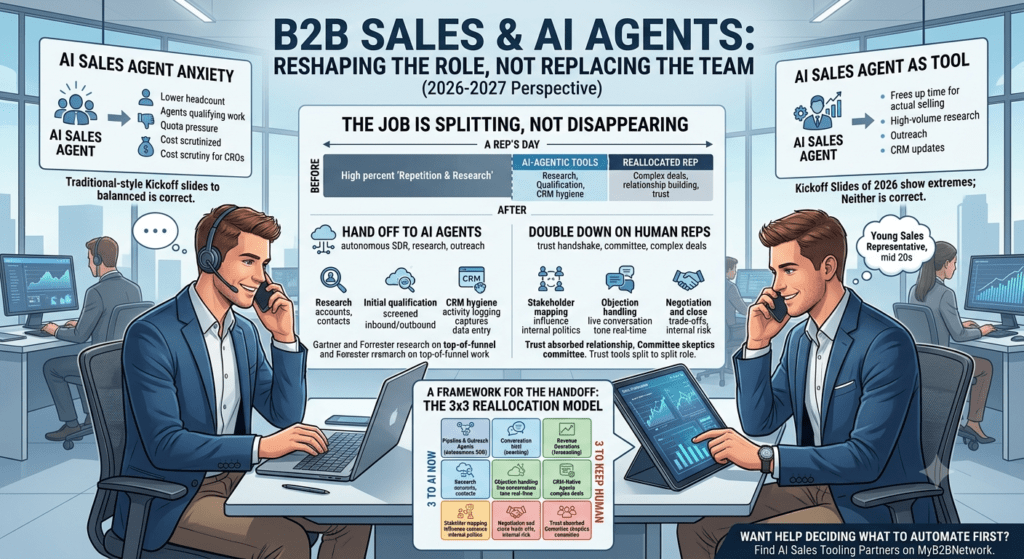
Here’s the honest answer: neither extreme on that kickoff slide is right. AI is already absorbing real chunks of a rep’s day. But trust-building, judgment under ambiguity, and negotiation with another human haven’t shown signs of being automatable soon. The job is splitting, not disappearing.
This piece covers what AI sales agents can actually do today. It looks at why 2027 became the informal deadline in this debate, where the evidence says agents are strong or weak, and a practical way to decide what to hand off now versus what to keep.
What Are AI Sales Agents?
AI sales agents are software systems that independently execute multi-step sales tasks. Think account research, outreach, lead scoring, CRM updates — all based on a defined goal, with limited human sign-off along the way. That’s the key difference from older “sales AI” tools, which assisted a human rather than acting on their own.
Earlier tools told a rep who to call first. A sales agent can research the account, draft the message, send it, log the reply, and queue the next step. The rep steps in later — right where judgment and relationship-building actually matter.
Why This Question Matters for B2B Sales Leaders Now
It matters because headcount decisions made this year rest on assumptions about a market that could look very different by 2027. Getting it wrong is costly either way. Overinvest in headcount before agents mature, and you waste budget. Cut reps too early, and you damage the relationship-stage selling that still drives revenue.
A few reasons the pressure is real right now:
- Cost scrutiny. CROs face board-level pressure to show revenue efficiency, and AI-driven pipeline work is an easy way to prove it.
- Buyers are changing too. More buyers now do early research with AI tools themselves, shrinking the rep’s traditional early-funnel role regardless of internal tech choices.
- Talent strategy hinges on the answer. Sales ops teams are deciding right now whether to hire junior SDRs or fund agent tooling instead, and that call is hard to reverse.
What AI Agents Actually Do Well Today
Short answer: agents excel at high-volume, well-defined tasks with little ambiguity. Research, rules-based qualification, and first-touch outreach lead the list. They struggle wherever a task depends on reading an ambiguous human situation.
Gartner’s research on sales technology points to agentic tools taking over top-of-funnel work like research and first engagement. That frees sellers for later-stage conversations. Forrester’s go-to-market research frames this shift the same way — as augmentation for now, not outright replacement, at least within the current planning horizon.
Tasks agents are handling reliably today:
- Account and contact research, pulled from public and licensed data sources
- First-touch outreach, personalized using firmographic and intent signals
- Lead qualification against clear, rules-based criteria like budget and timeline
- CRM hygiene — logging activity, updating fields, flagging stale deals
Where Human Reps Still Win — Trust and Complex Negotiation
Short answer: reps stay essential wherever a deal needs trust from a skeptical buying committee, or negotiation around unstated interests agents can’t read.
Complex B2B deals rarely stall on missing information. They stall on internal politics, unspoken risk, or a buyer who needs to trust the person, not just the product. An agent might notice a champion has gone quiet. It can’t reliably explain why, or know what to do about it. That read — and the relationship capital behind it — is still a human skill.
Trust also works differently here than in consumer sales. A buying committee signing a seven-figure contract is staking its own internal credibility on that choice. That risk gets absorbed through a relationship with a person, not an interface.
Tools and Platforms Leading the Shift
Short answer: today’s AI sales agent tools split roughly into three groups — research and outreach automation, conversation intelligence, and full pipeline platforms. Each handles a different slice of the job.
Tools sales leaders are testing or already running in 2026:
- Pipeline and outreach agents — positioned as autonomous SDRs, handling research through first outreach with little human input
- Conversation intelligence — tools like Gong and Chorus analyze sales calls, surfacing coaching cues and risk flags for reps
- Revenue operations platforms — tools like Clari layer AI forecasting on pipeline data, flagging at-risk deals earlier
- CRM-native agent features — Salesforce’s Agentforce and HubSpot’s Breeze build agentic task execution directly into tools reps already use
One pattern holds across all of them. They’re strongest early in the funnel, and less capable — and less trusted by buyers — the closer a deal gets to signature.
A Framework for the Handoff: The 3×3 Reallocation Model
Instead of treating “AI versus human” as one big decision, split the rep’s role. Call it the 3×3 Reallocation Model — three tasks to hand to AI now, three to double down on personally.
Hand off to AI now:
- Account research — pulling firmographic, technographic, and intent data before a first touch
- Initial qualification — screening inbound and outbound leads against fit criteria you’ve already defined
- CRM and activity logging — capturing and updating records without manual data entry
Double down on personally:
- Stakeholder mapping in complex deals — reading who actually holds influence, which takes conversation, not just an org chart
- Objection handling in live conversation — responding to an unscripted concern in real time, where tone matters as much as content
- Negotiation and close — navigating trade-offs and internal risk concerns a buyer won’t put in writing to a bot
Map your own pipeline against this split, and the question changes. It stops being “will AI replace me” and becomes “which half of my week should look different.”
FAQ
What are AI sales agents and why do they matter for B2B businesses?
They’re autonomous systems that research, qualify, and engage prospects with limited human input. They matter because they’re reshaping how teams split rep time between early-funnel volume work and late-funnel relationship work.
How do I choose the right AI agent vendor within my budget?
Start with the one task you want automated — research, outreach, or qualification — instead of buying a broad platform. Narrow tools are usually cheaper and easier to judge against a clear metric.
What checks should I do before outsourcing this work to an AI agent vendor?
Confirm how the vendor sources and stores prospect data. Ask about SOC 2 or ISO 27001 certification, and request references on deliverability and reply-rate results from a similar industry.
How long does it take to stand up an AI-agent-supported outbound motion, and what does it cost?
Most teams need four to six weeks to configure and tune an agent against their real ICP and messaging. Pricing usually runs as a monthly platform fee, not a one-time cost.
Want Help Deciding What to Automate First?
Deciding what to hand to AI and what to keep human is easier with outside perspective. MyB2BNetwork connects sales leaders and RevOps teams with vetted AI sales tooling partners and implementation specialists who help build the split, not just sell the software. Find AI sales tooling partners on MyB2BNetwork.
Hiring or Outsourcing AI Sales Agent Implementation in the U.S.
Two things matter most when a U.S. company brings in outside help here: budget fit and data security due diligence.
On budget, a focused implementation covering one workflow — research and first-touch outreach, say — typically runs $2,000–$5,000 per month in platform and setup fees. A broader RevOps engagement covering forecasting, qualification, and CRM integration can land in the mid-five-figures annually. MyB2BNetwork can help source accurate, vetted quotations instead of relying on a vendor’s list pricing alone.
On due diligence, confirm the vendor’s data handling meets SOC 2 or ISO 27001 standards wherever sensitive customer data is involved. Check CCPA compliance too, for any California-based accounts in your pipeline. This applies whether you’re a SaaS company in Austin, a fintech firm in New York, or a manufacturer in Ohio evaluating agent tools against regulated buyer industries.