Brand safety for AI-generated content has become a board-level concern almost overnight. And most marketing teams are still reviewing AI ad creative the same way they reviewed human-written copy. Which is exactly the gap that’s causing the public mistakes you’ve seen in your feed this year. AI-generated creative moves faster than traditional review cycles were built for. And the failure modes are different enough from human error that a standard copy-edit pass doesn’t catch them.
The stakes aren’t hypothetical. A Gartner survey of more than 1,500 U.S. consumers found that half of them would actively prefer to do business with brands that avoid using generative AI in consumer-facing messaging and advertising. Meaning the downside of a visible AI misstep isn’t just embarrassment, it’s measurable customer preference working against you. At same time, adoption isn’t slowing down; most marketing teams are generating creative with AI tools in some part of their workflow. Which means the review gap is widening even as the risk grows.
This piece is written for brand managers and marketing ops leaders who need a practical answer. Not a theoretical one: what actually goes wrong when AI-generated ads and content aren’t reviewed properly. What tools and standards exist to catch problems before publish, and a pre-publish checklist you can put in front of your team this week. Brand safety for AI-generated content isn’t a reason to stop using these tools. It’s a reason to build the review step that most teams skipped when they adopted them.
By the end, you’ll have a clear framework for what “reviewed properly” actually means. And a checklist built specifically for AI creative rather than adapted from traditional copy review.
What Is Brand Safety for AI-Generated Content?
Brand safety for AI-generated content is the practice of reviewing AI-produced ads, copy, images, and video before publication to catch factual errors. Biased or offensive output, misused likenesses, and claims that could expose the brand to legal or reputational risk. It extends traditional brand safety — keeping ads away from harmful adjacent content. Into a new category: catching harm the creative itself might contain.
The distinction matters because AI-generated content fails in ways human-written content rarely does. A human copywriter doesn’t usually invent a fake statistic with total confidence. Or generate an image that unintentionally resembles a real, identifiable person. AI models do both regularly, which is why brand safety for AI-generated content requires its own review step rather than folding into existing proofreading.
Why Does Brand Safety for AI-Generated Content Matter for Businesses?
It matters because the financial and reputational cost of a single unreviewed AI ad can outweigh months of efficiency gains from using the tool in the first place. A hallucinated product claim, a biased image output, or an unlicensed celebrity likeness isn’t a minor copy error. It’s the kind of mistake that triggers press coverage, regulatory attention, or a legal claim.
It also matters because consumer trust is already shifting. Gartner’s research found that half of U.S. consumers prefer brands that avoid GenAI in their advertising altogether. And Gartner analysts have specifically advised marketers to treat generative AI “as a trust decision as much as a technology decision.” A brand that gets caught publishing an obvious AI error reinforces exactly the skepticism that half the market already holds.
What Can Go Wrong When AI-Generated Ads Aren’t Reviewed?
The most common failure is a confidently stated but false claim — AI models generate specific numbers, comparisons. And product capabilities that sound authoritative and simply aren’t true. The FTC has explicitly flagged this risk, warning in its 2023 guidance that marketers must substantiate every claim in their advertising “whether explicit or implied,” regardless of whether AI or a human produced it.
Several other failure modes show up consistently in unreviewed AI creative:
- Biased or stereotyped imagery, where an AI image generator defaults to narrow, non-representative depictions of a role, profession, or demographic group unless specifically guided otherwise.
- Unintended likeness or deepfake risk, where AI-generated faces or voices resemble real. Identifiable people closely enough to create consent and right-of-publicity issues.
- Inconsistent brand voice, where generated copy drifts from established tone, terminology, or positioning across a large batch of assets produced quickly.
- Fabricated testimonials or reviews, which the FTC treats as a deceptive practice regardless of whether a human or an AI tool generated the fake review.
- Missing AI disclosure, in contexts where regulators or platforms require marketers to disclose that content or an endorsement was AI-generated.
A well-known real-world example: in 2024, a Glasgow event promoted as an immersive “Willy Wonka Experience” drew international coverage after its marketing materials. Built heavily from AI-generated images — bore little resemblance to the actual, sparsely produced event attendees encountered. The failure wasn’t that AI was used; it was that nobody checked the creative against reality before it went out the door.
Which Tools and Standards Help Catch These Risks Before Publish?
A mix of technical tools and brand governance processes can catch most of these risks before an asset goes live, but none of them replace a human sign-off step. Content provenance standards like C2PA (Coalition for Content Provenance and Authenticity) let brands attach verifiable metadata showing an asset was AI-generated or edite. Which supports transparent disclosure rather than hiding AI involvement.
On the governance side, brand guideline enforcement tools built into platforms like Adobe Firefly and Jasper can flag off-brand tone or terminology automatically. While fact-checking and claims-review workflows — whether a dedicated tool or a structured legal/compliance checklist. Catch the hallucinated-statistic problem before it reaches a reviewer’s eyes. NIST’s AI Risk Management Framework offers a useful structural reference for building this kind of review process. Even though it wasn’t written specifically for marketing: its core guidance to “map, measure, and manage” AI-related risk applies directly to a pre-publish creative workflow.
| Risk Type | What Can Go Wrong | Pre-Publish Check |
|---|---|---|
| Factual claims | AI invents a statistic, comparison, or capability that sounds authoritative but isn’t substantiated | Require a named reviewer to verify every claim against a real source before approval |
| Imagery and likeness | Generated images default to biased depictions or resemble a real, identifiable person | Run visual review for bias and likeness risk; use provenance metadata (C2PA) to document AI origin |
| Brand voice and tone | Large batches of AI copy drift from established tone, terminology, or positioning | Run a brand-voice diff check against approved guidelines before batch publishing |
| Disclosure and endorsements | AI-generated testimonials or endorsements are published without required disclosure | Confirm disclosure language is present per FTC guidance on AI claims and endorsements |
What Should a Pre-Publish Review Checklist Include?
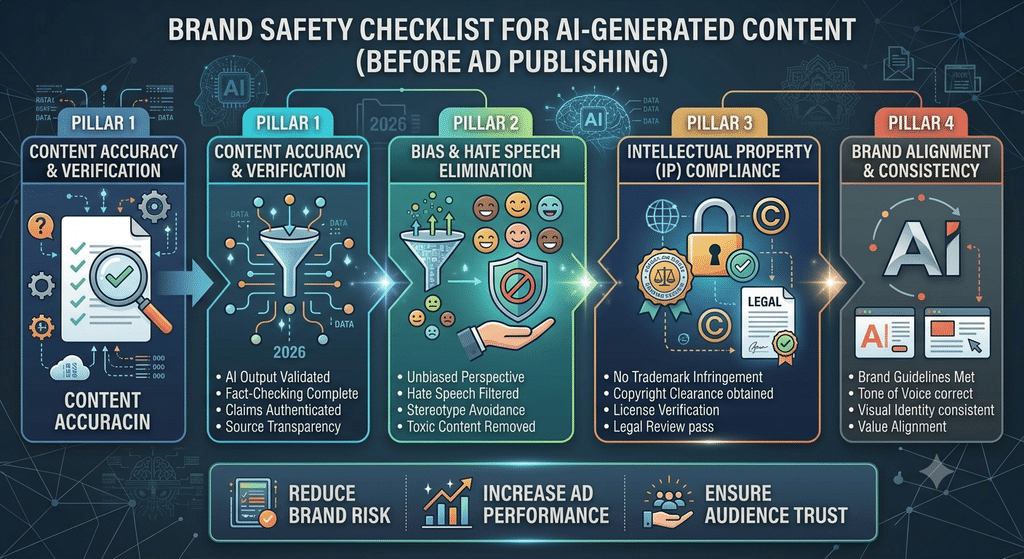
Brand teams need a review structure built specifically for how AI creative fails, not a repurposed copy-edit checklist. The CHECK framework below gives marketing ops and brand managers a five-point structure to run before any AI-generated asset goes live:
- Claims verified — every factual statement, statistic, or comparison in the asset has been checked against a real, named source.
- Human likeness and IP reviewed — generated images or voices have been checked for resemblance to real individuals and for any trademark or copyrighted material that slipped into the output.
- Equity and bias checked — imagery and copy have been reviewed for stereotyped, exclusionary, or non-representative depictions.
- Compliance and disclosure confirmed — required AI disclosure language is present where regulations, platform policy, or company standards call for it.
- Known brand voice matched — tone, terminology, and messaging align with approved brand guidelines, not just grammatically correct output.
Running every AI-generated asset through the CHECK framework before publish doesn’t eliminate risk entirely, but it closes the specific gap that caused most of the public AI-ad failures of the past two years: nobody was looking for these particular problems, because the review process was built for a different kind of mistake.
FAQ
What is brand safety for AI-generated content and why does it matter for B2B businesses?
It’s the practice of reviewing AI-produced ads, copy, and visuals for factual, legal, and reputational risk before publication. It matters because AI content fails differently than human-written content — confidently stated false claims, biased imagery, and likeness issues. And a Gartner survey found half of consumers already prefer brands that avoid GenAI in advertising altogether.
How do I choose the right vendor or tool for AI content review within my budget?
Start by deciding whether you need a full review workflow or a lighter automated check for tone and factual consistency. Since that scope decision drives cost more than any single tool choice. Prioritize vendors who can show how their process maps to the kinds of risk outlined above. Hallucinated claims, likeness issues, bias — rather than general “content quality” promises.
What checks should I do before outsourcing AI content review or brand governance?
Ask for examples of how the vendor has caught a specific AI failure mode in the past, not just a general quality-assurance pitch. Confirm their process includes a named human sign-off step, request their approach to claims substantiation and disclosure compliance. And get response times and escalation paths written into the contract.
How long does setting up a proper AI content review process typically take and what does it cost?
Standing up a basic review workflow — checklist, named approvers, a claims-verification step. Typically takes 2–4 weeks internally; bringing in outside support for a more robust governance process can extend that to 6–8 weeks. Costs vary widely by scope, from a few thousand dollars for a lightweight internal process to the low five figures monthly for ongoing outsourced review and compliance support.
Build Brand Safety for AI-Generated Content With MyB2BNetwork
Most brand and marketing ops teams don’t need another AI generation tool. They need a reliable review partner who already knows what to look for. MyB2BNetwork connects brand managers and marketing ops leaders with vetted content review, brand governance. And compliance partners who can implement a structured process like the CHECK framework instead of leaving it to whoever happens to proofread before a campaign goes live.
Explore our content review and brand governance partners to compare vendors on process rigor. Not just turnaround speed, or read our related guide on protecting your IP when outsourcing creative work for the contract terms that matter when an outside team is producing brand-facing assets.
How to Hire, Source, or Outsource AI Content Review in the U.S.
Brand safety needs for AI-generated content show up across every major market. SaaS firms in San Francisco, fintech brands in New York, and healthcare marketers in Chicago all face the same core problem of reviewing AI creative fast enough to keep up with production volume. Two things matter most before you bring in outside help.
How to choose a vendor within budget. Filter first by whether you need full governance (legal, compliance, and brand sign-off built into a workflow) or a lighter fact-and-tone check, since scope is the main driver of cost. Lightweight outsourced review support typically starts in the low four figures per month; full brand governance programs with legal and compliance integration more commonly run into the mid-five figures monthly. And MyB2BNetwork can help you get accurate, comparable quotes across vendors at either tier.
Checks needed before outsourcing. Confirm the vendor’s familiarity with relevant standards and guidance — FTC rules on AI claims and disclosure. NIST’s AI Risk Management Framework for structuring risk review, and SOC 2 if they’ll be handling your brand assets or customer data directly. If your marketing touches regulated categories, ask specifically how they handle HIPAA-adjacent health claims or CCPA-relevant consumer data. Request sample review logs or a trial run on a real asset batch. And get escalation timelines and sign-off accountability written into the SLA before launch.