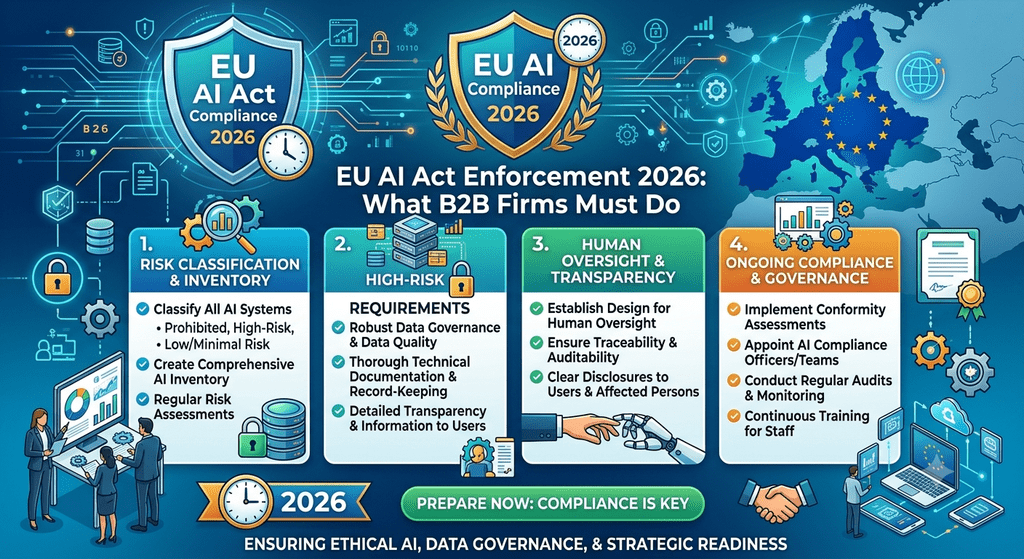
EU AI Act enforcement 2026 is no longer a future-tense compliance topic — parts of it are already live, and the parts that aren’t have firm new dates attached to them. Prohibited AI practices have carried enforceable fines since February 2, 2025. General-purpose AI model obligations became binding on August 2, 2025. And as of this year, transparency requirements for AI systems interacting with the public are in force too, even as the biggest wave — high-risk system obligations — just got a significant timeline change most companies haven’t caught up on yet.
That last part matters, because a lot of what’s circulated online about “the August 2026 deadline” is now out of date. In mid-2026, EU lawmakers finalized a Digital Omnibus package that pushed the compliance date for high-risk AI systems under Annex III from August 2026 to December 2027. That’s genuinely good news for compliance teams racing a shrinking clock — but it doesn’t mean 2026 obligations disappeared. Transparency rules, prohibited-practice bans, and GPAI governance requirements are unaffected by the delay, and a new prohibition on a specific category of harmful AI content takes effect this December.
Most SMBs assume EU AI Act enforcement 2026 is something that only applies to companies headquartered in Europe or building frontier AI models. Neither is true. The Act applies based on where your AI system’s outputs are used, not where your company is based — meaning a U.S. SaaS company with EU customers, or a founder using an AI hiring tool that screens EU applicants, can be squarely in scope without ever opening an EU office.
What Is EU AI Act Enforcement 2026?
EU AI Act enforcement 2026 refers to the set of compliance obligations under Regulation (EU) 2024/1689 that are legally binding during calendar year 2026. As distinct from obligations that took effect earlier (2025) or that were pushed into 2027–2028 by recent amendments. The Act itself entered into force in August 2024, but it rolls out obligations in phases tied to risk level rather than applying everything at once.
The confusion most companies run into is treating “the EU AI Act” as one single deadline. In practice it’s a staggered set of dates, and which ones apply to you depends on your role and what risk category your specific use case falls into.
Why Does EU AI Act Enforcement Matter for B2B Businesses Right Now?
It matters because the penalties are real, already active for the earliest-effective provisions. And calculated as whichever is higher between a fixed euro amount and a percentage of global revenue. Under Article 99, prohibited-practice violations carry fines up to €35 million or 7% of worldwide annual turnover. High-risk and transparency violations up to €15 million or 3%. And providing misleading information to regulators up to €7.5 million or 1%.
It also matters because enforcement doesn’t require an EU headquarters. If your AI product screens job applicants, scores creditworthiness, or otherwise touches people in the EU. You can be classified as a “provider” or “deployer” under the Act regardless of where your company is incorporated. One detail cuts the other way for smaller companies: the Act includes an SME and startup adjustment where the penalty cap uses whichever amount is lower. The fixed figure or the percentage — rather than whichever is higher, meaningfully reducing exposure for genuinely small operators.
Which AI Use Cases Trigger Compliance Obligations?
Your obligations depend on which of the Act’s four risk tiers your AI use case falls into. Not on the size of your company or how the tool is marketed internally.
| Risk Tier | Example Use Cases | Compliance Status in 2026 |
|---|---|---|
| Unacceptable (Prohibited) | Social scoring, manipulative or subliminal AI, real-time public biometric surveillance by law enforcement | Banned outright — enforceable since February 2, 2025 |
| High-Risk (Annex III) | AI in hiring/HR screening, credit scoring, insurance pricing, biometric identification, critical infrastructure | Conformity assessments and technical documentation required — now due December 2, 2027 (delayed from August 2026) |
| Limited Risk (Transparency) | Customer-facing chatbots, AI-generated content, emotion-recognition tools | Disclosure and labeling obligations — in force since August 2, 2026 |
| Minimal Risk | Spam filters, internal recommendation engines, AI-assisted inventory tools | No mandatory obligations; voluntary codes of conduct encouraged |
A few use cases deserve specific attention going into the rest of 2026:
- AI hiring and HR tools almost always fall into the high-risk Annex III category. Since employment-related AI decisions are explicitly named in the Act.
- Customer-facing chatbots and AI content tools fall under transparency obligations that are already in force. Users must be told they’re interacting with AI, and AI-generated content generally needs to be labeled.
- AI systems generating non-consensual intimate imagery, including outputs that are a “reasonably foreseeable” result of normal use. Face a new standalone prohibition taking effect December 2, 2026, independent of a company’s other risk classification.
What Changed in the EU AI Act Timeline for 2026?
The single biggest 2026 development is the Digital Omnibus package, which the Council of the European Union gave final approval to in June 2026. Formally delaying the Annex III high-risk compliance deadline from August 2, 2026 to December 2, 2027 — a 16-month extension. Annex I high-risk obligations (AI embedded in already-regulated products like medical devices) shift similarly, from August 2027 to August 2028.
Importantly, not everything moved. Article 50 transparency requirements — telling users they’re interacting with AI and labeling AI-generated content. Stayed on their original August 2, 2026 timeline, meaning they’re already enforceable as you read this. Only the specific technical requirement to watermark AI content already in deployment got a short four-month reprieve. To December 2, 2026, alongside the new intimate-imagery prohibition landing the same day.
For a compliance lead building a 2026–2027 roadmap, the practical takeaway is this: don’t treat the Annex III delay as license to stop working. It bought real time on the most demanding obligations, but it didn’t touch the ones already live.
How Do You Know If Your Business Is In Scope? The SCOPE Test
A fast way to self-assess EU AI Act enforcement 2026 exposure is what we call the SCOPE Test — five questions that cover the factors that actually determine your obligations:
- Supply-chain role — Are you building an AI system (provider), using one in your business (deployer), or importing/distributing one into the EU market? Each role carries different obligations.
- Category of use case — Does your AI system touch hiring, credit, insurance, biometric identification, critical infrastructure, or another Annex III category? That determines whether you’re looking at a 2027 deadline or an already-active one.
- Operating market — Does your product have any EU-based users, employees, or customers, regardless of where your company is headquartered? EU exposure — not EU incorporation — is what triggers the Act.
- Personal or biometric data involved — Systems processing biometric, emotional, or other sensitive personal data face additional scrutiny and often overlap with GDPR obligations.
- Enforcement date applicable to you — Once you know your role and category, map it to the correct 2025, 2026, 2027, or 2028 date rather than assuming a single blanket deadline applies.
If you answer “yes” to EU exposure and land in the high-risk or prohibited category on even one AI use case. That’s enough to warrant a real compliance review — not a wait-and-see approach, even with the Annex III delay in place.
What Happens If You Don’t Comply?
Non-compliance triggers one of three fine tiers depending on the violation. And enforcement authority is split between the EU’s AI Office and national regulators in each member state. As of mid-2026, industry surveys have found a large share of organizations. Cited figures run as high as roughly three-quarters — have not yet taken meaningful compliance steps. Which suggests enforcement activity is likely to concentrate on the most visible and highest-risk violations first as regulators build case history.
Beyond the direct fine, a finding of non-compliance can result in an AI system being pulled from the EU market entirely. Which for a B2B SaaS company with EU customers is often a more immediate commercial problem than the fine itself.
FAQ
What is EU AI Act enforcement 2026 and why does it matter for B2B businesses?
It’s the set of compliance obligations under the EU AI Act that are legally binding this year. Including prohibited-practice bans (since 2025), transparency requirements (since August 2026). And a new prohibition landing this December even as the largest high-risk obligations were delayed to 2027. It matters because fines run up to €35 million or 7% of global turnover, and the Act applies based on EU market exposure, not company headquarters.
How do I choose the right compliance partner for EU AI Act work within my budget?
Start by scoping whether you need a one-time risk classification and gap assessment or ongoing compliance monitoring, since those are priced very differently. Prioritize consultants or vendors who can point to specific Annex III or Article 5 experience rather than general “AI governance” language.
What checks should I do before outsourcing EU AI Act compliance work?
Ask for references from clients with a comparable AI use case and risk classification, and confirm the vendor’s familiarity with your specific national regulator. Since enforcement for most systems sits at the member-state level. Get clear deliverables — risk classification report, technical documentation templates, remediation timeline. Written into the engagement scope rather than left as an open-ended retainer.
How long does EU AI Act compliance outsourcing typically take and what does it cost?
An initial risk classification and gap assessment typically takes 4–8 weeks; full remediation for a high-risk system. Including documentation and conformity assessment prep, more commonly runs 3–6 months. Costs vary widely by scope, but a scoped assessment often falls in the low-to-mid five figures. While full high-risk conformity work can move well past that depending on system complexity.
Get EU AI Act Enforcement 2026 Right With MyB2BNetwork
Classifying your AI systems correctly is the first and highest-leverage step in EU AI Act enforcement 2026 — and it’s also the step most SMBs are least equipped to do alone. MyB2BNetwork connects compliance leads and founders with vetted AI governance and legal partners who already work inside this framework, and can get you accurate, comparable quotes across vendors before you commit.
Browse our AI compliance and governance partners to compare vendors on relevant experience. Or read our related guide on protecting your IP when outsourcing for the contract-level protections worth pairing with any AI compliance engagement.
How to Hire, Source, or Outsource EU AI Act Compliance Support in the U.S.
U.S. companies with EU exposure show up across every major tech hub — SaaS startups in Austin, fintech firms in New York. And healthcare technology companies in Chicago are all common candidates for AI use cases that trigger Annex III scrutiny. Particularly around hiring, credit, and biometric tools. Two things matter most before you engage anyone.
How to choose a vendor within budget. Filter first by whether you need a one-time risk classification or ongoing compliance support. Since recurring monitoring costs far more than a single assessment. A standalone risk classification and gap assessment commonly runs in the low-to-mid five figures. While ongoing governance retainers can reach mid-five-figures annually or more depending on how many AI systems you operate. MyB2BNetwork can get accurate, comparable quotations across vendors for either scope.
Checks needed before outsourcing. Confirm the vendor’s familiarity with relevant U.S. and international standards that often overlap with AI Act work — NIST’s AI Risk Management Framework. ISO/IEC 27001 for information security, and SOC 2 for data handling are common reference points. Alongside GDPR where EU personal data is involved and CCPA for California-based users. Ask for a sample technical documentation deliverable. Confirm their track record with your specific risk category, and get a defined remediation timeline in writing before signing.