A 30-day lead plan for an agency starting from zero pipeline should aim for conversations and proposals, not closed revenue. In practice that means warming up your existing network in the first two weeks, adding a small, targeted cold outreach batch in week three, and spending week four converting replies into meetings and proposals. Done well, it gives you a first set of real prospects and a repeatable process rather than a one-off burst of activity.
The reason to be modest about the 30-day window is the sales cycle. One B2B fintech benchmark from The Starr Conspiracy, as reported by Vendasta, found specialist agencies averaging a 67-day sales cycle and generalists 94 days. A first signed client inside 30 days is possible, usually through a warm introduction, but you shouldn’t build your cash plan around it.
Founders, CTOs, and legal leads each own a piece of this plan. Founders pick the offer and the target. CTOs set up the sending domain, CRM, and tracking. Legal checks outreach, consent, and contract terms before volume goes out.
This Q&A walks through the plan week by week, with realistic targets, the tools involved, the risks, and when it makes sense to outsource the work.
What Is a 30-Day Lead Plan?
A 30-day lead plan is a time-boxed schedule of specific prospecting actions, with numeric targets, designed to take an agency from no active pipeline to a measurable set of qualified conversations. It covers who you target, what you offer, which channels you use, and what you measure each week.
This is not a growth strategy. It is a starting sprint that tests your offer and messaging so you know what to scale afterward.
Why Does a 30-Day Lead Plan Matter for an Agency With No Pipeline?
It matters because an agency with no pipeline tends to scramble: a few random emails, a referral request or two, and no way to tell what worked. A defined 30-day lead plan forces you to choose a narrow target and measure results, so day 31 starts with data instead of guesses.
It also protects against a common trap. Gartner’s 2025 sales survey found 61% of B2B buyers prefer a rep-free buying experience, so buyers ignore generic pitches. Narrow, relevant outreach is the only version of cold contact worth running.
Why Start With Your Network Instead of Cold Outreach?
Because warm introductions reply at far higher rates, and they cost nothing. Vendasta, citing KnowledgeNet’s analysis of 2.1 million outbound touches, reports a 27% reply rate for warm intros, about 19 times the rate of cold email alone. The same article cites RSW/US’s 2025 survey, in which referrals were the leading source of new business for 73% of professional-service firms.
Both figures come from secondary reporting, so treat them as directional. The practical point holds either way: ask your warmest contacts first, and use cold outreach to supplement them.
How Does the 30-Day Lead Plan Work Week by Week?
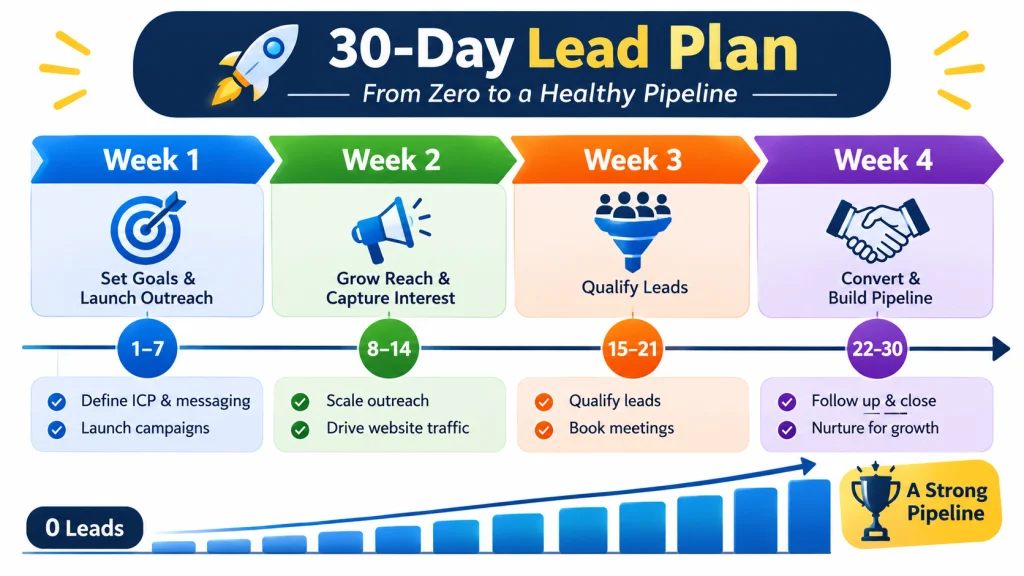
Use what we’ll call the 30-Day Pipeline Ladder: four weeks, each with one job and one number to hit.
| Week | Focus | Target output |
|---|---|---|
| 1. Foundation | Define one ideal client, one offer, a 100 to 250 account list, tracking, and sending setup | Target list built, CRM and tracking live |
| 2. Warm | Ask past clients, colleagues, and partners for introductions | 40 to 50 warm contacts reached |
| 3. Cold | Send personalized first-touch emails and LinkedIn messages to the target list | 200 to 300 targeted touches sent |
| 4. Convert | Follow up, book calls, send scoped proposals | Booked meetings and 2 to 4 proposals |
Week 1: Foundation. Pick a narrow niche, since specialists in the Starr Conspiracy benchmark closed faster than generalists. Write a one-sentence offer, build the account list, and set up a separate sending domain with proper email authentication so your main domain isn’t at risk.
Week 2: Warm. List former colleagues, past clients, classmates, and partners who work near your ideal client. Send each a short, specific ask for an introduction, not a general “let me know if you hear of anything.”
Week 3: Cold. Research each account for a trigger, such as a funding round, a new hire, or a recent campaign. Send first touches that reference that trigger, and add a follow-up sequence.
Week 4: Convert. Follow up on every reply, offer a short scoped call, and send proposals within a day or two of each meeting.
What Results Should You Expect From a 30-Day Lead Plan?
Expect a handful of qualified conversations and a few proposals, not a full pipeline. These are planning estimates built from published benchmarks, not guarantees:
- Cold email replies: Instantly’s benchmark report puts the average reply rate at 3.43% and the top quartile at 5.5%, so 300 emails yields roughly 10 to 16 replies.
- Cold meetings: RevenueFlow reports average agencies booking 5 to 15 meetings per 1,000 cold emails, which suggests roughly 1 to 5 meetings from 300.
- Warm introductions: 40 to 50 warm asks at a directional 27% reply rate suggests around 10 to 14 replies.
- Timeline: one lead generation firm reports first meetings inside 30 to 45 days and a repeatable pipeline by day 90.
If you land 4 to 10 qualified conversations and 2 to 4 proposals, the plan worked. If you land fewer, change the offer or the target before you increase volume.
What Can Go Wrong, and How Do You Avoid It?
Most failures come from four mistakes:
- Targeting too broadly. A vague “we help businesses grow” message earns silence. Narrow the niche.
- Sending volume before setup. A new domain with no authentication or warm-up can land in spam. Keep early volume low.
- Skipping legal review. Outreach and consent rules differ by market, and contract terms matter once proposals go out.
- Measuring activity, not outcomes. Emails sent is a vanity metric. Track replies, meetings, proposals, and close rate.
Run a short weekly review: what you sent, what replied, what you’ll change. That habit is the real product of the 30 days.
FAQ
What is a 30-day lead plan and why does it matter for B2B businesses?
It’s a time-boxed set of prospecting actions with numeric targets that takes an agency from no pipeline to measurable conversations. It matters because it replaces random outreach with a tested process you can repeat and scale.
How do I choose the right vendor to run a 30-day lead plan within my budget?
Decide whether you need full outbound execution, list building and research only, or coaching for your own team, since scope drives price. Ask for reply-rate and meeting benchmarks from agency clients and avoid vendors that guarantee a specific number of clients.
What checks should I do before outsourcing a 30-day lead plan?
Confirm the work runs in your own email domain, CRM, and data accounts so you keep the assets afterward. Ask how they source contacts and handle consent and opt-outs, and get reporting cadence and contract exit terms in writing.
How long does a 30-day lead plan outsourcing engagement typically take and what does it cost?
Setup commonly takes two to four weeks before volume starts, and first meetings often arrive 30 to 45 days in. Costs range from a modest project fee to a monthly retainer, depending on volume and channels.
Get Your 30-Day Lead Plan Moving With MyB2BNetwork
If you have the strategy but not the hours to execute it, MyB2BNetwork can match your agency with vetted outbound and SDR partners and help you compare quotes side by side before you commit. The aim is a partner who reports meetings and proposals, not just emails sent.
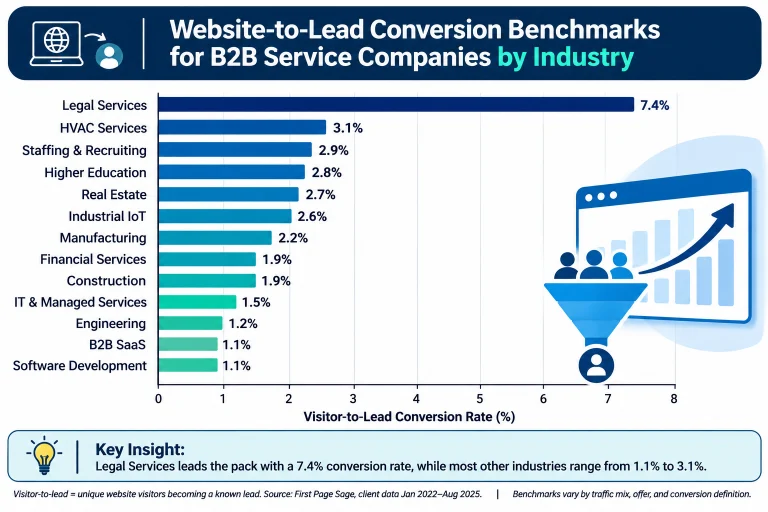
Browse our outbound and SDR partners to compare options, read why cold outreach isn’t dead when it’s relevant and timely, and see how website-to-lead conversion rate affects the leads your site brings in during the same 30 days.
How to Hire, Source, or Outsource a 30-Day Lead Plan in the U.S.
Agencies across the U.S. outsource lead generation, from SaaS-focused shops in Austin and fintech specialists in New York to B2B firms in San Francisco and professional-services agencies in Chicago. Two things matter most.
Choosing a vendor within budget. Scope drives price. A fractional or outsourced outbound program commonly runs roughly $3,000 to $8,000 per month, while one lead generation firm notes a fully loaded in-house SDR in the U.S. costs $70,000 to $90,000 a year before ramp time. These are approximate market ranges, and MyB2BNetwork can get accurate quotations for your scope. Prioritize vendors who share reply-rate benchmarks by seniority and don’t lock you into long contracts.
Checks before outsourcing. Ask how the vendor follows the FTC’s CAN-SPAM rules for email, and about TCPA requirements if calls or texts are involved. If you target California contacts or EU and UK contacts, ask about CCPA and GDPR or UK GDPR handling. A SOC 2 report or ISO 27001 certification is a reasonable baseline if they will touch your CRM data. Plan for two to four weeks of setup, first meetings around day 30 to 45, and a repeatable pipeline closer to day 90.