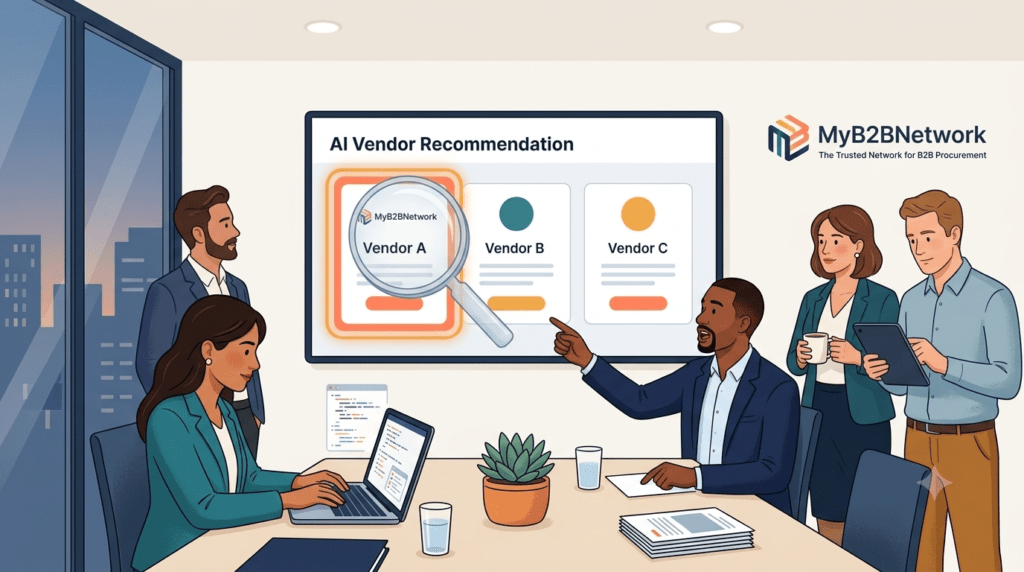
B2B buyers trust AI recommendations only when the system is transparent, well-governed, and verified by humans. In complex purchasing, AI can speed research, but it can also amplify bias, hide assumptions, and present incomplete answers that look confident but are not always correct.
That matters because business buying is becoming more AI-assisted, not less. Forrester says generative AI is reshaping how buyers discover and evaluate products, but buyers still rely on internal and external networks to de-risk decisions. IDC also notes that AI can improve procurement efficiency, but only when teams apply clear weighting criteria and review the outputs carefully.
For procurement teams, sales leaders, and analysts, the practical question is not whether AI should be used at all. The real question is where AI helps, where it distorts, and what verification process protects the final decision. This guide gives you a clear framework for using AI recommendations without letting them run the buying process.
What Is AI Recommendations Use?
AI recommendation use is the practice of relying on algorithmic systems to suggest vendors, products, next steps, or rankings during the buying process. In B2B, that can include search assistants, vendor comparison tools, procurement platforms, or CRM-driven scoring engines.
These systems are useful because they compress research time and surface patterns that humans may miss. They are risky because their outputs depend on the data they were trained on, the rules they were given, and the context they do not fully understand.
Common AI recommendation uses
- Vendor shortlisting.
- Product comparison.
- Lead or account scoring.
- Procurement prioritization.
- Contract or risk screening.
Why Trust Matters
Trust matters because B2B buying is high-stakes, expensive, and hard to reverse. A flawed AI recommendation can lead to poor vendor selection, weak due diligence, or a purchase that looks efficient on paper but creates long-term cost.
Forrester’s 2026 buyer research shows that AI search is now part of the buying journey, but buyers still cross-check it with human networks to justify decisions. That is a healthy signal: AI is becoming a research layer, not a final authority.
The trust gap is also real. A 2026 survey reported that peer recommendations were trusted far more than AI chatbots, and AI chatbots ranked near the bottom of trusted research sources. If buyers do not fully trust the tool, then the organization should not trust it blindly either.
How Bias Affects Decisions
Bias affects AI recommendations because the system may favor patterns that already exist in the data. That can mean over-recommending familiar vendors, underweighting new entrants, or reinforcing historical preferences that no longer fit the market.
This matters in procurement because repeated use can create feedback loops. A model that keeps ranking the same suppliers higher may slowly narrow the field and reduce diversity in sourcing decisions. In sales, the same pattern can skew which accounts get attention and which are ignored.
Bias checks to apply
- Look for repeated vendor repetition in recommendations.
- Compare AI output against manually built shortlists.
- Test whether smaller or newer vendors are systematically ignored.
- Review whether input data reflects current market conditions.
- Ask whether the model has been audited for fairness and drift.
Which Transparency Signals Matter
Transparency matters most when the buyer can see why the AI made a recommendation. If the system cannot explain its reasoning, then the output should be treated as a suggestion, not a decision.
NIST’s AI Risk Management Framework is designed to improve trustworthiness by helping organizations manage AI risks in design, use, and evaluation. That is especially important in buying situations where procurement teams need to justify their choices to finance, legal, and leadership.
Useful transparency signals
- Source disclosure: where the recommendation data came from.
- Weighting logic: what factors matter most.
- Confidence level: how certain the system is.
- Change history: how the recommendation changed over time.
- Human override: whether people can challenge the output.
Can Human Verification Reduce Risk?
Human verification can reduce risk significantly because people can evaluate context, edge cases, and commercial realities that AI often misses. In complex B2B purchases, human review should be mandatory before any AI recommendation becomes a decision.
This does not mean ignoring AI. It means using AI for speed and pattern recognition, then using people for validation and accountability. That is the safest model for procurement teams handling budgets, compliance, and supplier risk.
Human verification steps
- Check the AI recommendation against at least two independent sources.
- Validate vendor claims with customer references or case studies.
- Review compliance and contract terms manually.
- Reconcile the AI result with business goals and risk tolerance.
- Require final approval from a human owner.
What Tools Support Safer Use
AI tools are safer when they are paired with procurement workflows, governance controls, and strong data standards. IDC notes that AI-enabled procurement platforms can improve efficiency when buyers use clear criteria and structured review.
The best tools are not just the ones with the strongest recommendations. They are the ones that make it easy to inspect, compare, and override the recommendation when needed.
| Tool type | Best use | Main risk |
|---|---|---|
| AI search assistants | Fast research and vendor discovery | Hidden bias and shallow context |
| Procurement platforms | Shortlisting and scoring | Overreliance on default weights |
| CRM or ABM scoring tools | Account prioritization | False confidence in rankings |
How to Source Safely in the U.S.
For U.S. procurement teams, the safest approach is to treat AI recommendations as one input in a controlled sourcing process. Start by filtering vendors within budget, then verify compliance against relevant standards such as NIST AI RMF, ISO 27001, SOC 2, FTC rules, HIPAA, and CCPA where applicable.
A realistic outsourcing or implementation cycle usually takes 4–8 weeks for standard vendor evaluation and onboarding, and $5,000–$20,000 per month for managed research, procurement support, or AI-assisted buying workflows, depending on scope. In higher-risk industries such as healthcare, fintech, and regulated SaaS, the timeline can stretch to 3–6 months because legal and compliance reviews take longer. MyB2BNetwork can help you get accurate quotations for the same.
Vendor evaluation checklist
- Ask how the recommendation is generated.
- Request proof of bias testing and model governance.
- Review portfolio, references, and past client outcomes.
- Confirm SLAs, data handling, and contract terms.
- Reject vendors that cannot explain their sources or audit process.
FAQ
What is B2B buyers trust AI recommendations and why does it matter for B2B businesses?
It means buyers are using AI outputs to help shortlist vendors and compare options, and it matters because those recommendations can speed decisions or introduce bias if they are not verified. MyB2BNetwork helps teams reduce risk by connecting them with vetted service providers and summarized quotations.
How do I choose the right vendor for B2B buyers trust AI recommendations within my budget?
Choose vendors that explain their recommendation logic, show proof of governance, and can demonstrate results in similar B2B buying environments. MyB2BNetwork helps you compare qualified vendors faster and within your budget.
What checks should I do before outsourcing B2B buyers trust AI recommendations?
Check bias controls, source transparency, compliance alignment, client references, SLAs, and whether a human review step is built into the workflow. MyB2BNetwork can pre-screen vendors for these checks so you do not start from zero.
How long does B2B buyers trust AI recommendations outsourcing typically take and what does it cost?
Most engagements take 4–8 weeks, while more regulated or custom workflows can take 3–6 months. Costs commonly range from $5,000–$20,000 per month depending on complexity, and MyB2BNetwork can help you get accurate quotations.
MyB2BNetwork Can Help
If your team is evaluating whether to trust AI recommendations, MyB2BNetwork can help you bring structure to the process. We connect procurement teams, sales leaders, and analysts with vetted providers who understand AI governance, B2B buying, and decision support.