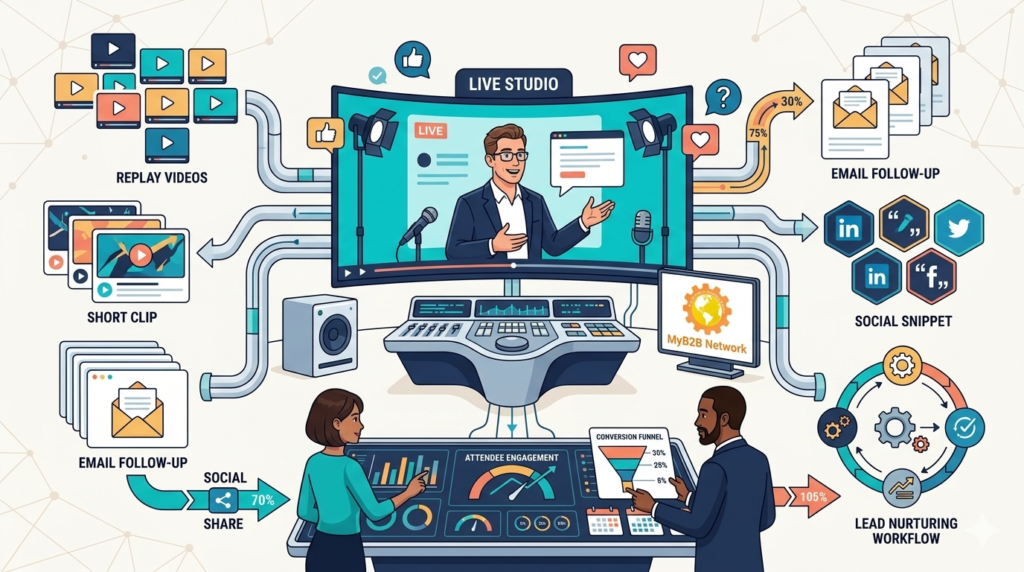
Webinars in 2026 are still worth it, but only if you stop treating them like one-off live events. Attendance and engagement are under pressure, yet webinars still work when they are designed as a content system that includes live delivery, replay distribution, clips, and structured follow-up.
That shift matters because B2B teams no longer get value from a single broadcast alone. The real return now comes from repurposing the session into multiple assets and using those assets to keep the conversation going after the event ends. If your webinar stops when the live room closes, you are leaving most of the value untouched.
Demand gen teams and event marketers need a different model: one webinar should create several touchpoints, not just one attendance metric. That is how webinars stay relevant in a market where buyers want short, useful, and on-demand content.
What Is a Webinars?
A webinar is a live or recorded online session used to educate, engage, and convert an audience around a specific topic, product, or problem. In B2B, webinars often support demand generation, thought leadership, partner education, and product demos.
The format still works because it combines attention, expertise, and interaction in one place. But the format has changed: shorter sessions, clearer takeaways, and stronger post-event content now matter more than long slide decks or generic presentations.
Common webinar uses
- Product education and demos.
- Educational thought leadership.
- Customer onboarding and training.
- Partner and pipeline enablement.
Why Webinars Matter for Businesses
Webinars matter because they can create both immediate engagement and long-tail content value. Even if live attendance is smaller than in past years, the replay, clips, and follow-up sequence can continue generating leads and influence after the event.
That makes webinars useful for companies that need education and demand at the same time. They help teams explain complex ideas, capture intent, and build credibility in a way that static content often cannot. The trade-off is that webinars require more planning and tighter execution than many teams expect.
For B2B companies, the real question is not whether webinars are alive. It is whether your webinar program is built for conversion or just for attendance.
How Replay Content Extends Value
Replay content extends value by turning one live event into an on-demand asset that works long after the session ends. This is especially important because many webinar views now happen after the live date, not only during the event.
A replay lets prospects watch on their own schedule, which improves reach and gives sales teams more material for follow-up. It also provides a cleaner way to segment viewers by engagement, so your nurture flows can be more targeted.
Replay content ideas
- Full event recording.
- Chaptered clips by topic.
- Short social posts from key moments.
- Email follow-up with the replay and next step.
Which Clips Drive the Most Engagement?
The clips that drive the most engagement are the ones that deliver a complete idea quickly. In 2026, short, useful segments outperform generic highlight reels because buyers want immediate value, not long promotional edits.
Useful clips often include a strong point of view, a customer question, a tactical answer, or a surprising data point. Those are easy to distribute across LinkedIn, email, and landing pages. They also give the webinar a second life as a content library rather than a single event.
Best clip types
- 30–90 second tactical answers.
- Opinion-led moments from speakers.
- Data-backed insights.
- Customer Q&A highlights.
Can Follow-Up Systems Improve ROI?
Yes, follow-up systems can improve webinar ROI more than the live event itself. Livestorm and other webinar platforms emphasize that webinar success depends on what happens after registration and after the event, including replay emails, bonus resources, and lead qualification.
A good follow-up system turns interest into action. That means different emails for attendees, no-shows, and high-engagement viewers, plus sales alerts for people who watched key segments or asked questions. Without that structure, a webinar becomes a content asset with no conversion path.
Follow-up workflow
- Send confirmation and calendar reminders.
- Share replay and key takeaways after the event.
- Segment attendees by engagement.
- Trigger sales follow-up for high-intent viewers.
Why Webinar Format Matters More Now
Webinar format matters more now because audience expectations have changed. Shorter sessions, more interaction, and better moderation usually perform better than long presentations with little participation.
That means the most effective webinar in 2026 are not lectures. They are structured, conversational, and designed around one problem the audience actually wants solved. If your format feels too broad or too sales-heavy, it will underperform regardless of topic quality.
Format choices that help
- 20–30 minute focused sessions.
- Live Q&A instead of long monologues.
- Interactive polls and moderated chat.
- Simulive or hybrid delivery when needed.
How to Source Webinar Support in the U.S.
If you outsource webinar support in the U.S., choose vendors that can handle both production and post-event distribution. Prioritize teams that can manage registration pages, platform setup, clip creation, and automated follow-up rather than only live hosting.
A realistic timeline is 4–8 weeks for a webinar program setup and 3–6 months for a more mature system with replay workflows, content repurposing, and reporting. Budget ranges often sit between $5,000 and $20,000 per month, depending on event volume, editing needs, and automation complexity. In SaaS startups in Austin, healthcare in Chicago, fintech in New York, manufacturing in Ohio, logistics in Atlanta, and B2B firms in San Francisco, it is smart to ask about SOC 2, privacy handling, and data retention practices. MyB2BNetwork can help you get accurate quotations for the same.
Vendor evaluation checklist
- Ask how they repurpose webinars into clips and follow-up assets.
- Review examples of replay and nurture workflows.
- Confirm SLAs, platform expertise, and reporting.
- Check for red flags like single-event thinking or weak content reuse.
- Make sure they can tie webinar work to pipeline metrics.
FAQ
What are webinars in 2026 and why do they matter for B2B businesses?
Webinars are live or recorded online sessions used to educate and convert audiences, and they matter because they still create trust, engagement, and long-tail content value.
How do I choose the right vendor for webinars in 2026 within my budget?
Choose a vendor that can manage production, replay content, clips, and follow-up automation, then compare pricing by scope rather than just event hosting.
What checks should I do before outsourcing webinars in 2026?
Check case studies, platform experience, clip repurposing, reporting quality, SLAs, and how they handle attendee data and post-event workflows.
How long does webinars in 2026 outsourcing typically take and what does it cost?
Most webinar programs take 4–8 weeks to set up and 3–6 months to scale. Monthly costs often range from $5,000 to $20,000 depending on scope, and MyB2BNetwork can help you get accurate quotations.
Turn Webinars Into a Content System
Webinars in 2026 are still worth it when they are treated as a repeatable content engine, not a one-time live event. The teams that win are the ones that build replay libraries, clip workflows, and follow-up systems around every session.
MyB2BNetwork helps demand gen teams and event marketers find the right partners to build that system. Explore B2B outsourcing models, marketing operations tips, and B2B lead generation strategy to strengthen your webinar program and get vendor quotations that fit your needs.