A vendor says their AI has “human-in-the-loop” oversight. You ask what that actually means. The answer is a shrug, or a vague line about “our team reviewing things.” No checkpoint. No audit log and No named person accountable for a decision. Just a phrase that sounds reassuring on a slide.
This is the credibility problem compliance officers and procurement teams are running into in 2026. Human-in-the-loop used to describe a specific engineering practice: defined checkpoints where a person reviews, approves, or overrides an AI decision before it takes effect. Now it’s often just a phrase vendors add to a pitch deck, with no process behind it at all.
Buyers have noticed. Trust fatigue is setting in fast. Every AI vendor claims some version of “human oversight,” and most of those claims can’t survive a follow-up question. That gap between the language and the actual process is exactly where risk hides. It’s especially dangerous for regulated industries, where “we had a human review it” needs to hold up in an audit, not just a sales call.
This piece draws a clear line between real human-in-the-loop practice and marketing language with nothing behind it. It covers why the distinction matters, where trust fatigue comes from, and what tools actually prove oversight is real. It closes with a short verification checklist you can use on any AI vendor, before you sign anything.
What Is Human-in-the-Loop?
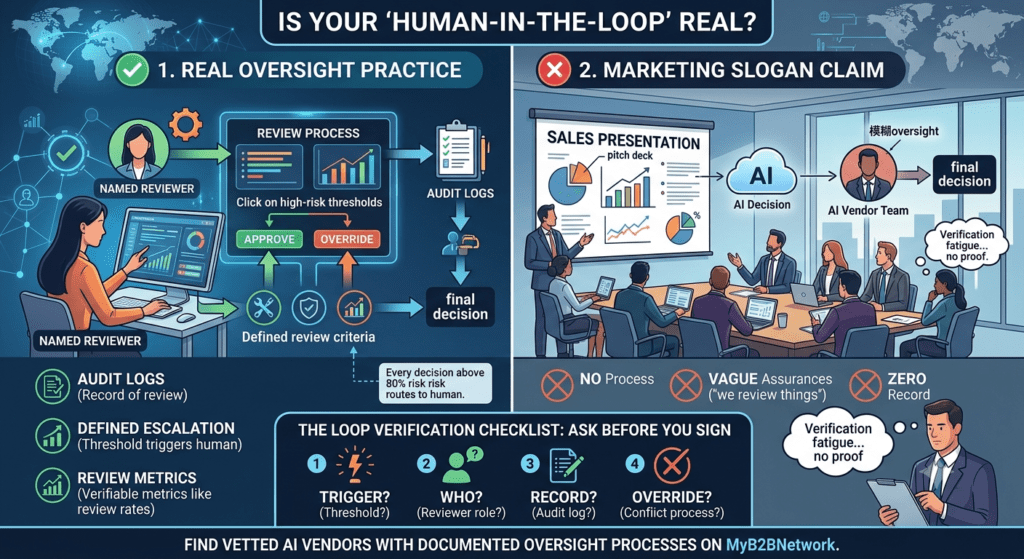
Human-in-the-loop is a defined process. A person reviews, approves, or can override an AI system’s output at specific checkpoints, before that output becomes a final decision or action. The key word is “defined.” A vague promise that “someone checks it sometimes” isn’t human-in-the-loop. It’s a marketing claim wearing the same clothes.
Real human-in-the-loop design includes a few consistent features. There’s a named checkpoint in the workflow where review happens. There’s a record of what was reviewed and by whom. And there’s a clear path for what happens when a human disagrees with the AI’s output. Remove any one of those, and you’re left with a phrase, not a practice.
Why Human-in-the-Loop Matters for Businesses
It matters because “human oversight” is quickly becoming a compliance requirement, not just a nice-to-have feature. Regulators are starting to ask for evidence of it, and “we have human-in-the-loop” without documentation won’t hold up under scrutiny.
A few reasons this is now a real business risk, not just a buzzword debate:
- Audit exposure. If a regulator or customer asks for proof of human review and none exists, the company is left explaining a gap it didn’t know it had.
- Vendor risk transfer. Buying an AI tool with unverified oversight claims means inheriting that vendor’s process gaps as your own operational risk.
- Trust erosion with customers. Once one AI-safety claim gets exposed as hollow, buyers start doubting every other claim on the same vendor’s site, warranted or not.
Real Oversight vs. Marketing Language: The Reality Check
Direct answer: the difference comes down to specifics. Real practice points to a specific checkpoint, a specific reviewer, and a specific record — not just a general assurance.
Marketing language tends to sound like this: “Our AI is designed with human oversight built in.” It’s true in the loosest possible sense and verifiable in none. Real practice sounds narrower and more specific: “Every output above a defined risk threshold routes to a named reviewer.” That reviewer has 24 hours to approve or override it, and the decision gets logged.
The second version can be audited. The first version can only be repeated. That’s the whole test, in practice.
Where Trust Fatigue Comes From
Direct answer: trust fatigue comes from a flood of AI-safety claims buyers can’t verify. It’s made worse by a track record of some of those claims turning out to be exaggerated once tested.
Edelman’s trust research has tracked declining confidence in institutions making unverified claims for years, and AI marketing is following the same pattern now. Forrester’s AI trust research points to a similar dynamic: buyers increasingly discount vendor claims about responsible AI unless there’s third-party or documented evidence behind them.
What’s driving the skepticism, specifically:
- Vendors reusing the same “human-in-the-loop” language regardless of whether any actual review process exists
- High-profile AI failures where a company claimed human oversight was in place, and it turned out review had been skipped or automated away
- No industry-standard way for buyers to verify oversight claims independently, which leaves the vendor’s word as the only evidence available
Tools and Practices That Prove the Loop Is Real
Direct answer: real human-in-the-loop practice leaves a paper trail — audit logs, defined escalation paths, and review metrics a vendor can actually produce on request.
Practices and tools that separate real oversight from a slogan:
- Audit logging systems that timestamp every review decision, who made it, and what the AI’s original output was before the override
- Escalation thresholds that automatically route higher-risk decisions to a human reviewer, rather than leaving review optional or informal
- Review-rate reporting, where a vendor can tell you what percentage of outputs actually get reviewed, not just claim that review “happens”
- Frameworks like NIST’s AI Risk Management Framework, which explicitly calls for documented human oversight mechanisms as part of responsible AI governance
If a vendor can’t produce any of this on request, the “human-in-the-loop” claim is likely aspirational, not operational.
The 4-Question Loop Verification Checklist
Before trusting any vendor’s human-in-the-loop claim, ask these four questions directly. A vendor with a real process will answer all four without hesitation.
- What specific checkpoint in the workflow triggers human review, and what threshold determines it?
- Who is the named reviewer or role, and what’s their average response time before a decision goes live?
- Is there an audit log showing what was reviewed, by whom, and what the outcome was?
- What happens when a human disagrees with the AI’s output — is there a documented override path, or does the AI’s decision stand regardless?
A vendor who answers all four clearly has a real process, A vendor who answers with generalities, or gets defensive about the questions, is likely selling a slogan.
FAQ
What is human-in-the-loop, and why does it matter for B2B businesses?
It’s a defined process where a person reviews or overrides AI decisions at specific checkpoints, with a record of that review. It matters because regulators and customers increasingly expect proof of oversight, not just a claim of it, and unverified claims create real audit and trust risk.
How do I choose the right vendor for human-in-the-loop practices within my budget?
Prioritize vendors who can show you actual audit logs and review-rate data over vendors who only describe their process in general terms. Match the depth of verification you require to how regulated your industry is, since a low-risk use case needs less scrutiny than a healthcare or financial one.
What checks should I do before outsourcing to a vendor claiming human oversight?
Ask the four verification questions above before signing anything, and request a sample audit log if the vendor claims to keep one. Confirm the escalation and override process in writing, not just in a sales conversation.
How long does vendor verification for this typically take, and what does it cost?
A focused vendor review, covering documentation, audit log samples, and reference checks, usually takes two to four weeks. It’s normally folded into procurement’s existing due diligence process rather than priced as a separate cost.
Want Help Vetting an AI Vendor’s Oversight Claims?
Verifying human-in-the-loop claims takes time procurement and compliance teams don’t always have. MyB2BNetwork connects compliance officers, CMOs, and procurement teams with vetted AI vendors whose oversight processes hold up under scrutiny. Find vetted AI vendors on MyB2BNetwork.
Hiring or Outsourcing AI Vendor Vetting in the U.S.
Two things matter most when a U.S. company needs outside help verifying AI vendor oversight claims: due diligence depth, and matching the review to your industry’s compliance bar.
On due diligence, insist on documentation over description. A vendor should be able to produce sample audit logs, name the specific role responsible for review, and explain their escalation path without a scripted pitch. Red flags include vague answers to the four verification questions, no written escalation process, and reluctance to share review-rate data even under NDA.
On compliance, the standards that matter shift with your industry. Healthcare organizations, including hospital systems in Chicago, should confirm HIPAA-aligned review processes for any AI touching patient data. Financial and fintech firms in New York should look for SOC 2 attestation alongside documented oversight. NIST’s AI Risk Management Framework applies broadly across sectors. It’s a reasonable baseline to ask any vendor about, whether you’re a SaaS company in Austin or a logistics operation in Atlanta evaluating AI tools for the first time. MyB2BNetwork can help source accurate, vetted quotations for vendor vetting engagements if you need outside support running this process.