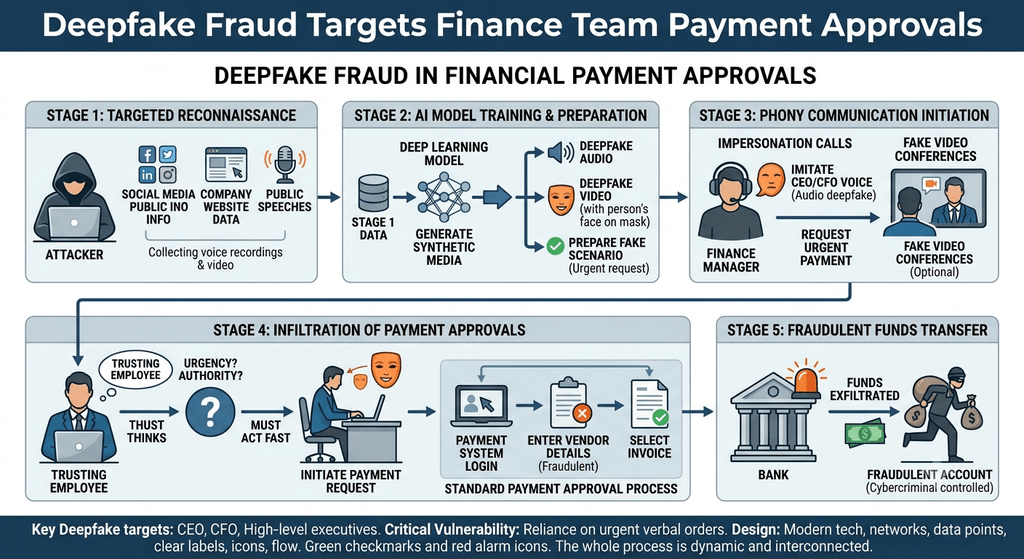
Deepfake fraud has moved from theoretical risk to documented, multimillion-dollar loss, and finance and procurement teams are the specific target. In early 2024, a finance employee at the engineering firm Arup joined a video call with people who looked and sounded exactly like the company’s CFO and several colleagues. And authorized 15 wire transfers totaling $25.6 million before anyone realized every other participant on that call was AI-generated. Every person on the call sounded, looked, and behaved like someone the employee already trusted.
That case isn’t an outlier anymore. A 2025 Gartner survey of 302 cybersecurity leaders worldwide found that 62% of organizations experienced a deepfake attack in the past 12 months. With 37% specifically encountering a deepfake during a live video call. Deepfake fraud is no longer a future threat finance teams should plan around eventually. It’s a current one that’s already shown up in board-level incident reports.
For CFOs, procurement leaders, and finance teams specifically, this matters because the entire function is built around exactly the kind of high-trust. Time-pressured approval that deepfake attacks are designed to exploit: an urgent request. A familiar voice or face, and a payment that needs to move now. Traditional fraud training — teaching people to spot a suspicious email or a spoofed domain. Doesn’t prepare anyone for a video call where the “CFO” they’re looking at isn’t real.
This piece explains how deepfake fraud actually works against finance and procurement teams. What the real data shows about how fast it’s growing. And a specific verification protocol you can put in place before your next high-value payment approval — not after the wire has already gone out.
What Is Deepfake Fraud?
Deepfake fraud is the use of AI-generated synthetic audio or video; a cloned voice or a fabricated face — to impersonate a real person. Typically an executive or trusted vendor contact, in order to manipulate someone into authorizing a payment, transfer, or sensitive action. It differs from traditional business email compromise by adding a real-time, seemingly verifiable layer: a voice on the phone or a face on a video call that appears to confirm the fraudulent email that came before it.
Modern voice-cloning tools require as little as three seconds of audio to produce a convincing match, according to McAfee’s research on the technology — meaning a single earnings call, conference talk, or public video is often enough source material for an attacker. That’s what makes deepfake fraud fundamentally different from older scams: it doesn’t just imitate someone’s writing style, it imitates their actual voice and face on demand.
Why Deepfake Fraud Matters for Finance and Procurement Teams
Deepfake fraud matters because finance and procurement functions are structurally built around the exact trust signals attackers now know how to fake. A request that arrives by email, gets “confirmed” by a familiar voice on a follow-up call. And carries real urgency is precisely the pattern that bypassed controls at Arup and in similar documented cases.
The financial exposure is already large and growing. The FBI’s Internet Crime Complaint Center reported close to $2.8 billion in business email compromise losses in 2024 alone across more than 21,000 complaints. And Deloitte’s Center for Financial Services projects that generative-AI-enabled fraud could push total U.S. fraud losses to $40 billion by 2027, up from $12.3 billion in 2023. Deepfake technology doesn’t create a new fraud category from scratch. It makes the existing, already-costly category of executive impersonation fraud dramatically more convincing.
How Are Attackers Actually Targeting Finance and Procurement Teams?
Attackers are combining a fraudulent email or message with a deepfake voice or video “confirmation” call. Specifically because that combination defeats the verification instinct finance teams have been trained to use. The email raises the request; the deepfake call is what makes the employee stop second-guessing it.
The most commonly documented attack patterns include:
- Urgent wire transfer impersonation: A deepfaked CFO or CEO voice or video calls or joins a meeting to authorize an unusual. Time-pressured transfer — the pattern behind the Arup case and multiple smaller, less publicized incidents.
- Vendor bank-detail change fraud: A deepfaked voice from a “known vendor contact” calls procurement to confirm a change in banking details. Redirecting a legitimate, expected payment to a fraudulent account.
- Multi-participant meeting spoofing: As in the Arup incident, attackers deepfake several participants on a single video call simultaneously. So the target sees what looks like a normal internal meeting rather than a one-on-one impersonation attempt.
- Voice-confirmation follow-up to phishing email: An AI-written phishing email sets up a wire request. Then a follow-up call using a cloned executive voice “confirms” it . A cross-channel pattern the FBI has specifically flagged as an emerging tactic.
Which Warning Signs and Detection Tools Actually Help?
Human judgment alone is no longer a reliable line of defense. Which is exactly why a written verification protocol matters more than instinct. Research on deepfake detection consistently shows that people are poor at spotting high-quality synthetic video and audio in real time. Since these attacks are designed to defeat exactly the visual and auditory cues employees have always used to confirm identity.
Purpose-built detection tools — platforms like Reality Defender, Pindrop, and GetReal Labs. Can flag synthetic audio or video signals in real time and are increasingly used by finance and security teams handling high volumes of calls. But detection technology should be treated as one layer. Not the whole defense: independent research cited by the World Economic Forum found that commercial deepfake detection systems lose roughly half their accuracy moving from lab conditions to real-world deployment. The reliable fix is procedural, not just technical.
Gartner’s own guidance reflects this. VP Analyst Akif Khan has recommended that finance teams require authorization at the application level rather than relying on a phone call alone. Meaning a payment can be requested verbally. But it still has to be logged into the finance system and approved there. Ideally behind phishing-resistant multi-factor authentication, before it’s released.
What Should a Verification Protocol for High-Value Payments Include?
The CHECK Protocol:
- C — Callback on a known number. Never confirm a payment request using a phone number or link provided in the same message or call requesting it. Call back using a number already on file, pulled from your own system, not one supplied by the requester.
- H — Hold when urgency is used as pressure. Treat “this needs to happen right now” as a signal to slow down, not speed up. Deepfake fraud relies on urgency to short-circuit normal review.
- E — Enforce dual approval on high-value transfers. No single employee, regardless of who appears to be requesting it. Should be able to authorize a payment above a defined threshold alone.
- C — Confirm with a pre-agreed code phrase. For genuinely urgent, out-of-cycle requests from executives, a private. Periodically rotated verification phrase — known internally, never shared over email — adds a check a deepfake cannot replicate.
- K — Keep a logged record independent of the request channel. Require that every high-value approval be entered and confirmed inside your finance or ERP system. Not approved verbally and executed from memory.
| Verification Method | Reliability Against Deepfake Fraud | Best Use Case |
|---|---|---|
| Visual/voice recognition on the same call | Low — this is the exact channel deepfakes are built to defeat | Should never be the sole check for high-value payments |
| Callback to a number on file | High — attacker cannot control a channel they don’t initiate | Standard step for any transfer or bank-detail change request |
| Code phrase + dual approval + system log | Highest — combines an unspoofable secret with independent sign-off | Required for all high-value or unusual urgent transfers |
FAQ
What is deepfake fraud and why does it matter for B2B finance and procurement teams?
Deepfake fraud uses AI-generated voice or video to impersonate a trusted executive or vendor contact and manipulate someone into authorizing a payment. It matters because finance and procurement approvals are built on exactly the trust signals. A familiar voice, a familiar face, urgency — that this technology is now capable of faking convincingly.
How do I choose the right fraud-prevention or verification vendor within my budget?
Start by defining scope: real-time call/video deepfake detection, employee training and simulation. Or a broader fraud-monitoring platform each carry different pricing and different implementation effort. Weigh a vendor’s real-world detection accuracy, not just lab-tested claims, since independent research shows a meaningful gap between the two.
What checks should I do before outsourcing deepfake or fraud-prevention monitoring?
Ask for documented detection accuracy in production environments, not marketing claims. And confirm how the vendor’s tool integrates with your existing finance and approval systems. Verify their data handling meets recognized security standards, since a fraud-prevention vendor will itself be processing sensitive call and payment data.
How long does implementing a deepfake verification protocol typically take, and what does it cost?
Rolling out a callback-and-dual-approval protocol like the CHECK framework internally can happen in 1–2 weeks, since it’s largely a policy and training change rather than a technical build. Adding dedicated detection software on top typically involves a 4–8 week evaluation and integration period, with costs ranging from a few hundred dollars monthly for smaller teams to the mid-five-figures annually for enterprise-scale call monitoring.
Build a Deepfake-Resistant Finance Function With MyB2BNetwork
Reading about the CHECK protocol is the easy part — implementing it consistently across a finance and procurement team, and layering in the right detection tools, takes real vendor and process expertise. MyB2BNetwork connects finance and procurement leaders with vetted fraud-prevention and security partners who can help build and audit a real verification protocol, not just sell a detection tool and walk away.
Explore our vetted security and fraud-prevention partners to compare vendors, or read our related guide on protecting your IP when outsourcing for a broader look at contractual and technical safeguards worth building into any vendor relationship.
How to Hire, Source, or Outsource Deepfake Fraud Prevention in the U.S.
Deepfake fraud risk touches every sector handling significant wire volume — fintech firms in New York, manufacturing companies in Ohio managing large supplier payments, and logistics firms in Atlanta coordinating vendor transfers across multiple accounts are all realistic targets. Two things matter most before you bring in outside help.
How to choose a vendor within budget. Filter first by whether you need training and process design (cheaper, faster to deploy) versus real-time detection software (more expensive, longer integration). Basic fraud-awareness training and protocol design engagements often run in the low-to-mid four figures, while enterprise detection platforms with call and video monitoring commonly reach the mid-five-figures annually — and MyB2BNetwork can help you get accurate, comparable quotes across vendors before committing to either tier.
Checks needed before outsourcing. Confirm any fraud-prevention vendor’s security practices align with recognized standards — SOC 2 and ISO 27001 are reasonable baselines for a vendor handling call and payment data, and NIST’s Cybersecurity Framework is a useful reference point for evaluating their overall approach. If your organization handles consumer financial data, make sure the vendor’s practices also account for relevant FTC rules and, for California-based customers, CCPA requirements. Get response times, false-positive rates, and data-handling terms written into the contract, and budget 4–8 weeks for a proper pilot before rolling any tool out company-wide.