A project manager approves a design at 5 p.m. in Chicago. The outsourced dev team in Manila doesn’t see it until their workday is nearly over. By the time they respond, the PM is asleep. Three days pass before a two-minute decision actually gets made. This is the quiet failure mode behind most struggling outsourcing relationships. It’s rarely the vendor’s skill. It’s the handoff gap between two teams who are never awake at the same time, with no structure to bridge it. Time zone management for outsourced teams isn’t a soft scheduling detail. It’s an operational discipline, and teams that treat it that way avoid the delays that quietly erode trust in an outsourcing partnership.
This piece covers what disciplined time zone management actually looks like, why it matters more than most contracts acknowledge, the async structures that close handoff gaps, and a sample daily handoff template you can adapt this week.
What Is Time Zone Management for Outsourced Teams?
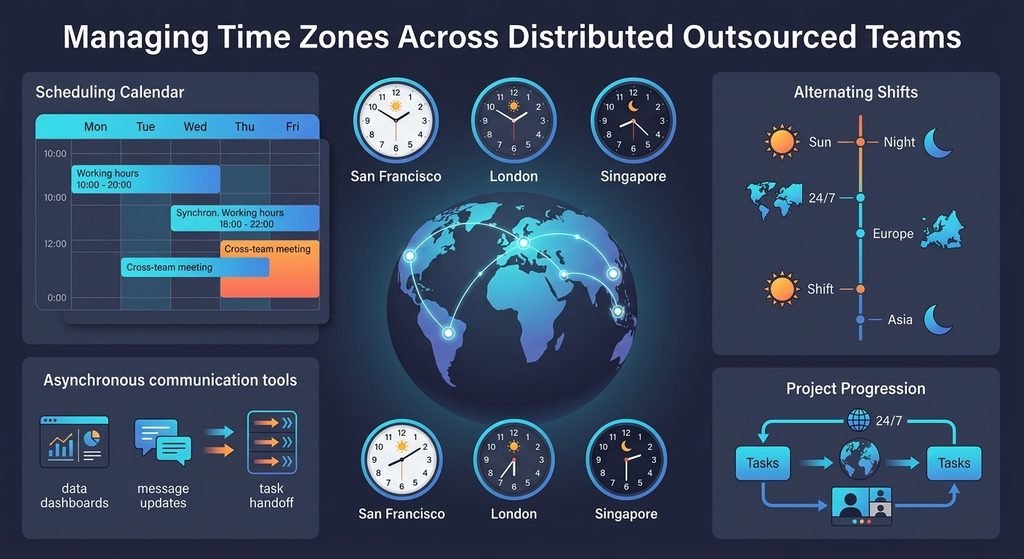
Time zone management for outsourced teams is the deliberate design of overlap hours, handoff documentation, and async workflows so work keeps moving when teams aren’t online together. It’s a system, not a courtesy meeting scheduled around someone’s lunch break.
Done well, it treats the time gap as a resource. Work handed off cleanly at the end of one team’s day can be picked up and progressed while the other team sleeps, effectively extending the workday across the full 24-hour clock.
Why Time Zone Management Matters for Businesses
Direct answer: poor time zone planning is one of the most common reasons outsourcing relationships break down, according to project management research from PMI on distributed team performance. It shows up as slipped deadlines, not as a single dramatic failure.
A few reasons it matters commercially:
- Delay compounds. A single day lost to a missed handoff often becomes three or four days lost once dependent tasks queue up behind it.
- Trust erodes quietly. Clients rarely blame time zones directly. They blame the vendor for being “slow,” even when the real cause is a structural gap.
- The 24-hour advantage disappears. The main promise of distributed delivery — work continuing around the clock — only holds if handoffs are designed for it.
The Core Problem: Overlap Hours and Handoff Gaps
Direct answer: most outsourcing relationships fail here because they rely on a small overlap window for real-time decisions, then leave the rest of the day undocumented and unstructured. The overlap hours get overloaded, and everything outside them stalls.
Two failure patterns show up again and again:
- The overloaded overlap. Teams cram status updates, questions, and approvals into a one-hour window, so nothing gets fully resolved and issues roll over to the next day.
- The silent handoff. Work gets passed at end of day with no written context, so the receiving team spends the first hour of their day just figuring out what changed.
Both patterns are fixable with structure, not with more meetings.
Async Communication Structures That Actually Work
Direct answer: the teams that manage this well replace status meetings with written, timestamped handoffs and use overlap hours only for decisions that truly require real-time discussion. Everything else moves async, by design.
Structures worth adopting:
- A single source of truth per task. One thread, ticket, or doc per work item, updated at handoff, so no one has to reconstruct context from scattered messages.
- Recorded video updates for nuance. A two-minute Loom-style recording often communicates more accurately than a rushed written note, especially for design or UX feedback.
- Explicit “blocked” flags. A task marked blocked, with the specific question attached, lets the next team member act the moment they log on.
Tools commonly used to support this include Asana or Jira for task-level handoff notes, Slack or Microsoft Teams with scheduled-send features, and Loom for async video context.
A Sample Daily Handoff Template
Direct answer: a good handoff template answers three questions in under two minutes to read — what moved forward, what’s blocked, and what’s needed next. Here’s a simple version teams can adapt immediately:
End-of-day handoff — [Date] — [Team/Shift name]
- Completed today: List finished tasks with links, not just task names.
- In progress: Note current status and expected completion, in plain terms.
- Blocked or needs input: Name the specific blocker and who can unblock it.
- Priority for next shift: State the single most important task to start with.
- Flag for overlap window: List anything that genuinely needs real-time discussion, not just a written answer.
Teams that fill this out consistently report far fewer “what’s the status” messages, because the answer is already written down.
A Framework for Structuring Overlap: The Bridge Window Model
Rather than treating overlap hours as one undifferentiated block, it helps to split them by purpose. We’ll call this the Bridge Window Model, with three short segments instead of one long meeting:
- Sync check (10–15 minutes). A quick live touchpoint to confirm priorities and surface anything urgent, not a full status meeting.
- Decision window (remaining overlap time). Reserved specifically for approvals and questions that truly need real-time back-and-forth.
- Buffer gap (last 30 minutes of overlap). Time reserved for writing the handoff note itself, so it doesn’t get skipped at the end of a rushed day.
Teams using this model report that overlap hours feel calmer, because each segment has one clear job instead of trying to do everything at once.
FAQ
What is time zone management for outsourced teams and why does it matter for B2B businesses?
It’s the structured design of overlap hours and handoff documentation so distributed teams keep work moving across time zones. It matters because poor planning here, not vendor skill, is a leading cause of stalled outsourcing relationships.
How do I choose the right outsourcing vendor for time zone coverage within my budget?
Prioritize vendors who already document handoffs as standard practice, not ones who promise to adopt it after signing. Match the overlap-hour commitment to your team’s actual decision-making needs, since more overlap costs more but isn’t always necessary.
What checks should I do before outsourcing to a distributed team?
Ask for a sample handoff document from a past client engagement, not just a proposal. Confirm SLA terms specify response windows in hours, not just “same day,” since time zones make that phrase ambiguous.
How long does setting up a distributed outsourcing relationship typically take, and what does it cost?
Expect three to six weeks to establish working handoff processes and overlap rhythms with a new vendor. Costs vary widely by role and region, so get a specific quote rather than relying on published rate averages.
Want Help Structuring a Distributed Team Relationship?
Building reliable handoff processes takes more than good intentions. It takes a vendor who already runs this way. MyB2BNetwork connects ops leaders and project managers with vetted outsourcing partners experienced in distributed delivery, not just distributed staffing. Find vetted outsourcing partners on MyB2BNetwork.
Hiring or Outsourcing Distributed Teams in the U.S.
Two things matter most for U.S. companies outsourcing to distributed teams: budget fit by region and due diligence on handoff practices, not just technical skill.
On budget, offshore development or ops support typically runs $25–$55 per hour depending on region and specialization, while a fully staffed distributed pod with dedicated overlap hours can reach the mid-five-figures monthly for larger engagements. MyB2BNetwork can help source accurate, vetted quotations instead of relying on generic rate cards.
On due diligence, ask vendors directly how they document handoffs today, not how they plan to. For regulated work, confirm relevant compliance coverage, such as SOC 2 or ISO 27001 certification, especially for fintech teams in New York or healthcare-adjacent work out of Chicago. This same discipline applies to SaaS teams in Austin, manufacturing ops in Ohio, and logistics coordination out of Atlanta, where missed handoffs carry real operational cost.