AI copilots for sales reps have become close to a checkbox feature — nearly every CRM, dialer. And sales engagement platform now claims one, often with the same vague promise of “boosting productivity.” The usage data tells a messier story: some tasks show clear, repeatable time savings, and others quietly add more work than they remove.
Gartner’s 2026 survey of 210 chief sales officers and senior sales leaders found that AI tools save sellers close to 4.8 hours per week on average — a real, meaningful number. But the same survey found that 72% of sales organizations fail to reinvest that recovered time into higher-value selling activity. Meaning the hours saved don’t automatically translate into more revenue. The gap between “time saved” and “time well spent” is exactly where most of the confusion about AI copilots for sales reps comes from.
This piece separates the two categories with actual data: which specific tasks show proven, repeatable time savings, and which ones tend to shift effort around rather than remove it. For sales reps deciding what to actually adopt, and sales enablement teams deciding what to roll out. That distinction matters more than any vendor’s feature list.
What Are AI Copilots for Sales Reps?
AI copilots for sales reps are generative-AI assistants embedded directly into a seller’s existing tools — CRM, email, calling platform, or meeting software. That draft, summarize, or recommend actions based on the seller’s live data. Unlike a standalone chatbot, a copilot works inside the rep’s actual workflow: it reads a call transcript, drafts a follow-up email, or updates a CRM field without the rep switching tools.
Examples include Microsoft 365 Copilot for Sales, Salesforce’s Agentforce and Einstein Copilot. Gong’s AI features, HubSpot Breeze, and Salesloft’s AI assistant. Each integrates with CRM data differently, but the shared premise is the same: reduce the manual, repetitive parts of selling so reps spend more time in front of buyers.
Why AI Copilots Matter for B2B Sales Organizations
AI copilots matter because non-selling work has quietly become most of a sales rep’s job. Industry research cited by Salesforce places the share of a rep’s week spent on non-selling tasks. Data entry, research, internal admin — at roughly 60%, meaning the actual selling activity a quota depends on often gets a minority of the workday.
Gartner’s research adds urgency to closing that gap: the firm projects that by 2027, 95% of sellers’ research workflows will begin with AI, up from less than 20% in 2024. That’s a five-year shift compressed into three. Which means enablement teams that wait to evaluate AI copilots for sales reps are increasingly evaluating a default rather than an option.
Which Sales Tasks Do AI Copilots Actually Save Time On?
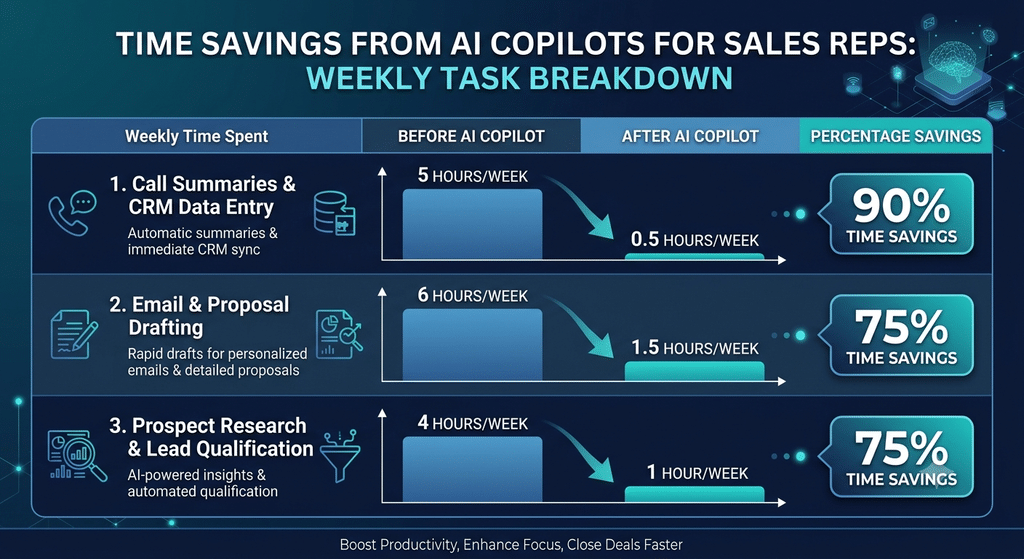
Three specific tasks show consistent, measurable time savings across independent research, rather than vendor-reported anecdotes. Each works because it replaces a task that was already mechanical — summarizing, logging, drafting — rather than trying to replace judgment.
| Task | Measured Time Savings | Source |
|---|---|---|
| Call/meeting summarization & CRM logging | Contributes to Gartner’s average of 4.8 hours saved per seller per week | Gartner, 2026 CSO & Sales Leader survey |
| Draft generation (follow-up emails, proposals, decks) | Microsoft sales users reported roughly 90 minutes saved per week using Copilot for Sales | Panto AI / Microsoft Copilot for Sales user survey, 2026 |
| Account & prospect research | Projected to be the entry point for 95% of sellers’ research workflows by 2027, up from under 20% in 2024 | Gartner, 2026 CSO & Sales Leader Conference |
- Call summarization and CRM logging. A copilot that listens to a call and auto-populates notes, next steps. And CRM fields removes one of the most universally disliked parts of a rep’s day. And it’s the single biggest contributor to the 4.8-hours-per-week figure Gartner reported.
- Draft generation for emails, proposals, and decks. Forrester’s commissioned Total Economic Impact study of Microsoft 365 Copilot for Sales found the largest quantified benefits came from drafting summaries and assembling proposal materials. Work that’s repetitive by nature and doesn’t require much judgment to produce a usable first draft.
- Account and prospect research. Pulling together firmographic data, recent news, and buying signals before a call used to take reps 20–30 minutes per account. Copilots that synthesize this automatically are why Gartner expects the vast majority of research workflows to start with AI within the next two years.
Where Do AI Copilots Add Busywork Instead of Saving Time?
AI copilots add busywork when they generate output a rep still has to fully verify, edit. Or re-explain — turning a task into two tasks instead of zero. Gong’s research on AI deployments found that 95% fall short of their expected impact. The distinguishing factor for the small percentage that succeed is that the AI is embedded as an action driver in the workflow. Not bolted on as an extra information source to check.
The clearest failure pattern shows up in dashboards and “insight” tools that surface dozens of AI-generated metrics without telling the rep what to actually do with them. A copilot that tells a rep “send this specific email to this specific account today” gets used. One that hands a rep 47 metrics to interpret usually doesn’t, according to the same research.
The reinvestment gap compounds this. Even when a copilot genuinely saves time — as the summarization and drafting use cases above do. Gartner found 72% of sales organizations don’t have a deliberate process for redirecting those saved hours into selling activity. So the time savings shows up in survey data but not in revenue.
The SAVE Framework: Getting Real ROI From AI Copilots for Sales Reps
To separate genuine time savings from busywork before rolling out a tool broadly. Run each proposed copilot use case through the SAVE framework:
- Scope — Is this a narrow, repetitive task (summarizing, drafting, logging) rather than one requiring judgment or relationship context?
- Automate — Does the copilot complete the task with minimal rep intervention. Or does it just generate a starting point the rep must substantially rework?
- Verify — Can a rep confirm the output is correct in under a minute. Or does checking it take nearly as long as doing the task manually?
- Elevate — Is there a defined plan for what the rep does with the time saved — more calls, more account research, more pipeline work. Or does the saved time simply disappear into other admin?
A copilot use case that clears all four criteria is a strong candidate for team-wide rollout. One that fails “Verify” or “Elevate” is exactly the kind of adoption that shows up as a Gartner statistic without showing up in pipeline.
FAQ
What are AI copilots for sales reps, and why do they matter for B2B businesses?
AI copilots for sales reps are generative-AI assistants built into CRM, email, and calling tools that draft content, summarize calls, and recommend next actions inside a seller’s existing workflow. They matter because non-selling admin work consumes roughly 60% of a typical rep’s week. And closing even part of that gap has a direct, measurable effect on selling capacity.
How do I choose the right AI copilot vendor within my budget?
Match the vendor to your existing CRM stack first — Microsoft Copilot for Sales for Dynamics 365 users. Salesforce’s Agentforce/Einstein for Salesforce-native teams, and platform-agnostic options like Gong or HubSpot Breeze otherwise. Since integration depth matters more than feature count. Prioritize vendors with published, independently verified time-savings data over ones citing only internal case studies.
What checks should I do before rolling out an AI copilot to my sales team?
Pilot the tool with a small group against the SAVE framework above before a full rollout. And specifically test how much editing the AI-generated output actually requires. Confirm the vendor’s data handling practices for call recordings and CRM data, since copilots typically process sensitive customer conversations.
How long does AI copilot implementation typically take, and what does it cost?
Most enablement teams need 4–8 weeks to pilot a copilot with a subset of reps and validate real adoption before a company-wide rollout. Licensing costs vary by platform and seat count, but per-seat pricing for enterprise sales copilots commonly runs from the low tens of dollars per user per month up to mid-five-figures annually for a full team deployment with integration support.
Roll Out AI Copilots for Sales Reps With MyB2BNetwork
Picking the right AI copilot is only half the work — implementation, CRM integration, and rep adoption are where most rollouts actually succeed or stall. MyB2BNetwork connects sales enablement teams and founders with vetted implementation partners who specialize in copilot rollouts across Microsoft, Salesforce, and other CRM ecosystems, and can get you accurate, comparable quotes before you commit to a platform.
Explore our sales enablement implementation partners to compare vendors on integration experience. Or read our related piece on vendor response time benchmarks if fast follow-up is one of the workflows you’re hoping AI copilots will help your team close faster.
How to Hire, Source, or Outsource AI Copilot Implementation in the U.S.
Sales teams rolling out AI copilots for sales reps span every major U.S. sales hub. SaaS companies in Austin standardizing on HubSpot Breeze, fintech firms in New York deploying Salesforce Agentforce. And B2B firms in San Francisco piloting Microsoft Copilot for Sales across Dynamics 365 environments. Two things matter most before committing budget.
How to choose an implementation partner within budget. Filter first by CRM specialization — a partner deeply experienced in Salesforce implementations isn’t automatically the right fit for a Microsoft Dynamics rollout, and vice versa. Implementation and change-management support typically runs from the low five figures for a single-team pilot to mid-five-figures annually for a full-scale. Multi-team deployment with ongoing optimization, and MyB2BNetwork can help you get accurate, comparable quotes across partners before choosing one.
Relevant standards to verify. Because AI copilots typically process call recordings and customer conversation data, confirm the vendor’s compliance posture against SOC 2 for data security, and CCPA or GDPR depending on where your customers are located, since call-recording consent rules vary meaningfully by state and country. If your industry is regulated — healthcare in Chicago or financial services in New York, for example — confirm the copilot vendor’s data handling aligns with HIPAA or relevant financial compliance requirements before any customer conversation data flows through the tool.