Fractional hiring has moved from a founder workaround to a structural part of how B2B companies build leadership teams. Instead of committing to a full-time salary and equity package for every senior function, more founders and HR/Ops leaders are filling specific roles — finance, marketing, HR, legal — with experienced specialists who work a set number of hours or days per month across multiple clients.
The shift is backed by real numbers, not just anecdote. The population of fractional executives in the U.S. roughly doubled between 2022 and 2024, growing from about 60,000 to 120,000 professionals. And Gartner has forecast that by 2027, more than 30% of midsize enterprises will retain at least one fractional executive. Separately, Upwork’s Freelance Forward research found 64 million Americans performed freelance work in the most recent year measured. 38% of the entire U.S. workforce — contributing an estimated $1.27 trillion to the economy.
For founders and HR/Ops leaders, that means fractional hiring isn’t a stopgap anymore; it’s a legitimate first option for filling a leadership gap. Especially at the stage where a company needs senior expertise but can’t yet justify — or fund — a full-time executive salary. The harder question isn’t whether to consider fractional hiring. It’s which roles actually make sense to fill this way, and which still need a full-time owner.
This piece walks through what fractional hiring actually means, why it’s accelerating now, which four roles are the best starting point. And how it compares to full-time and project-based freelance models. So you can make that call with real information instead of a hunch.
What Is Fractional Hiring?
Fractional hiring is the practice of engaging an experienced professional — usually at a senior or executive level. For a defined, part-time portion of their working time, rather than as a full-time employee. A fractional CFO might work two days a week across two or three client companies simultaneously. Bringing the same caliber of expertise a full-time hire would, scaled to the hours the business actually needs.
It differs from traditional freelancing in scope and seniority: freelancers are typically brought in for a discrete project or deliverable, while fractional hires are embedded, ongoing, and often sit in leadership meetings, own a budget, or manage a team, just on a part-time cadence.
Why Does Fractional Hiring Matter for B2B Businesses?
Fractional hiring matters because it closes the gap between “we can’t afford this expertise full-time” and “we’re operating without it.” For a Series A SaaS company or a growing services firm, a full-time CMO might cost $275,000 to $500,000 or more annually in salary and equity. While a fractional CMO providing the same strategic leadership typically runs $60,000 to $240,000 per year, according to industry compensation data.
It also matters for speed. Hiring a full-time executive typically takes months of search, interviews, and negotiation. A fractional hire, sourced through the right network, can often start within weeks. Which matters when a company needs financial leadership before a fundraise or marketing direction before a product launch, not six months later.
Which Roles Are Best Suited to Fractional Hiring Right Now?
The roles best suited to fractional hiring right now share a common trait: they require senior strategic judgment on a recurring basis, but not necessarily 40 hours of hands-on execution every week. Four functions consistently top that list for B2B companies.
- Fractional CFO. Financial strategy, fundraising support, and board-ready reporting are exactly the kind of judgment-heavy. Part-time-compatible work fractional hiring was built for — demand for interim CFO engagements rose 46% year-over-year according to Business Talent Group’s tracking of the category.
- Fractional CMO. Marketing strategy and positioning don’t require daily hands-on management the way a full internal marketing team does. Making this one of the most established fractional categories, alongside CFO and CTO roles.
- Fractional Head of HR / People Ops. Building comp structures, performance frameworks, and hiring processes is strategic work well-suited to a part-time senior lead. Especially for companies under 100 employees that don’t yet need a full-time VP of People.
- Fractional General Counsel. Contract review, compliance guidance, and risk management are recurring but rarely full-time needs at early stages. Making legal one of the clearest fits for fractional engagement.
How Does Fractional Hiring Compare to Full-Time and Freelance Models?
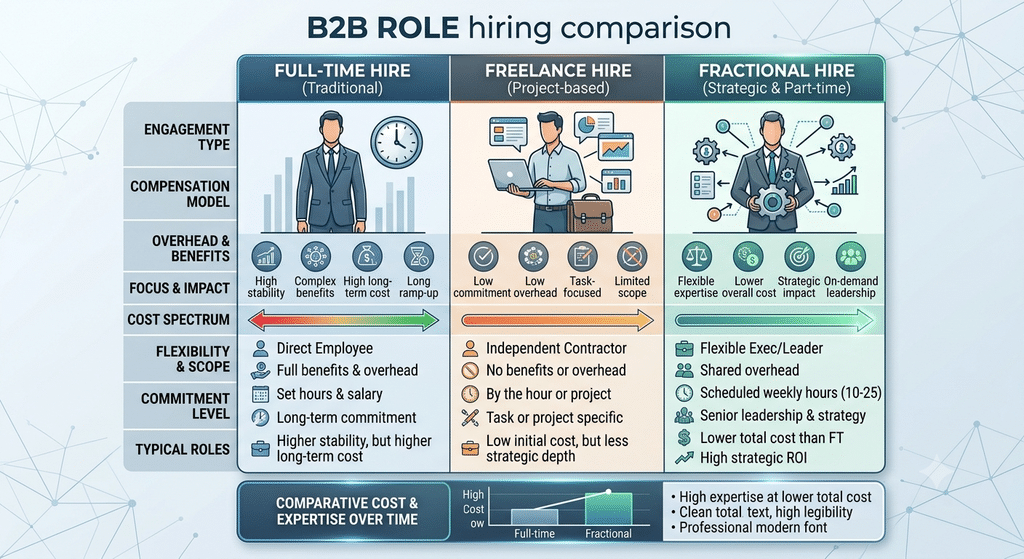
Fractional hiring sits deliberately between full-time employment and one-off freelance work. And the right choice depends on how ongoing and strategic the work is.
| Model | Typical Cost | Commitment Level | Best Suited For |
|---|---|---|---|
| Full-time executive hire | $200K–$500K+ annually (salary + equity) | 5 days/week, indefinite | Core functions needing daily hands-on leadership and full team ownership |
| Fractional executive | $60K–$240K annually (role-dependent) | 1–3 days/week, ongoing | Strategic leadership functions (CFO, CMO, HR, legal) without full-time volume |
| Project-based freelancer | Hourly or fixed project fee | Defined start/end date | Discrete deliverables — a website build, a single campaign, a one-time audit |
The distinction that matters most for founders is commitment and continuity. A freelancer solves a defined problem and moves on; a fractional executive stays embedded in strategy and decision-making over time, which is why fractional hiring, not project freelancing, is the right comparison for a leadership role.
Which Tools and Platforms Power Fractional Hiring Today?
Fractional hiring runs on a specific set of marketplaces and infrastructure tools that didn’t fully exist a decade ago. On the sourcing side, platforms like Toptal and MBO Partners specialize in vetting senior independent talent. While broader marketplaces like Upwork serve lower-commitment freelance and project work.
On the operational side, companies use tools like Deel and Remote to handle contractor payments and compliance across states or countries. Since a fractional hire is legally a contractor, not an employee, and needs to be paid and classified accordingly. Purpose-built fractional networks focused on specific functions — for finance, marketing, and legal roles specifically. Have also grown alongside general marketplaces, reflecting how specialized the category has become.
What Are the Risks of Fractional Hiring, and How Do You Manage Them?
The main risks are worker misclassification, divided attention, and knowledge continuity. All manageable with the right structure, but real enough to plan for upfront. Misclassifying a fractional hire as a contractor when their role functions like an employee’s can create real legal and tax exposure. So contracts need to clearly define scope, hours, and deliverables rather than open-ended availability.
Divided attention is a structural trade-off: a fractional CFO working across three clients is, by definition. Not available to yours full-time, which means urgent, same-day needs may occasionally wait. Managing this well means setting clear response-time expectations upfront and reserving fractional roles for functions where that trade-off is acceptable — strategy and oversight, not daily firefighting.
FAQ
What is fractional hiring and why does it matter for B2B businesses?
Fractional hiring means engaging a senior professional for a defined part-time commitment rather than a full-time role. Giving companies access to executive-level expertise without a full-time salary. It matters because it lets growing B2B companies fill strategic gaps — finance, marketing, HR, legal. Months earlier and at a fraction of the cost of a full-time hire.
How do I choose the right fractional hire within my budget?
Start by identifying whether the role needs strategic oversight (a good fit for fractional) or daily hands-on execution (better suited to a full-time or freelance hire). Compare candidates on relevant industry experience and client references at least as heavily as rate. Since a lower-cost fractional hire with no comparable experience often costs more in redone work.
What checks should I do before engaging a fractional executive?
Ask for references from current or recent clients in a similar stage or industry, and clarify upfront how many hours per week or month they’re actually committing. Confirm how they handle confidentiality and data access, and put scope, deliverables, and expected availability in writing rather than relying on a verbal understanding.
How long does it typically take to bring on a fractional hire, and what does it cost?
Sourcing and onboarding a fractional executive typically takes 2–4 weeks through a specialized network, faster than the 3–6 months a full-time executive search often requires. Costs vary by function and seniority, but commonly range from the low four figures per month for narrower scopes to the mid-five-figures annually for a broader fractional executive engagement.
Find Vetted Fractional Talent Through MyB2BNetwork
Knowing which roles to fill fractionally is only useful once you can actually find qualified people to fill them. MyB2BNetwork connects founders and HR/Ops leaders with vetted fractional CFOs, CMOs, HR leaders, and legal counsel — with real client references and transparent pricing, so you’re comparing candidates on substance rather than a resume alone.
Explore our vetted fractional talent network to compare candidates by function and budget, or read our related guide on protecting your IP when outsourcing if your fractional hire will touch sensitive code or company data.
How to Hire, Source, or Outsource Fractional Talent in the U.S.
Fractional hiring is especially common among SaaS startups in Austin needing a part-time CFO ahead of a raise, healthcare technology companies in Chicago filling a fractional compliance-savvy General Counsel role, and manufacturing firms in Ohio bringing in fractional HR leadership to professionalize people operations without a full department. Two things matter most before you engage anyone.
How to choose a vendor within budget. Filter first by how strategic versus hands-on the role is — the more strategic, the better the fit for fractional hiring — then compare candidates on relevant industry experience and verifiable client outcomes rather than rate alone. Typical fractional engagements run from the low four figures per month for narrower scopes (a few hours weekly) to the mid-five-figures annually for a broader executive commitment across finance, marketing, or HR; MyB2BNetwork can pull accurate, comparable quotes across vetted candidates so you’re not negotiating blind.
Checks needed before outsourcing. Verify references from recent clients, confirm data-handling practices if the role touches financial systems or customer data (SOC 2 awareness is a reasonable ask for any fractional CFO or CTO), and put clear contractor classification language in the agreement to stay aligned with U.S. Department of Labor guidance on employee versus independent contractor status. Budget 2–4 weeks to source and onboard a fractional hire, and treat the first 30 days as a mutual evaluation period before assuming the fit is permanent.