Chatbot vs form lead conversion is one of the most argued-about questions in B2B demand generation, and one of the least rigorously tested. Vendors publish dramatic multipliers, marketers repeat them, and almost nobody can point to a clean, controlled head-to-head test on their own traffic. So which converts better, a chatbot or a form?
The honest answer from the published evidence is: usually the chatbot captures more contacts, but the size of the gap varies from modest to enormous depending on how “conversion” is defined, who ran the test, and what was being sold. We searched for independent, controlled A/B results and found mostly vendor-reported ranges that disagree with each other by a factor of five or more.
That’s why this piece is built differently from a typical roundup. It lays out what the published figures claim, explains why they conflict, and gives you a test design with real sample-size math so you can produce your own number. A result measured on your traffic beats any benchmark, including every one cited here.
A note on method: we did not run a live experiment for this article, and we won’t present one as if we had. Every figure below is attributed to its source, and vendor claims are labeled as vendor claims.
What Is a Chatbot vs Form Lead Conversion A/B Test?
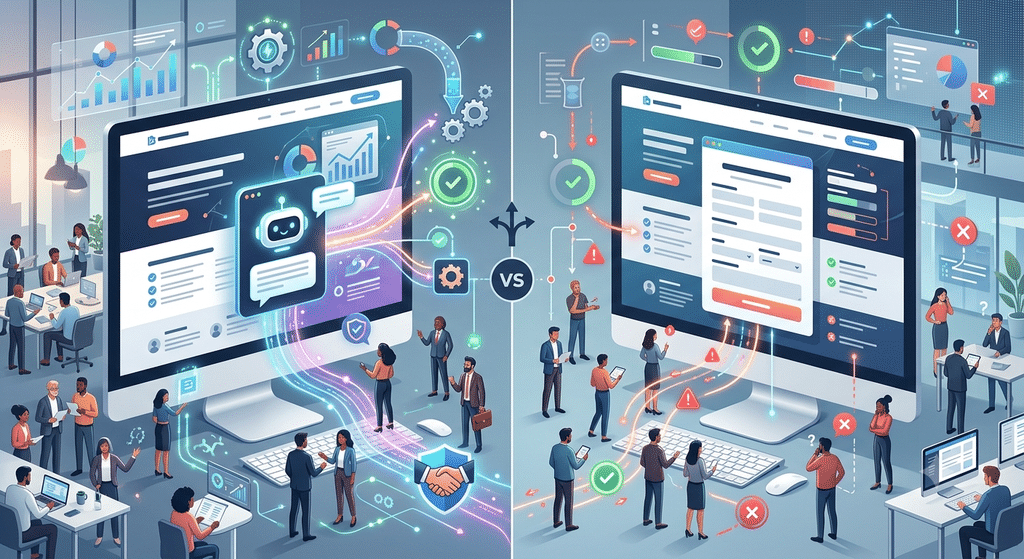
A chatbot vs form lead conversion A/B test splits comparable website traffic between two capture methods, a conversational chatbot and a standard form, and compares how many visitors in each group become leads. The goal is to isolate the capture method as the only meaningful difference between the groups.
“Lead” needs a definition before the test starts. A visitor who types an email into a chat window and a visitor who submits a six-field form are not equivalent, which is the root of most confusion in this debate.
Why Does Chatbot vs Form Lead Conversion Matter for B2B Teams?
It matters because capture method changes both the volume and the quality of what reaches sales. A change that raises submissions by 40% but fills the pipeline with unqualified contacts can cost more than it earns.
Speed is part of the case for chatbots. The widely cited MIT/InsideSales lead-response research found that contacting a lead within five minutes made it roughly 21 times more likely to be qualified than contacting them after 30 minutes. A chatbot can reply in seconds, while a form usually waits for a human. That’s an argument about response time, though, not proof that chat converts more visitors.
What Do Published Chatbot vs Form Conversion Numbers Say?
Published figures consistently favor chatbots, but they are almost all vendor-reported and they don’t agree on the size of the lift. Here is what four vendor sources claim:
| Source (type) | Form conversion | Chatbot conversion |
|---|---|---|
| BotNation (chatbot vendor) | 2%–5% | 15%–30% |
| NoForm.ai (chatbot vendor) | 1%–3% | 10%–15% |
| StudioMeyer (agency) | 1.7%–3.1% | 8%–15% |
| SurveySparrow (survey/chatbot vendor) | baseline | about 3x forms |
Treat these as marketing claims, not benchmarks. Every source sells chatbots or builds them, and none publishes a controlled test with sample sizes and confidence intervals. One of them says it plainly: a poorly built chatbot can underperform a basic form.
Why Do the Numbers Disagree So Much?
They disagree because each source measures something slightly different. Four differences explain most of the spread:
- Definition of conversion. Some count any chat started, others count only visitors who leave an email or phone number.
- Denominator. “Conversion” may be per visitor, per engaged visitor, or per chat opened, which inflates the percentage dramatically.
- Traffic mix. High-intent pages (pricing, demo) convert far better than blog traffic under either method.
- Lead quality. Raw capture rate says nothing about whether the contact becomes an opportunity.
If a vendor’s chatbot number is measured per chat opened and the form number is per page visitor, the comparison isn’t apples to apples.
How Do You Run a Chatbot vs Form Lead Conversion A/B Test?
Run it as a randomized split on one page type, with a pre-set sample size and a quality metric alongside capture rate. A workable protocol:
- Pick one page and one traffic source. A pricing or demo-request page keeps intent consistent.
- Define “lead” in writing. For example: a visitor who provides a valid work email.
- Randomize at the visitor level. Half see the form, half see the chatbot, with no overlap and no changing the split mid-test.
- Fix the sample size in advance. Don’t stop when the numbers look good.
- Run at least two full business cycles, typically two to four weeks, to cover weekday and weekend patterns.
- Track downstream quality. Measure sales-accepted leads and opportunities, not just submissions.
How much traffic do you need?
Less than most teams expect for a big lift, far more for a small one. Using a standard two-proportion test (95% confidence, 80% power), the required visitors per variant are:
- 3.0% → 6.0% (a 2x lift): about 750 visitors per group
- 3.0% → 4.5% (a 1.5x lift): about 2,500 per group
- 2.0% → 3.0%: about 3,800 per group
- 3.0% → 3.6% (a 20% lift): about 13,900 per group
If your page gets 1,000 visitors a month, you can detect a doubling in a few weeks but not a 20% improvement. Plan around the smallest lift that would change your decision.
What Should You Measure Beyond Conversion Rate? The CQC Scorecard
Measure capture, quality, and cost together. Here is a simple three-part model, the CQC Scorecard, for judging any capture method:
- Capture: visitors to leads, using your written definition.
- Qualify: leads accepted by sales as meeting your criteria.
- Close: opportunities and pipeline value per 1,000 visitors.
Compare the two arms on pipeline per 1,000 visitors, not on capture rate alone. A form that converts less but produces better-qualified leads can win on that measure, and a chatbot can win by qualifying in conversation. Only your data can tell you which.
FAQ
What is a chatbot vs form lead conversion A/B test, and why does it matter?
It’s a randomized comparison of conversational and form-based lead capture on similar traffic. It matters because published conversion multipliers are mostly vendor-reported and vary widely, so your own controlled result is the only reliable guide.
How do I choose the right chatbot or form vendor within my budget?
Ask any vendor for a controlled test with sample sizes, not a headline multiplier, and check what’s included, since conversation design, CRM integration, and analytics are sometimes billed separately. A hybrid, with a chatbot on high-intent pages and a form for low-stakes actions, is often the lowest-risk starting point.
What checks should I do before deploying a lead-capture chatbot?
Review how chat transcripts are stored and who can access them, confirm CRM handoff works, and test the flow on mobile. Make sure visitors can reach a human or a plain form if the bot fails.
How long does a chatbot vs form test take, and what does it cost?
Plan on two to four weeks of live traffic after one to three weeks of setup, longer on low-traffic sites. Costs range from low-cost self-serve chatbot tools to custom builds in the thousands of dollars per month, so get quotes before committing.
Test It on Your Own Traffic With MyB2BNetwork
If you want a clean test but lack the time to vet chatbot vendors or build the experiment, MyB2BNetwork connects B2B teams with vetted marketing and automation partners and can help you get comparable quotations before you commit.
Browse our vetted marketing partners to compare vendors, or read our study on vendor response time to see why the speed of your first reply shapes any capture method’s results.
How to Hire, Source, or Outsource Lead-Capture Testing in the U.S.
Conversion-testing support is common among SaaS startups in Austin, B2B firms in San Francisco, and fintech teams in New York.
How to choose a vendor within budget. Prioritize partners who define success as pipeline, not submissions, and who agree to a pre-registered test plan. Outsourced conversion optimization commonly runs from the low four figures to the low five figures per month depending on scope, and MyB2BNetwork can help you get accurate quotations for your situation.
Checks needed before outsourcing. Chat logs contain names, emails, and sometimes sensitive details, so confirm how the vendor handles that data. Under California’s CCPA, personal information collected through a chatbot can carry access and deletion rights, and SOC 2 or ISO 27001 reports are reasonable evidence of security controls. If you follow up by email, the federal CAN-SPAM Act still applies. Allow roughly 4–8 weeks to scope, build, and read a test.