An outsourcing pilot project is a short, paid trial, usually two to six weeks, in which a vendor completes a real slice of your work against written success criteria. It lets you see actual delivery quality, communication, and security practices before you commit to a six- or twelve-month contract.
Regret after signing is common. Gartner Digital Markets’ 2024 tech trends research found that 60% of software buyers regretted a recent purchase, and the top vendor-related causes were weak handoff between sales and implementation (43%) and mismanaged expectations (42%). That survey covers software buyers, not outsourcing specifically, but those are exactly the failure points a pilot tests.
A pilot doesn’t have to slow you down. It runs while the master contract is negotiated, and a good result converts directly into a signed statement of work.
This guide gives founders, operations managers, and procurement teams a four-gate model, a fill-in pilot brief template, and a go/no-go scorecard.
What Is an Outsourcing Pilot Project?
An outsourcing pilot project is a paid, time-boxed engagement, typically two to six weeks, where a vendor delivers a real, limited piece of your work under written success criteria. This guide uses a 30-day format because it fits one full cycle of onboarding, delivery, feedback, and decision.
It differs from a demo or free sample because it uses your real data, a real delivery team, and real deadlines. It differs from the first phase of a long contract because it carries no obligation to continue. Most importantly, it ends on a decision date agreed in advance.
Why Does a Paid Pilot Matter for Businesses?
A paid pilot matters because the costliest outsourcing mistakes surface after signing, when switching costs are highest. Deloitte’s 2024 Global Outsourcing Survey of more than 500 executives found that 70% had selectively brought previously outsourced work back in-house over the prior five years.
An older Deloitte survey of 300 outsourcing contract holders found that 35% of executives wished they had spent more time on vendor evaluation and selection [VERIFY year; the survey is believed to date from the mid-2000s]. Together, the findings suggest many buyers discover vendor problems too late.
One honest caveat: no public study isolates how much a pilot reduces regret. The case rests on logic. A pilot tests handoffs, expectations, and communication at a small fraction of full-contract cost.
Why Should an Outsourcing Pilot Project Be Paid?
A paid pilot gets you the vendor’s real delivery team instead of a sales-led demo, and it gives both sides a reason to treat the work seriously. As a planning heuristic (not a published benchmark), budget roughly 5% to 10% of the expected first-year contract value.
Paying also changes what you can ask for:
- Real team, real hours: the vendor staffs the pilot the way it would staff your account.
- Real access: you can test onboarding, tooling, and security controls, not just talk about them.
- Clear ownership: a signed pilot brief settles who owns the work product from day one.
- Fairness: a vendor paid for its time is more willing to be candid about risks.
How Long Should a Pilot Run, and Can It Avoid Delaying the Project?
Thirty days suits most pilots: about one week for setup, two weeks for delivery, and one week for review and decision. Simple tasks can run two weeks, while integrations or regulated data may need up to six.
A pilot need not delay the full project if you negotiate the master services agreement (MSA) in parallel. Agree upfront that a “go” decision converts into a signed statement of work within five business days. The trade-off is real: you start full-scale work up to a month later, but you avoid a long commitment to an unproven vendor.
Track the pilot in Jira or Asana, keep communication in a shared Slack channel, and score results in a shared Google Sheet.
Which Is Better: a Pilot, an RFP, or a Short Initial Contract?
For most service engagements, a paid 30-day pilot gives the most evidence per dollar because it tests real delivery rather than promises. Paper evaluations cost less but test claims, while a full contract with an exit clause tests delivery at full cost and notice periods.
| Approach | Typical cost | Risk exposure | Speed to start | What you learn |
|---|---|---|---|---|
| Paper evaluation (RFP, demo) | Low (internal time) | High: promises untested | Fast | Claims, references, pricing |
| Free trial or sample | Low | Medium: not the real team | Fast | Sample quality only |
| Paid 30-day pilot | Moderate (about 5% to 10% heuristic) | Low | Moderate: adds up to 30 days | Real delivery, communication, security fit |
| Full contract with exit clause | High | Medium to high: notice periods, switching costs | Fastest | Everything, at full cost |
How to Run a 30-Day Outsourcing Pilot Project: The 4-Gate Pilot Model
Run the pilot through four gates, each with a deadline, a question, and evidence: Brief and Security (before kickoff), Week-1 Fit Check (day 7), Midpoint Review (day 15), and Go/No-Go (day 30). The 4-Gate Pilot Model keeps the pilot short and the decision objective.
| Gate | When | Key question and evidence |
|---|---|---|
| 1. Brief and Security | Before kickoff | Is scope signed? Evidence: signed pilot brief, SOC 2 Type II report or ISO 27001 certificate reviewed |
| 2. Week-1 Fit Check | Day 7 | Is the right team working? Evidence: named staff, access set up, early response times |
| 3. Midpoint Review | Day 15 | Is delivery on track? Evidence: deliverables against plan in Jira or Asana, rework count |
| 4. Go/No-Go | Day 30 | Did it meet the criteria? Evidence: weighted scorecard and a signed decision |
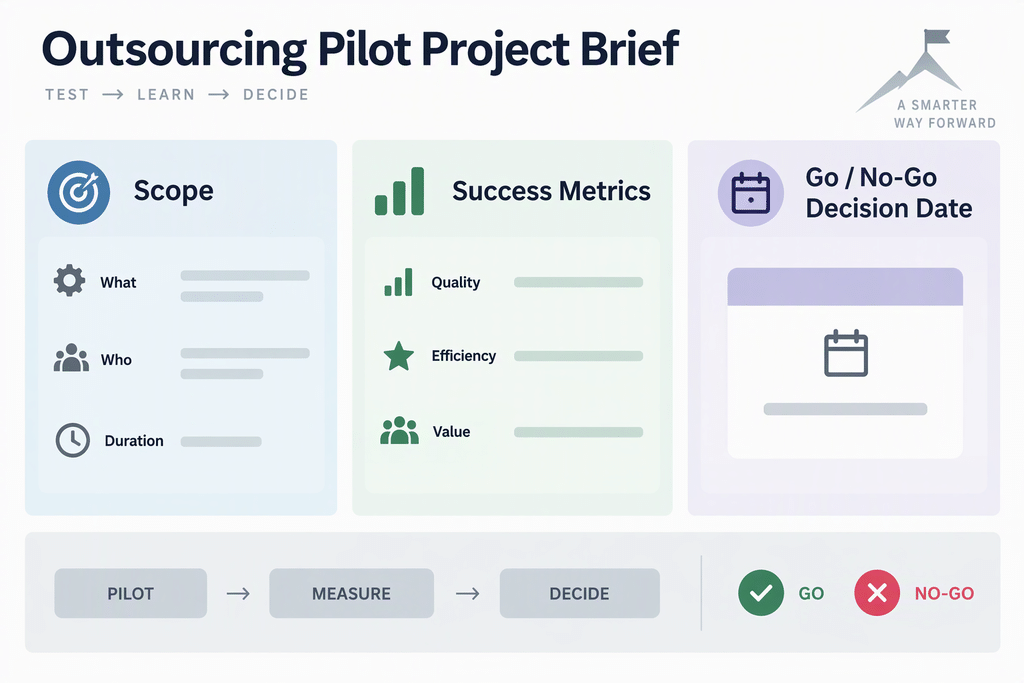
Pilot Brief Template (fill in before kickoff)
| Field | What to write | Example |
|---|---|---|
| Objective | One sentence on what the pilot must prove | Prove the vendor can resolve tier-1 support tickets at our quality bar |
| Scope (in/out) | What is included and excluded | In: email tickets, Product A. Out: billing disputes |
| Deliverables | Items with due dates | 400 tickets resolved by day 25; weekly report every Friday |
| Success metrics | 3 to 5 measurable thresholds | First response under 1 hour; CSAT 85% or higher; error rate under 3% |
| Team and access | Named staff, systems, least-privilege access | 2 agents and 1 lead; read-only helpdesk access |
| Security and IP | NDA, data handling, ownership | NDA signed; IP assigned on creation |
| Budget cap and payment | Fixed fee or hours cap, payment terms | Cap of $X; 50% at kickoff, 50% at day 30 |
| Check-ins and tools | Cadence, channel, tracker | Weekly 30-minute call; Slack channel; Jira board |
| Go/no-go date and owner | Date, decision-maker, rule | Day 30; COO decides; “Go” at 80/100 or higher |
| Exit terms | What happens either way | Work product delivered regardless; no obligation to continue |
The example figures are illustrative, so replace them with your own. Before sharing any data, review how you protect your IP when outsourcing, and test early responsiveness against a benchmark such as our vendor response time study.
Sample go/no-go scorecard (adjust to your priorities): quality 40 points, timeliness 20, communication 20, security and compliance 10, collaboration 10. Go at 80 or above with no critical security failures. Extend two weeks at 65 to 79. No-go below 65.
Red flags during a pilot:
- The vendor refuses a paid, scoped pilot or pushes a long contract first.
- Senior staff in the sales process disappear once the pilot starts.
- Security documentation is vague or delayed.
- Success metrics stay fuzzy after kickoff.
- Replies slow down once the vendor has your signature.
FAQ
What is an outsourcing pilot project and why does it matter for B2B businesses?
It is a paid, scoped trial, usually about 30 days, with written success criteria and a fixed decision date. It matters because it tests the vendor’s real delivery and communication before you commit to a long contract.
How do I choose the right vendor for an outsourcing pilot project within my budget?
Match pilot scope to a budget of roughly 5% to 10% of expected first-year value, then shortlist vendors who can show relevant references and a security attestation. Prefer vendors who agree to a written brief and a fixed decision date.
What checks should I do before starting a pilot?
Review portfolio work, speak with two or three comparable past clients, and ask for a SOC 2 Type II report or ISO 27001 certificate. Put IP ownership, data handling, and exit terms in the pilot brief.
How long does a pilot typically take and what does it cost?
Most run about 30 days, with simple tasks at two weeks and complex integrations up to six. Cost depends on scope and team mix, so confirm it against a quote; the U.S. section below gives illustrative tiers.
Test Your Next Vendor Through MyB2BNetwork
MyB2BNetwork helps you shortlist vendors and compare quotations side by side, so your pilot starts with the right candidates. Use the brief template above as the basis for your request, and ask each vendor to quote a scoped pilot as well as the full engagement.
Founders can use the pilot to protect cash, operations managers to test delivery under real conditions, and procurement teams to bring evidence, not promises, to the final contract. To start, browse the MyB2BNetwork outsourcing marketplace and request matched quotations.
How to Hire, Source, or Outsource With an Outsourcing Pilot Project in the U.S.
U.S. pilots usually fall into three illustrative tiers: a micro-pilot of about $2,000 to $5,000 (one deliverable, two weeks), a standard 30-day pilot of about $5,000 to $20,000, and a complex or regulated pilot of $20,000 to $50,000 or more. These are approximate planning ranges that vary with scope and hours, and MyB2BNetwork can provide accurate quotations for your project.
Before starting, check portfolios, speak with two or three comparable past clients, and ask for a SOC 2 Type II report or ISO 27001 certificate. Review SLAs, IP assignment, and termination terms, and treat refusal to share references or security documents as a red flag. NIST SP 800-161 is a useful reference for supplier risk, CCPA applies if you share California residents’ data, and healthcare teams in Chicago will need a HIPAA business associate agreement. SaaS startups in Austin and fintech firms in New York often add security questionnaires. For offshore vendors, also ask about GDPR or UK GDPR handling.
Allow one to two weeks to shortlist and sign the brief, 30 days for the pilot, and about a week to decide: roughly six to seven weeks to a signed contract.