A B2B buying committee is a cross-functional group of internal stakeholders—typically comprising 6 to 10 decision-makers—who jointly evaluate, approve, and purchase business software or outsourcing services. Instead of a single executive signing off on a contract, modern B2B purchases require consensus across technical, financial, legal, and operational leaders.
For CTOs, legal counsel, and startup founders, understanding how a B2B buying committee operates prevents late-stage deal stalls and misaligned vendor selections. When technical architecture, data compliance, and commercial terms are reviewed in silos, projects routinely stall weeks before signature.
Structuring this group early ensures that every stakeholder evaluates vendors against shared business outcomes rather than competing departmental priorities. Below is a practical breakdown of committee size, stakeholder roles, and a framework to keep your next vendor evaluation moving smoothly.
What Is a B2B Buying Committee?
A B2B buying committee is a formal or informal group of employees tasked with researching problems, comparing vendors, and authorizing high-value business purchases. According to Gartner research on B2B buying journeys, typical enterprise buying groups involve 6 to 10 decision-makers, each armed with four or five independent pieces of research.
Unlike consumer purchases driven by one individual, B2B vendor selection carries operational, financial, and security risks across multiple departments. A cloud migration or agency retainer affects engineering bandwidth, legal liability, and cash flow simultaneously. Consequently, organizations distribute purchasing authority to balance speed with risk mitigation.
Why Does a B2B Buying Committee Matter for Businesses?
A well-aligned B2B buying committee protects companies from buyer regret, redundant software spend, and compliance failures. Gartner notes that 77% of B2B buyers describe their latest purchase as very complex or difficult, largely due to conflicting internal requirements.
When stakeholders align early, organizations achieve three measurable outcomes:
- Faster contract velocity: Legal and InfoSec review compliance standards in parallel with technical demos rather than blocking deals at the finish line.
- Higher vendor adoption: End-users and department leads co-own the selection criteria, reducing post-purchase shelfware.
- Controlled budget variance: Finance validates total cost of ownership—including onboarding and integration fees—before pricing negotiations begin.
How Many People Are in a B2B Buying Committee?
Most mid-market and enterprise purchases involve 6 to 10 stakeholders, though complex global deployments can expand to 11 or more participants. For early-stage startups with fewer than 50 employees, the committee usually stays compact at 3 to 4 core leaders—typically the Founder, CTO, and external legal counsel.
The exact headcount depends on annual contract value (ACV) and data sensitivity:
- Tactical software or short-term contractors ($5,000–$25,000): 2 to 4 stakeholders (Department Lead, Founder/VP, Finance).
- Core operational platforms or agency retainers ($25,000–$100,000): 5 to 7 stakeholders (CTO, Legal, Procurement, Product Lead, Finance).
- Enterprise infrastructure or mission-critical outsourcing ($100,000+): 8 to 12+ stakeholders across IT, Legal, Compliance, Executive Sponsors, and End-Users.
Who Sits on a B2B Buying Committee? (The 4-Pillar Alignment Model)
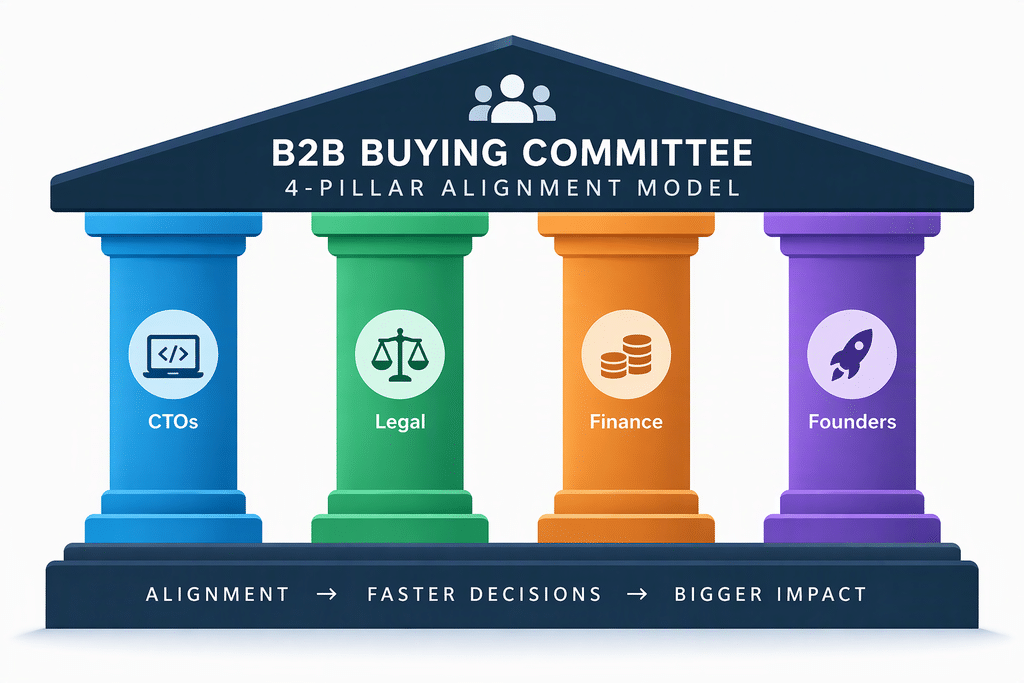
To prevent decision paralysis, organizations can structure their B2B buying committee using the 4-Pillar Alignment Model: Vision, Architecture, Governance, and Execution. Assigning each stakeholder to a specific pillar clarifies who holds veto power versus advisory input.
| Buying Pillar | Primary Stakeholder | Core Evaluation Focus | Key Verification Assets |
| 1. Vision & ROI | Founder / CEO / CFO | Strategic fit, payback period, and total contract value | Business case, ROI calculator, payment milestones |
| 2. Architecture | CTO / VP of Engineering | API compatibility, scalability, uptime SLAs, and tech debt | Sandbox access, technical documentation, SOC 2 reports |
| 3. Governance | General Counsel / Legal | IP ownership, indemnification, data privacy, and exit clauses | Master Services Agreement (MSA), DPA, liability caps |
| 4. Execution | Department Head / End-Users | Daily workflow usability, onboarding speed, and vendor support | Live pilot results, customer references, onboarding plan |
How Does a Buying Committee Compare to Single-Buyer Decisions?
A B2B buying committee trades initial speed for long-term risk reduction, whereas single-stakeholder purchasing prioritizes rapid deployment at the expense of cross-departmental governance. Understanding this trade-off helps founders decide when to formalize a group review.
| Evaluation Factor | Single-Buyer Purchase | Small Committee (3–5 People) | Enterprise Buying Committee (6–10+ People) |
| Typical Deal Size | Under $10,000 | $10,000 – $75,000 | $75,000 – $500,000+ |
| Average Decision Timeline | 1 to 2 weeks | 3 to 6 weeks | 2 to 6 months |
| Compliance & Legal Rigor | Minimal (click-through terms) | Moderate (standard NDA + MSA review) | High (custom MSA, InfoSec audit, NIST/ISO checks) |
| Primary Risk | Shadow IT, security gaps, hidden fees | Scope creep during onboarding | Consensus paralysis and delayed launch |
How to Run a B2B Buying Committee Evaluation
Running an efficient B2B buying committee requires a standardized intake brief that captures every department’s non-negotiables before speaking to vendors. Teams commonly coordinate these scorecards using tools like Asana, Jira, Notion, or Slack to keep feedback asynchronous and documented.
Use this fill-in Buying Committee Charter Template at the start of any vendor search:
| Charter Field | Committee Input / Target Standard | Responsible Owner |
| Business Problem & Scope | [Define exact deliverable or software gap to solve] | Founder / Department Head |
| Hard Budget Cap | [$X setup fee +$Y monthly/annual recurring ceiling] | CFO / Finance Lead |
| Technical Non-Negotiables | [Required integrations, uptime SLA %, SSO/SAML support] | CTO / Engineering Lead |
| Security & Compliance Baseline | [e.g., SOC 2 Type II, ISO 27001, GDPR/CCPA data residency] | Legal & InfoSec |
| Shortlist Scoring Deadline | [Date for narrowing 5 vendors down to 2 finalists] | Procurement / Project Lead |
| Final Go/No-Go Sign-Off Date | [Target contract execution date across all approvers] | Executive Sponsor |
For broader frameworks on structuring external partnerships, explore our B2B vendor evaluation guides, compare IT outsourcing strategies, and review our enterprise procurement checklists on the MyB2BNetwork blog.
Frequently Asked Questions (FAQ)
What is a B2B buying committee and why does it matter?
A B2B buying committee is a group of 6 to 10 cross-functional stakeholders—spanning leadership, tech, finance, and legal—who jointly approve business purchases. It matters because multi-stakeholder review prevents security vulnerabilities, unfavorable legal terms, and wasted software or agency spend.
How many people are typically in a B2B buying committee?
According to Gartner, an average enterprise B2B buying committee consists of 6 to 10 decision-makers. In startups and mid-sized firms, committees typically stay smaller at 3 to 5 core leaders, expanding only when contracts involve sensitive customer data or six-figure budgets.
What checks should a buying committee run before signing a vendor?
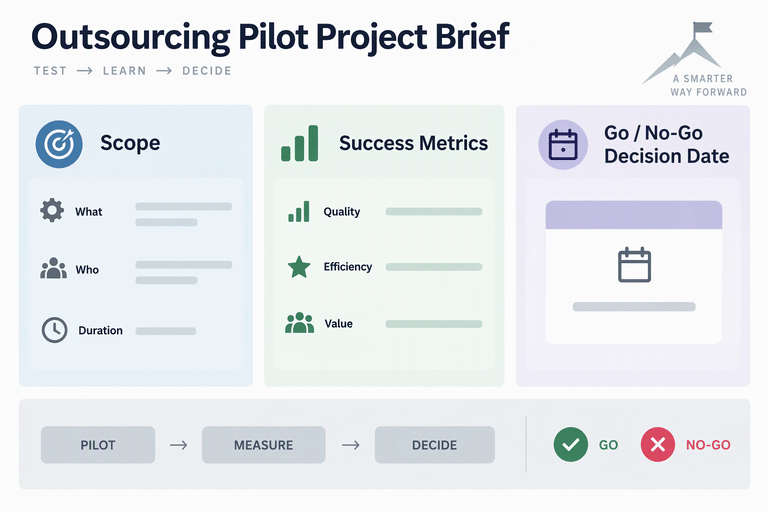
Committees should verify audited security certifications (such as SOC 2 or ISO 27001), intellectual property ownership clauses, termination rights, and verifiable client references. Running a scoped 30-day pilot also validates delivery quality before committing to annual lock-ins.
When should founders bring CTOs and legal counsel into vendor selection?
Founders should involve CTOs during initial technical scoping and bring legal counsel in once the vendor shortlist narrows to two finalists. Early inclusion prevents last-minute redlines over data privacy, liability caps, or incompatible APIs from derailing launch timelines.
Streamline Your Next Vendor Selection with MyB2BNetwork
Coordinating a B2B buying committee across endless agency pitches and unverified proposals drains valuable leadership hours. MyB2BNetwork simplifies B2B sourcing by connecting founders, CTOs, and procurement teams directly with pre-vetted service providers matched to your exact technical, budget, and compliance criteria.
Submit one structured requirement brief and receive tailored, comparable quotations from verified agencies—helping your entire committee reach a confident decision faster.
How to Hire and Source Vendors Through a Buying Committee in the U.S.
In the U.S., B2B vendor evaluations typically require $15,000 to $150,000+ in annual budget commitments depending on scope, with MyB2BNetwork able to source accurate, apples-to-apples quotations across vetted providers. Before signing, U.S. buying committees must verify SOC 2 Type II or ISO 27001 security attestations, NIST Cybersecurity Framework alignment, and statutory compliance—such as HIPAA for healthcare teams in Chicago, CCPA for consumer-facing SaaS firms in Austin, or FTC data-handling rules for fintech companies in New York.
Pre-engagement due diligence should include reviewing Master Services Agreements (MSAs) for IP assignment, checking Service Level Agreements (SLAs) for uptime guarantees, and auditing at least two reference clients in a similar industry. Watch for red flags like vague subcontractor disclosures or uncapped auto-renewal clauses. Realistic U.S. hiring timelines span 3 to 5 weeks for mid-market agency retainers and 8 to 14 weeks for enterprise software deployments requiring formal legal and InfoSec sign-off.