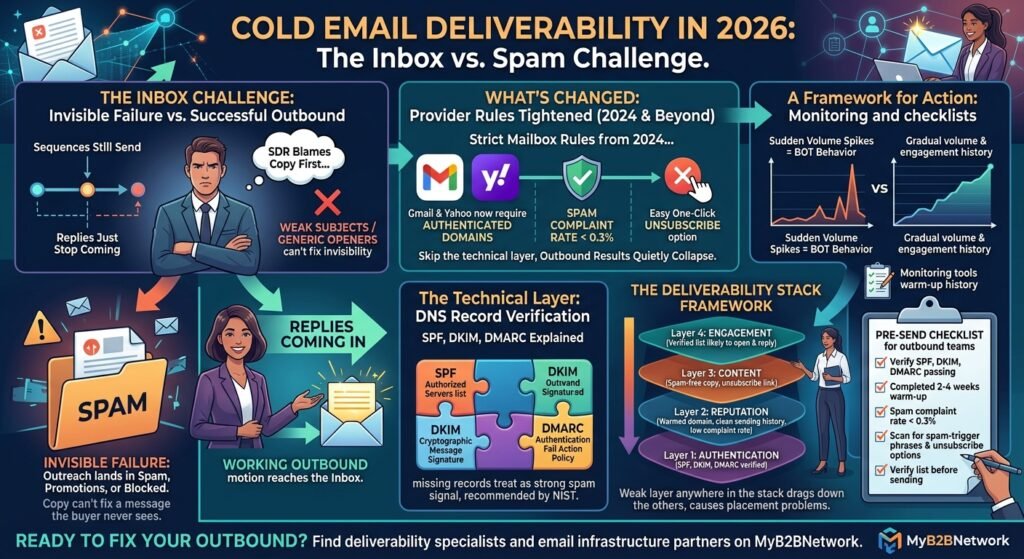
Cold email deliverability has become the difference between a working outbound motion and a quiet, invisible failure. Sequences still send. Replies just stop coming, because the messages never reach the inbox at all.
SDRs often blame copy first. Weak subject lines, generic openers, bad timing. But a growing share of outreach never gets read simply because it lands in spam, promotions, or gets blocked before delivery. Copy can’t fix a message the buyer never sees.
Mailbox providers tightened the rules significantly in 2024, and those standards have only gotten stricter since. Gmail and Yahoo now require authentication, low spam complaint rates, and clean sending patterns before a domain earns consistent inbox placement. Teams that skipped this technical layer are the ones seeing outbound results quietly collapse.
This guide breaks down what actually controls inbox placement today, separates myth from mechanism, and closes with a pre-send checklist SDRs and outbound teams can run before every campaign.
What Is Cold Email Deliverability?
Cold email deliverability is the measure of whether a sent message actually reaches a recipient’s primary inbox, rather than landing in spam, promotions, or getting rejected outright. It’s a technical outcome, not a copywriting one, though both play a role.
Deliverability sits upstream of every other outbound metric. A perfectly written email that lands in spam produces a zero percent reply rate regardless of how good the offer is. Fixing deliverability protects the return on every other investment a team makes in outreach.
Why Cold Email Deliverability Matters for B2B Businesses
It matters because outbound remains a core pipeline channel for most B2B sales teams, and a deliverability problem quietly breaks that channel without an obvious alarm. Reply rates drop, and teams often assume the message itself is the problem.
A few reasons this deserves direct attention, not guesswork:
- Damage compounds silently. A damaged sender reputation can take months to repair, unlike a bad subject line that’s fixed in minutes.
- Provider rules keep tightening. Gmail and Yahoo’s 2024 bulk sender requirements were a signal, not a one-time event, and further tightening is expected.
- Shared domains multiply risk. One careless sender on a shared domain can hurt deliverability for an entire sales team using the same infrastructure.
What’s Changed: 2024’s New Mailbox Provider Rules
Direct answer: Gmail and Yahoo now require authenticated domains, spam complaint rates under 0.3%, and an easy one-click unsubscribe option for any sender pushing meaningful email volume.
These requirements were rolled out to reduce spam volume across both platforms, and they apply to cold outreach the same way they apply to marketing newsletters. A sender without proper authentication now risks outright rejection, not just a spam-folder placement.
The practical effect for SDR teams has been significant. Sequences that worked reliably in 2022 can fail entirely in 2026 if the underlying domain setup was never updated to match current provider expectations.
The Technical Layer: SPF, DKIM, and DMARC Explained
Direct answer: SPF, DKIM, and DMARC are three DNS records that verify a sending domain is authorized and hasn’t been tampered with, and mailbox providers now treat missing records as a strong spam signal.
Each record does a distinct job. SPF (Sender Policy Framework) lists which mail servers are allowed to send on a domain’s behalf. DKIM (DomainKeys Identified Mail) attaches a cryptographic signature confirming a message wasn’t altered in transit. DMARC (Domain-based Message Authentication, Reporting, and Conformance) tells receiving servers what to do when SPF or DKIM checks fail.
NIST’s guidance on email security, published as part of its broader cybersecurity framework, recommends all three as baseline protections against spoofing and phishing, not just deliverability tools. Providers increasingly treat unauthenticated domains as more likely to be malicious, which pushes those messages straight to spam.
Content and Engagement Signals That Trigger Spam Filters
Direct answer: modern spam filters weigh recipient engagement and content patterns almost as heavily as technical authentication, so clean DNS records alone won’t guarantee inbox placement.
Signals that commonly hurt placement include:
- Low reply and open rates across a sending domain, which filters read as a sign recipients don’t want the mail
- Spammy content patterns, including excessive links, all-caps subject lines, or phrases commonly flagged by filters
- Sudden volume spikes from a new or recently warmed domain, which look like bot behavior to most providers
- High bounce rates from unverified or outdated contact lists, which damage sender reputation quickly
Providers now weigh how recipients treat a sender’s previous emails, not just the content of the current one. A domain with a history of low engagement will struggle even with well-written copy.
Tools for Monitoring and Warming Up Sender Reputation
Direct answer: deliverability management today requires dedicated tools for domain warm-up, inbox placement testing, and ongoing monitoring, not just a sequencing platform alone.
Commonly used tools include:
- Warm-up tools like Mailwarm or Instantly’s built-in warm-up feature, which gradually build sending volume and engagement history on a new domain
- Inbox placement testers like GlockApps or Mail-Tester, which show where a test message actually landed across major providers
- Authentication checkers that verify SPF, DKIM, and DMARC records are correctly configured before a campaign launches
- List verification tools that catch invalid or risky email addresses before they inflate bounce rates
Running these tools before, not after, a campaign launch is what separates teams with stable deliverability from teams chasing a mystery drop in replies.
A Framework and Checklist: The Deliverability Stack
Rather than treating deliverability as one setting to fix, it helps to think in layers. We’ll call this the Deliverability Stack, four layers that all need to hold up together:
- Authentication layer — SPF, DKIM, and DMARC correctly configured and verified
- Reputation layer — a warmed domain with a clean sending history and low complaint rate
- Content layer — copy free of spam-trigger patterns, with a working unsubscribe link
- Engagement layer — a verified, relevant recipient list likely to open and reply rather than ignore or report
A weak layer anywhere in the stack drags down the others, which is why teams that fix only the technical layer are often still surprised by continued placement problems.
A practical pre-send checklist based on this framework:
- Confirm SPF, DKIM, and DMARC are all correctly published and passing
- Verify the sending domain has completed at least two to four weeks of warm-up
- Run a spam complaint rate check and keep it under 0.3%
- Scan copy for excessive links, spam-trigger phrases, and missing unsubscribe options
- Verify the recipient list against a list-cleaning tool before the send
FAQ
What is cold email deliverability and why does it matter for B2B businesses?
It’s whether a sent message actually reaches a recipient’s primary inbox rather than spam or a rejection. It matters because a deliverability problem quietly breaks outbound results without an obvious warning sign.
How do I choose the right vendor for deliverability support within my budget?
Prioritize vendors who can show real inbox placement testing results, not just claims about improved reply rates. Match the engagement to your gap, whether that’s domain setup, ongoing monitoring, or full outbound infrastructure management.
What checks should I do before outsourcing deliverability management?
Ask for documented case studies showing before-and-after placement rates, and confirm how the vendor handles authentication setup across multiple sending domains. Review contract terms on who owns the domains and data if the engagement ends.
How long does deliverability outsourcing typically take, and what does it cost?
Initial authentication setup and domain warm-up usually take two to six weeks before consistent inbox placement stabilizes. Ongoing monitoring and infrastructure management is often priced as a monthly retainer given the continuous nature of the work.
Want Deliverability Handled by Specialists?
Fixing the Deliverability Stack takes technical setup most SDR teams don’t have time for between calls and sequences. MyB2BNetwork connects outbound sales teams with vetted deliverability and email infrastructure specialists who handle authentication, warm-up, and ongoing monitoring. Find deliverability and outbound infrastructure partners on MyB2BNetwork.
Hiring or Outsourcing Deliverability Management in the U.S.
Two things matter most when a U.S. company brings in outside help for email deliverability: budget fit and due diligence on domain security practices.
On budget, a domain setup and authentication project typically runs $1,500–$4,000 as a one-time engagement, while ongoing deliverability monitoring and infrastructure management is often priced at $1,000–$3,500 per month depending on sending volume. MyB2BNetwork can help source accurate, vetted quotations rather than relying on a single vendor’s rate card.
On due diligence, confirm the vendor follows recognized security practices such as NIST’s authentication guidance and ask directly how they isolate client domains to prevent one client’s reputation issue from affecting another. This applies whether you’re a SaaS company sending from Austin, a fintech team in New York, or a healthcare business in Chicago managing CCPA and HIPAA-adjacent data handling requirements alongside standard email compliance.