Content agency lead generation has a referral problem: referrals are the best source of new clients most agencies have, and also the one they cannot schedule, scale, or forecast. If your pipeline depends on a happy client mentioning you at the right moment, a quiet quarter is out of your hands. This post turns published agency-survey data into a repeatable system for earning qualified leads from CTOs, in-house legal teams, and founders without chasing introductions.
A note on “original research”: we did not run a new survey for this piece. We synthesized three published datasets, then added an original framework and a method you can use to produce your own numbers. The datasets are SparkToro and Paddy Moogan’s survey of agency owners (612 respondents in the 2024 edition), Hinge Marketing’s 2026 High Growth Study, and a Databox survey of 87 agency operators as summarized by Enrich Labs.
The headline is more useful than “referrals are bad.” Hinge reports that referrals and direct human outreach together account for nearly two-thirds of new business at professional services firms. The flaw is not the relationship-led model. The flaw is waiting for it to happen on its own.
Below: a definition, why referral dependence is risky, which channels have evidence behind them, a named model for building the system, and a short audit to measure where your own clients really come from.
What Is Content Agency Lead Generation?
Content agency lead generation is the set of repeatable activities an agency uses to attract, identify, and qualify prospective clients who need content services, such as thought leadership, technical documentation, SEO content, and compliance-reviewed articles, without relying on introductions. A qualified lead is a buyer with a defined problem, access to budget, and a realistic timeline.
Qualification looks different by buyer. A CTO usually needs technical accuracy and credible reviewers. In-house legal needs a review workflow and risk controls. A founder usually needs speed and a visible link to pipeline. Your qualification questions should reflect which of the three you are talking to.
Why Does Referral Dependence Hurt Content Agency Lead Generation?
Because referral volume is controlled by other people’s memory and timing, which makes revenue hard to forecast and growth hard to plan. SparkToro’s survey of agency owners found that referrals from existing and past clients remain by far the biggest driver of new business, unchanged from 2024. The same research reports that agency owners expect new business to be their top challenge over the following 12 months.
Referrals are also less passive than they look. Hinge’s study of 523 professional services firms found that 81.5% had received a referral from someone who had never been a client. That suggests referrals follow reputation and expertise as well as past experience, and visibility can influence both.
Buyer behavior adds a second reason. Gartner reports that 61% of B2B buyers prefer a rep-free buying experience, and a later Gartner survey found 69% of buyers turn to sales reps to validate AI-generated insights. Our read: a referred buyer still researches you alone first, so the proof on your own site and profiles decides whether the introduction converts.
Which Channels Produce Qualified Leads Without Referrals?
Search, targeted outbound, partner channels, and expert visibility all produce leads, but the evidence is stronger for some than others. The table summarizes what the cited surveys show and what each channel costs you.
| Channel | What the evidence shows | Best fit | Trade-off |
|---|---|---|---|
| Search content (SEO) | Databox’s survey of 87 operators, as summarized by Enrich Labs, ranks SEO second after referrals | Agencies with a defined niche and published expertise | Slow; often months before it compounds |
| Targeted outbound | SparkToro reports 59% of agencies have tried outbound, with mixed results | A narrow buyer profile with clear trigger events | Generic sequences fail; relevance and timing are required |
| Partner referrals | SparkToro’s 2025 survey: 15% of agencies say partner companies are their top referral driver | Agencies adjacent to dev shops, law firms, and consultancies | Still relationship-dependent, but you can systematize it |
| Expert visibility (talks, original data, events) | Hinge’s research on visible experts links expertise to referrals; SparkToro’s 2025 summary also flags events | Founder-led agencies | Heavy time cost on principals |
Treat these as directional. The surveys are self-selected, skew toward digital agencies rather than content-only shops, and measure what agencies report, not controlled outcomes.
How Do You Build a Qualified-Lead System? The Proof-First Pipeline Model
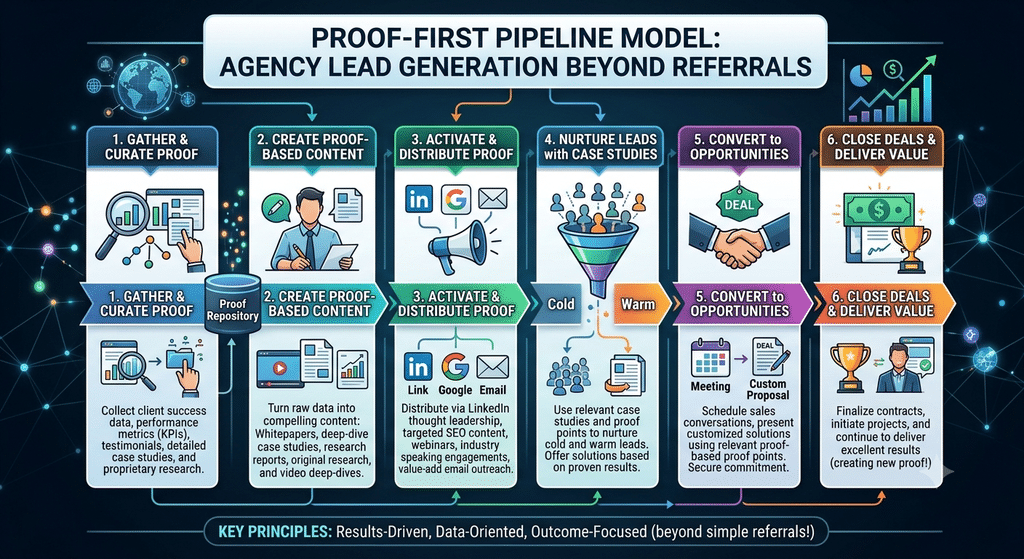
Build proof for one specific buyer first, point targeted channels at that proof, and measure everything by source. We call this the Proof-First Pipeline (PFP) Model. It is our own framework, built from the patterns in the data above, not a validated benchmark. Applied to content agency lead generation, it has six steps:
- Pick one buyer and one problem. A Databox survey, as summarized by Enrich Labs, found 80.52% of respondents believe a vertical niche lifts client acquisition. Examples: technical documentation for developer-tool CTOs, or reviewed content for legal-tech founders.
- Build proof that survives a skeptical reader. For CTOs, show named technical reviewers and accurate code samples. For legal, show the review workflow. For founders, show pipeline outcomes.
- Capture existing demand with search content. Write for problems your buyer already searches for, and measure it in Google Search Console.
- Add outbound only with a reason to write now. A funding round, launch, or hiring signal gives you one. If you are weighing this channel, see our breakdown of is cold outreach dead.
- Systematize partners. Pick five to ten adjacent firms and agree a simple handoff.
- Score and track by source. Record first touch and deciding touch in your CRM, such as HubSpot or Pipedrive.
To keep leads qualified, score each one on four questions: Is the problem named? Is the decision-maker identified? A budget range stated or discoverable? Is the timeline within roughly 90 days?
How Do You Measure Your Own Referral Dependence?
Run a Pipeline Source Audit on your last 20 to 30 closed-won clients. It takes an afternoon and gives you data nobody else has about your agency.
- List each client with contract value and sales-cycle length.
- Tag the first touch and the deciding touch for each.
- Calculate the share that came through referrals or introductions.
- Compare average contract value and cycle length by source.
- Compare your referral share against Hinge’s two-thirds figure for referrals plus direct outreach, as a reference point, not a target.
If referral-sourced deals close faster or larger, protect that channel. If most of your pipeline came from one or two clients, that concentration is the first thing to fix.
FAQ
What is content agency lead generation and why does it matter for B2B businesses?
It is the repeatable system an agency uses to find and qualify new clients without relying on introductions. It matters because referral-led pipelines are hard to forecast, and SparkToro’s survey shows agency owners still rank new business as a top challenge.
How do I choose the right approach to content agency lead generation within my budget?
Start with the channel that fits your niche and cash runway. Search content is slow but compounds, outbound can produce meetings within weeks if the targeting is tight, and partner referrals cost mostly time. Pick one primary channel and one secondary, not four at once.
What checks should I do before outsourcing content agency lead generation?
Ask for case studies from agencies in your niche, reply and meeting-booked benchmarks rather than “leads delivered,” and the exact sources used to build prospect lists. Confirm who owns the data and the sending domains, and put reporting cadence in writing.
How long does content agency lead generation take and what does it cost?
As a planning estimate, expect roughly 4 to 8 weeks to first outbound meetings and 4 to 6 months or more before search content compounds. Outsourced programs commonly run from the low four figures to the low five figures per month, depending on channel mix and volume. Vendors vary, so treat these as ranges.
Add Predictable Leads to Your Agency With MyB2BNetwork
A system only works if someone runs it every week. MyB2BNetwork helps agencies compare lead-generation and outsourcing partners and get accurate quotations before committing, so principals can stay on delivery and positioning.
Browse the B2B outsourcing marketplace to shortlist partners by channel and budget.
How to Outsource Content Agency Lead Generation in the U.S.
U.S. agencies outsource lead generation for the same reasons seen across tech hubs: SaaS-focused shops in Austin, fintech-focused agencies in New York, and B2B technology agencies in San Francisco often lack the capacity to run outbound and search consistently. Two topics matter most.
Budget and timeline. Outsourced outbound or SDR support commonly runs from the low four figures to the low five figures per month, and search content programs are often priced as retainers in a similar band. These are planning ranges, not quotes; MyB2BNetwork can get accurate quotations for your channels and volume. Expect about 4 to 8 weeks to launch and about 3 to 6 months to judge results fairly.
Checks and standards. Confirm the vendor follows the CAN-SPAM Act for email, enforced by the FTC, and handles contact data in line with CCPA, plus GDPR or UK-GDPR for EU and UK prospects. If the vendor touches your CRM, ask for a SOC 2 report or ISO 27001 certificate. Request measured first-response times, which our vendor response time study shows many vendors cannot quote. Red flags include no sample campaigns, unclear list sourcing, and no named account lead.