Outsourcing customer support looks simple on a spreadsheet: pick the country with the lowest hourly rate and sign. In practice, the cheapest country is rarely the cheapest outcome, because the right choice depends on where your customers are, when they write in, and how complex their problems are. India, the Philippines, and Eastern Europe each win in different situations, and each carries trade-offs that a rate card hides.
This guide compares the three regions on cost, English fluency, time-zone overlap, talent depth, and risk. The data comes from named sources: EF Education First, NASSCOM, IBPAP, ABSL, and Gartner. Cost figures are vendor-published benchmarks, so treat them as ranges rather than quotes.
The short answer: India tends to win on cost and scale for technical and asynchronous work. The Philippines tends to win on English-first, voice-heavy, extended-hours support. Eastern Europe tends to win on European-hours coverage and multilingual or complex technical queues, at a higher price. No country wins every factor.
The guide ends with a decision grid, the Region–Hours Fit Grid, that matches your customer region and support hours to a best-fit country.
What Is Outsourcing Customer Support?
Outsourcing customer support means contracting an external provider, usually a BPO or managed team, to handle some or all of your customer inquiries across phone, email, chat, and social channels under agreed service levels. The provider hires, trains, and manages the agents. You set the standards and measure the results.
Location models differ by distance. Offshore means a distant country such as India or the Philippines. Near-region means a neighboring time zone, such as Eastern Europe for a Western European business. Pricing is usually per agent hour, per seat, or per contact.
Why Does Outsourcing Customer Support Matter for Businesses?
It matters because it turns fixed headcount into flexible capacity, extends coverage hours, and lets internal staff focus on harder cases. The nature of that work is also changing. Gartner predicts that by 2029, agentic AI will autonomously resolve 80% of common customer service issues without human intervention, with a 30% reduction in operational costs.
Our read: if routine contacts shrink, the human-handled queue gets harder. That makes agent quality, language skill, and escalation judgment more important than the raw hourly rate when you choose a country.
Tooling lets you test this with your own data instead of marketing claims. Platforms such as Zendesk, Freshdesk, Salesforce Service Cloud, Genesys Cloud CX, and Five9 report handle time, CSAT, and QA scores by team. That is how you compare a Manila team against a Warsaw team on equal terms.
How Do India, the Philippines, and Eastern Europe Compare for Outsourcing Customer Support?
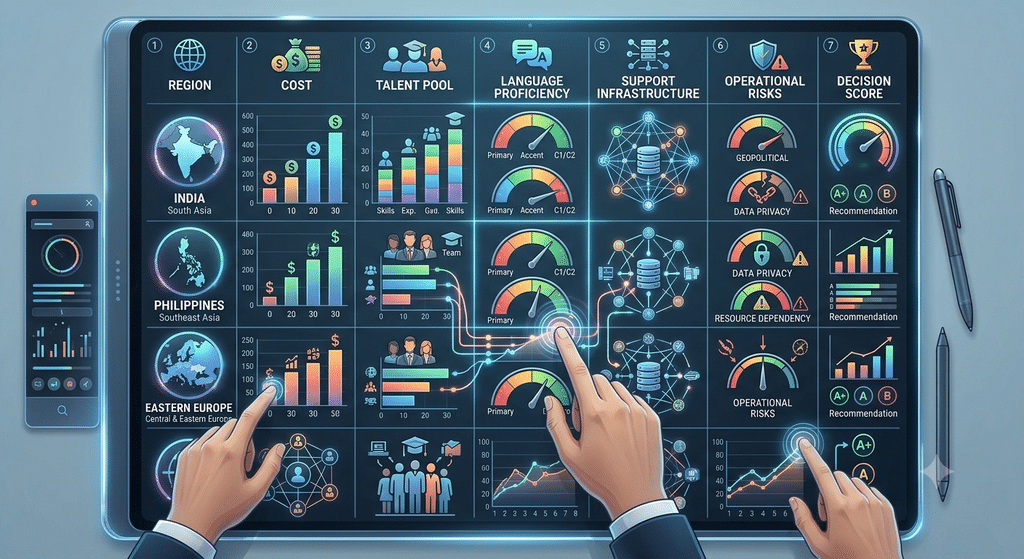
They differ most on price, English proficiency, and time-zone position, and they are closer on talent depth than most buyers assume. The table below summarizes the five factors.
| Factor | India | Philippines | Eastern Europe (Poland, Romania) |
|---|---|---|---|
| Typical cost per agent hour* | ~$6–$12 | ~$8–$15 | ~$12–$25 |
| English proficiency (EF EPI 2025) | 484, low band, near the 488 global average | 569, high band, 28th globally | Romania 605 (11th), Poland about 600, very high band |
| Time-zone position | UTC+5:30; overlaps Europe’s morning; night shifts for the Americas | UTC+8; strong Asia-Pacific overlap; night shifts for Europe and the Americas | UTC+1/+2; full European overlap; early-day overlap with North America’s East Coast |
| Talent depth | ~5.95M IT-BPM workforce (NASSCOM, FY26) | 1.89M IT-BPM workers, 1.68M in contact center and BPM (IBPAP, 2025) | Poland: 500,500 in 2,179 business service centres (ABSL, Q1 2026); CEE about 1.5M |
| Main risk | Fluency variance between vendors; night-shift strain | Typhoon exposure; local permit and tax friction | Higher rates; war-related regional concerns |
Vendor-published benchmarks (Helpware, Callin.io, Stealth Agents; 2025–2026). Base versus fully loaded rates vary by source and agent tier.
Three caveats keep this table honest. First, the EF English Proficiency Index comes from adults who voluntarily take an online test, so it reflects national averages, not screened agents. A well-vetted Indian team can sound very different from India’s national score. Second, the talent-depth figures use different definitions: NASSCOM and ABSL count IT, finance, and R&D roles alongside support, so they are not like-for-like. Third, the Philippines trails India on headcount but holds 17% of global IT-BPM headcount, according to IBPAP.
What Risks and Trade-Offs Should You Weigh in Each Region?
Every region trades something, and the lowest rate usually hides the largest trade-off. Weigh these before you shortlist.
- India: lowest rates and the largest pool. The trade-offs are fluency variance between vendors and night shifts for any Americas coverage. Data is governed by the Digital Personal Data Protection Act, 2023.
- Philippines: strong English and voice-support depth. The trade-offs are typhoon exposure, which calls for a tested continuity plan, and IBPAP’s own warning about inconsistent local permit and tax rules. Data is governed by the Data Privacy Act of 2012.
- Eastern Europe: European-hours coverage and multilingual capability. The trade-offs are higher rates and a smaller contact-center-specific pool. GDPR applies in EU member states such as Poland and Romania, which helps when you handle EU customer data.
Hourly rate is also not cost per resolved contact. As an illustration only: an agent at $6 an hour who needs two contacts to resolve an issue costs the same per resolution as a $12 agent who resolves it the first time. Track first-contact resolution next to rate.
If your support agents will touch product configuration or proprietary code, read our guide on how to protect your IP when outsourcing before you finalize any country.
Which Country Fits Your Customers? The Region–Hours Fit Grid
Match the country whose working day overlaps your customers’ day, then adjust for complexity. The Region–Hours Fit (RHF) Grid below uses standard 9-to-6 local hours and ignores daylight-saving shifts, so overlaps are approximate.
| Customer region | Live support (business hours) | Extended or 24/7 cover | Best-fit verdict |
|---|---|---|---|
| UK and Western Europe | Eastern Europe: near-full day overlap | India for overnight and weekend backfill (about 3.5–4.5 hours of overlap) | Eastern Europe primary, India secondary |
| North America | Eastern Europe covers early East Coast hours only (about 3 hours); no site covers the full day without shifts | Philippines or India on night shifts | Philippines for voice-heavy queues; India for technical and email or chat queues |
| Australia (east coast) | Philippines: about 6–7 hours of overlap | India for early and late cover (about 3.5–4.5 hours) | Philippines primary |
| Asia-Pacific (ex-Australia) | Philippines or India, depending on language | Either, with a split-site model | Philippines for English-first; India for scale |
Then adjust the verdict using four rules:
- Complex technical troubleshooting: weight India or Eastern Europe.
- Empathy-heavy voice support: weight the Philippines.
- European languages beyond English: weight Eastern Europe. Published vendor comparisons, including Stealth Agents’, list European-language coverage as its main advantage.
- Capped budget, high volume, asynchronous channels: weight India.
A split-site model, such as Eastern Europe for live hours plus India for overnight cover, extends coverage. It also adds management overhead and a second set of QA calibrations, so pilot one site first.
FAQ
What is outsourcing customer support and why does it matter for B2B businesses?
It means contracting an external team to handle customer inquiries under agreed service levels. For B2B firms, it matters because response time, resolution quality, and coverage hours directly affect renewals and account trust. Our vendor response time study shows how often those basics slip.
How do I choose the right country for outsourcing customer support within my budget?
Start with your customers’ time zone and support hours, then filter by complexity. Published ranges run about $6–$12 per hour in India, $8–$15 in the Philippines, and $12–$25 in Eastern Europe. Compare vendors on cost per resolved contact, not hourly rate alone.
What checks should I do before outsourcing customer support?
Request a live pilot or call-monitoring access, security attestations, continuity plans, attrition data, and references in your industry. Put first-response time, CSAT, and QA targets into the SLA. Confirm how the provider handles data transfers and deletion.
How long does outsourcing customer support take and what does it cost?
Plan on roughly 4–8 weeks to launch a pilot, then about three months to stabilize quality. That is a planning estimate, not a study, and it varies by vendor. Costs follow the hourly ranges above, plus setup, QA, and tooling.
Compare Countries for Outsourcing Customer Support With MyB2BNetwork
Choosing a country is only half the decision. You also need a provider whose team, security posture, and pricing match your queue. MyB2BNetwork helps operations and support leaders compare providers across India, the Philippines, and Eastern Europe and get accurate quotations before committing.
Browse the B2B outsourcing marketplace to shortlist providers by region, channel, and budget.
How to Outsource Customer Support From the U.S.: Budget, Timeline, and Compliance
U.S. companies outsource support for the same reasons seen across tech hubs: SaaS startups in Austin extending coverage, fintech teams in New York handling payment queries, healthcare operators in Chicago scaling intake, and B2B firms in San Francisco adding after-hours cover. Two topics matter most before you sign.
Budget and timeline. As illustration, take a 10-agent team at about 160 billable hours per agent per month, using the published hourly ranges. That implies roughly $10,000–$24,000 per month in India or the Philippines and roughly $19,000–$40,000 in Eastern Europe, before setup fees, QA, and tooling. Expect 4–8 weeks to launch a pilot. MyB2BNetwork can get accurate quotations for your volume and channels.
Checks and standards. Ask for a SOC 2 Type II report and an ISO 27001 certificate with a scope that covers the delivery site. Map their controls to the NIST Cybersecurity Framework, and ask about ISO 22301 continuity planning, which matters for typhoon-exposed sites. Add PCI DSS for payment queues, HIPAA for healthcare data, CCPA for California customers, and GDPR or UK-GDPR when you serve EU or UK customers. Red flags include no pilot, no named team lead, and unwillingness to share attrition or QA data. The ISO 27001 standard is a useful reference when you read certificate scopes.