In the rush to optimize B2B revenue pipelines, organizations spend millions tracking primary metrics like closed deals, open opportunities, and email click-through rates. Yet, an immense portion of valuable sales intelligence is quietly discarded every single day. This overlooked phenomenon is known as data exhausts, and it represents one of the most powerful, underexplored resources in modern commerce.
Whenever a sales representative interacts with a prospect, schedules a meeting, or updates a CRM record, a digital footprint is created. Most revenue teams view these passive data trails as mere operational byproducts. However, forward-thinking organizations are beginning to realize that analyzing these secondary data points can reveal hidden buyer behaviors and operational bottlenecks.
Data-driven sales content is strong and still underexplored because most companies struggle to look beyond surface-level key performance indicators (KPIs). By systematically capturing and decoding this ambient information, revenue leaders can transition from reactive selling to highly accurate, predictive forecasting. Let us unpack exactly how your business can weaponize this hidden resource to drive scalable revenue.
What Is Data Exhausts in Sales?
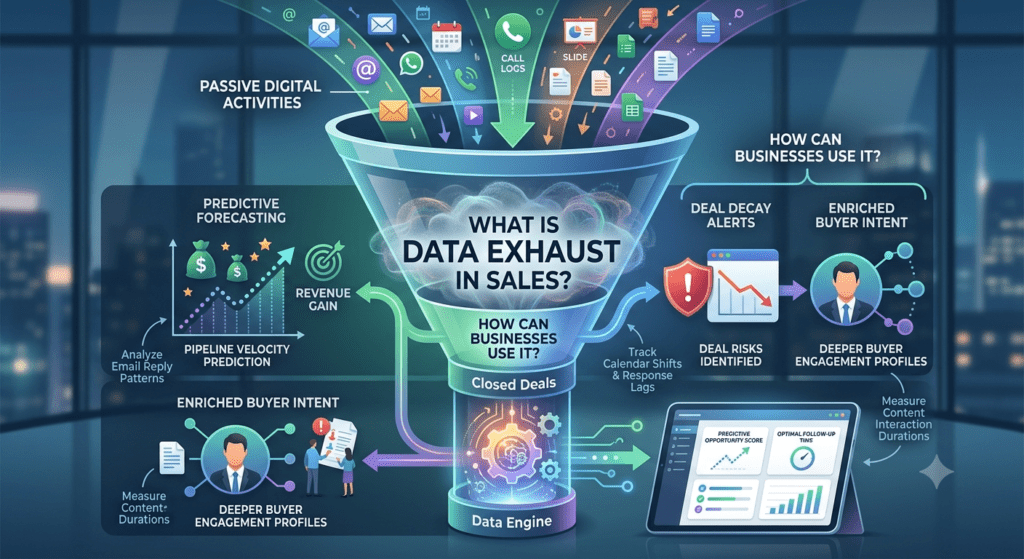
Data exhausts in sales refers to the trail of passive, secondary data generated automatically by everyday digital activities and sales workflows that is typically left unanalyzed. This includes background metadata such as email reply times, calendar invite shifts, the exact duration a prospect views a proposal slide, and dialer log patterns.
Unlike intentional data entry—such as manually typing notes into a CRM—this information accumulates automatically in the background of your software infrastructure. According to market research on enterprise analytics by IDC, over 80% of corporate data is unstructured or passive, meaning teams that fail to capture it are missing the vast majority of their operational reality.
Why Capturing Sales Data Exhausts Matters for Businesses
Capturing your team’s digital footprints matters because surface-level metrics frequently lie, but automated metadata always reveals the ground truth of buyer engagement. For example, a prospect might tell an SDR that they are “highly interested” in a software demo, but if your platform detects that they forwarded the summary deck to five internal stakeholders, the data exhaust confirms true organizational buy-in.
When revenue operations (RevOps) teams systematically analyze these passive signals, they eliminate pipeline guesswork. It allows sales heads to intervene in slipping deals long before a representative officially marks them as delayed or lost.
Key Benefits of Analyzing Sales Footprints
- Unprecedented Pipeline Visibility: Surfaces subtle behavioral indicators that predict whether an enterprise account is actually moving toward a purchase.
- SDR Performance Optimization: Identifies the precise behavioral patterns—such as optimal follow-up intervals—that differentiate top-performing reps from underachievers.
- Enriched Customer Intent Profiles: Captures accurate macro-trends regarding how target industries interact with your sales collateral over time.
How Can Businesses Transform Raw Sales Exhaust Into Revenue?
To successfully transform passive background logs into actionable revenue, organizations can deploy the Exhaust Extraction and Activation Framework (EEAF). This operational model establishes a continuous loop that ingests background logs, structures them into behavioral triggers, and pushes them back into active sales playbooks.
                    [ Exhaust Extraction & Activation Framework ]
                                         │
         ┌───────────────────────────────┼───────────────────────────────┐
         ▼                               ▼                               ▼
 [ Stage 1: Ingestion ]         [ Stage 2: Synthesis ]         [ Stage 3: Activation ]
 Logs Metadata Automatically    Identifies Buying Anomalies   Triggers High-Value Playbooks
The EEAF structure relies on three distinct processing phases:
- Stage 1: Automated Ambient Ingestion: Background background software tools seamlessly copy every communication artifact, time stamp, and touchpoint across your tech stack without requiring manual input from reps.
- Stage 2: Algorithmic Behavioral Synthesis: Analytics engines process the unstructured logs to find anomalies, such as a sudden drop-off in executive email response velocity.
- Stage 3: Contextual Sales Activation: The system automatically alerts the account owner or triggers an automated nurture sequence to address the changing deal dynamics.
How Does Data Exhausts Compare to Intent Data?
Understanding how to leverage background digital trails requires distinguishing this information from traditional, third-party intent data packages. While both assist in identifying active buyers, they originate from entirely different sources and serve distinct stages of the sales cycle.
The comparison table below details the core differences across source origin, operational ownership, and application focus:
| Feature Metric | Third-Party Intent Data | Sales Data Exhaust |
| Data Origin Source | External web browsing, B2B forums, and article downloads | Internal corporate communication systems and CRM metadata |
| Data Ownership | Leased from external vendors (e.g., Bombora, ZoomInfo) | 100% owned and controlled by your organization |
| Pipeline Application | Top-of-funnel account discovery and initial cold prospecting | Middle-to-late funnel deal velocity and churn mitigation |
| Cost of Acquisition | High recurring subscription and licensing fees | Exceptionally low; relies on existing software integrations |
Which Tools Extract Value From Sales Metadata?
Extracting value from your system’s background footprints requires moving beyond basic spreadsheets and native CRM dashboard configurations. Modern revenue operations teams utilize sophisticated conversation intelligence and revenue workflow automation platforms to translate passive metadata into clear action items.
According to technical governance studies by the National Institute of Standards and Technology (NIST), deploying centralized data processing tools dramatically improves structural visibility while ensuring long-term data pipeline integrity.
Industry-Standard Metadata Platforms
- Conversation Intelligence Engines: Tools like Gong.io and Chorus.ai parse call recordings and email histories to track conversational topics, competitor mentions, and pricing pushback frequency.
- Revenue Operations Workspaces: Platforms such as Clari and People.ai automatically ingest activity logs across calendar and email applications to map true deal alignment.
- Engagement Analytics Layers: Solutions like Salesloft and Outreach.co measure micro-engagement metrics, identifying precisely which content formats yield the highest prospect response rates.
How to Source and Outsource Sales Data Analytics in the U.S.
When U.S. business leaders—ranging from tech startups in Austin and fintech institutions in New York to manufacturing giants in Ohio and logistics firms in Atlanta—decide to partner with external RevOps consulting firms to build out their data infrastructure, clear project parameters are mandatory.
Navigating Vendor Tiers and Budget Frameworks
Do not hire generic software developers to build out your data pipelines; instead, seek out dedicated Revenue Operations or Sales Analytics consultancies. In the U.S. market, commercial pricing tiers typically scale based on the complexity of your tech stack:
- Foundational CRM Cleanups: $4,000 – $8,500 one-time project fee to map basic activity logs (best for early-stage B2B firms in San Francisco or Denver).
- Managed RevOps Partnerships: $5,000 – $12,000+ per month for ongoing data architecture tuning, metadata analysis, and predictive pipeline setup.
- Note: Scaling enterprises can leverage platforms like MyB2BNetwork to secure custom, hyper-accurate cost estimations based on their exact software ecosystem.
Security Compliance and Operational Milestones
Because analyzing sales exhaust involves opening access to raw email communications and customer touchpoints, your chosen partner must maintain impeccable data security certifications. Ensure your vendor operates under strict compliance with SOC 2 Type II, CCPA, and HIPAA regulations (if handling healthcare verticals). Conduct a comprehensive portfolio review, speak with past clients to confirm their integration capabilities, and ensure your contract includes explicit SLAs regarding data encryption standards.
A realistic engagement to fully integrate, map, and activate your organization’s passive data streams typically requires 6 to 12 weeks.
FAQ Section
What is data exhaust in sales and why does it matter for B2B businesses?
Data exhausts in sales consists of the passive digital footprints and background metadata generated by daily sales workflows, including email response timestamps, calendar edits, and content interaction durations. It matters because it provides B2B companies with unvarnished behavioral insights that reveal true buyer intent and pipeline health far more accurately than manual CRM updates.
How do I choose the right vendor for sales data analytics within my budget?
To select the right sales analytics vendor, focus on specialized Revenue Operations consultants who have proven experience connecting communication metadata directly to CRMs. Evaluate providers based on their technical competency with your existing software stack and prioritize teams that offer scalable, tiered implementation frameworks.
What checks should I do before outsourcing my data infrastructure projects?
Before granting an external vendor access to your sales communications, verify that they adhere to strict security standards like SOC 2 Type II, CCPA, and FTC guidelines. Perform a rigorous portfolio review, check past client references regarding data confidentiality, and establish clear SLAs regarding end-to-end data encryption.
How long does data exhaust infrastructure onboarding typically take and what does it cost?
Configuring specialized platforms to capture, clean, and model background sales metadata typically takes 6 to 12 weeks depending on corporate tech stack complexity. Ongoing consulting fees for managed Revenue Operations support generally run between $5,000 and $12,000+ per month, while foundational setup projects sit in the mid-four-to-five-figures.
Optimize Your Sales Infrastructure with MyB2BNetwork
Unlocking the hidden power of your organization’s internal data requires highly specialized technical expertise and a secure operational foundation. If your team is ready to stop letting valuable pipeline metadata slip away, finding the right engineering or RevOps partner is your logical next step.
At MyB2BNetwork, we specialize in connecting ambitious corporate leaders with elite, thoroughly vetted B2B service agencies and data specialists. We help founders, sales heads, and demand gen teams skip long research cycles by introducing them directly to verified experts who prioritize data security and clear revenue outcomes. Explore premium analytics resources and connect with top-tier agencies via the MyB2BNetwork blog today to start transforming your data exhaust into predictable revenue.