Negative Reverse Selling: Close Stalling Deals

What Is Negative Reverse Selling?

Negative reverse selling is a counter-intuitive sales technique rooted in reverse psychology. Instead of pushing harder to close, you pull back — subtly suggesting the prospect may not be ready or that the solution may not be the right fit. This prompts the buyer to reconsider, re-engage, and often sell themselves on moving forward.

Picture this.

You have been nurturing a B2B deal for three months. The prospect seemed genuinely interested. They attended your demo, asked detailed questions, requested a proposal. Then — silence. Follow-up emails go unanswered. Calls go to voicemail. The deal sits in your pipeline, stalled and slowly decaying.
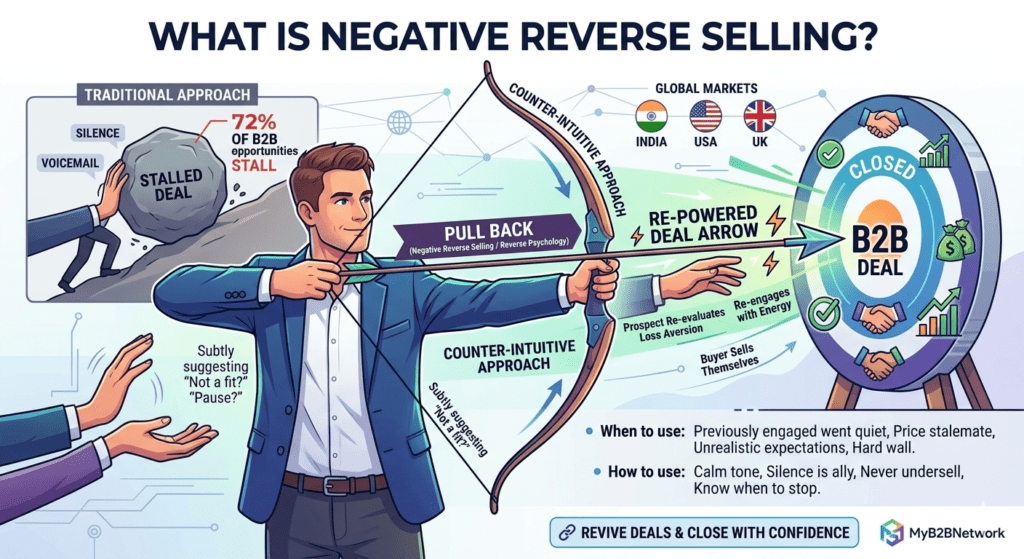
An infographic titled "What Is Negative Reverse Selling?" contrasting traditional and counter-intuitive sales approaches. On the left, a "Traditional Approach" inset shows a person struggling to push a heavy "Stalled Deal" boulder uphill. In the center, a confident salesperson pulls back a bowstring, illustrating the concept of "pulling back" (using reverse psychology). This action powers an arrow that shoots forward into a target labeled "Closed B2B Deal." Text along the arrow explains that this technique prompts prospects to re-evaluate, re-engage with energy, and sell themselves. The infographic includes brief bullet points on when and how to use the tactic, global market icons for India, the USA, and the UK
Sound familiar?

Research from Selling Power found that 72% of all new B2B sales opportunities stall in the middle to late stages of the pipeline — defined as no customer action for more than 60 days. That statistic is not just frustrating. For revenue-driven teams, it represents a massive leak in the pipeline that traditional sales approaches simply do not fix.

Chasing harder rarely works. Sending another “just following up” email rarely works. Offering a discount out of desperation almost always damages perceived value and signals weakness.

What does work — consistently, for skilled salespeople — is negative reverse selling: here’s how you close stalling deals by doing the exact opposite of what your instincts are telling you.

This blog breaks down the technique, when to use it, what to say, and how B2B teams across India, the US, and the UK are using it to revive cold deals and close with confidence.

The Psychology Behind Pulling Back to Move Forward

Before diving into tactics, it helps to understand why negative reverse selling works at a psychological level.

Human beings have a deep-seated aversion to loss and a natural desire for what feels slightly out of reach. When a salesperson pulls back — even subtly — it triggers a response in the prospect’s mind. They begin to question whether they are about to lose something valuable. They start to feel a need to justify their own interest.

This is the same principle that drives the effectiveness of scarcity marketing (“only 3 spots remaining”) and social proof (“other companies in your industry are already using this”). But negative reverse selling applies it directly in a live sales conversation — and it works because it is unexpected.

Most salespeople are trained to push. To overcome objections with rebuttals. To add urgency with pressure tactics. Buyers in competitive markets — whether they are procurement managers in Mumbai, marketing directors in Manchester, or founders in Austin — have encountered those tactics hundreds of times. They are immune to them.

A salesperson who says “I’m not sure this is the right fit for you” in a calm, confident tone? That is genuinely disarming. And it opens doors that pushier approaches slam shut.

When a Deal Stalls — and When Negative Reverse Selling Is the Answer

Not every stalled deal is a candidate for negative reverse selling. Using it in the wrong situation can backfire. Understanding when to deploy it is as important as knowing how.

Use negative reverse selling when:

  • A previously engaged prospect has gone quiet for two weeks or more with no clear reason.
  • A prospect is stuck in a price negotiation loop, making demands that are unrealistic or unfeasible.
  • A deal has been in the same pipeline stage for 30–60+ days without meaningful movement.
  • A prospect is expressing vague objections that are difficult to address directly.
  • A prospect seems to be using your proposal to benchmark competitors rather than to evaluate genuinely.

Do NOT use it when:

  • The prospect is actively engaged and moving forward — negative reverse selling in a healthy deal introduces unnecessary doubt.
  • The relationship is very early stage — it works best when some trust has already been established.
  • The stall has a clear external reason (budget freeze, internal restructuring) that is genuinely outside the prospect’s control.

The technique is a precision tool, not a default tactic. Used well, it recalibrates the dynamic. Used carelessly, it confirms the prospect’s hesitation and accelerates their exit.

The Four Core Scenarios Where This Technique Delivers

When the Prospect Unexpectedly Goes Silent

A previously responsive prospect stops replying. No explanation. No “we’re pausing the project.” Just silence.

The instinct is to follow up more frequently. The right move is the opposite.

What to say: “I haven’t heard back from you, so I’m assuming this project isn’t a priority right now. I completely understand — feel free to reach out when the timing is better.”

This statement does three things at once. It releases the pressure, it acknowledges their reality without judgment, and it forces a response. The prospect must now either confirm disinterest (which saves you time and clears the pipeline) or re-engage — often with more energy than they had before, because they now feel agency rather than pressure.

When Price Objections Become a Stalemate

The prospect says the price is too high. You explain the value. They say it is still too high. Round and round. This loop is one of the most common deal-killers in B2B sales.

Negative reverse selling cuts through it cleanly.

What to say: “It sounds like the investment doesn’t match the value you are expecting. Perhaps we should explore lower-cost alternatives that might be a better fit for your budget.”

The moment you suggest they look elsewhere, the prospect is no longer arguing about price. They are now questioning whether leaving is the right decision. In many cases, they start defending the value of your solution to themselves — which is exactly where you want them.

This approach works because price objections are rarely about price alone. They are usually about perceived value, internal budget politics, or risk aversion. Negative reverse selling surfaces the real issue faster than any rebuttal will.
When Unrealistic Expectations Are Blocking Progress

Some prospects enter negotiations with expectations that are simply not deliverable — premium service levels on a basic tier, extensive customization within a standard package, or timelines that are physically impossible.

Direct pushback often creates defensiveness. Negative reverse selling reframes the conversation without confrontation.

What to say: “Based on what you are describing, I want to be honest — our standard package may not be the right level for what you need. The features you are looking for are available in our enterprise tier, but if that doesn’t fit the budget, it might be worth exploring whether we are the right partner for this particular project.”

This creates productive tension. The prospect must now confront the gap between their expectations and their budget — a conversation you cannot have for them, but one that needs to happen before the deal can move.

When Negotiations Hit a Hard Wall

Sometimes a prospect makes demands that are genuinely outside what your company can offer — on pricing, contract terms, or product customization. Traditional negotiation keeps circling the same impasse.

What to say: “I hear you on the customization requirement. Honestly, what you are describing is outside what we can build within the current scope. If that specific feature is a firm requirement, I want to be upfront — we may not be the best fit. But I’d love to understand what is driving that requirement before we reach that conclusion.”

That last sentence is critical. You have stepped back from the demand while opening a door to the real need behind it. Often, the hard demand is a proxy for an underlying concern that has a much easier solution.

How to Use Negative Reverse Selling Without Losing the Deal

The power of this technique comes with a responsibility: restraint. Used too aggressively, it does not look like confidence — it looks like indifference. And indifference kills deals.

Here is how to keep the technique calibrated:

Keep your tone calm and genuine — not passive-aggressive
The goal is to create productive space for reflection, not to punish the prospect for stalling. If your tone sounds frustrated or manipulative, the technique backfires immediately. Calm, matter-of-fact delivery is everything.

Never undersell your product to make the technique work
Negative reverse selling does not mean disparaging your own solution. You are not telling prospects your product is bad. You are questioning whether it is the right fit for them — which is a very different, and very respectful, position to take.

Know when to stop
The moment a prospect starts re-engaging positively — asking questions, proposing next steps, showing renewed energy — stop pulling back. The technique has done its job. Shift back into a warm, collaborative sales mode and help reel them in without being too eager.

Silence is your ally
After delivering a negative reverse statement, resist the urge to fill the silence. Let the prospect process. Salespeople who rush to soften the statement immediately undermine its effect. Comfortable silence signals confidence.

Real-World Scripts That Work Across B2B Sales Contexts

Here are ready-to-use negative reverse selling phrases for common B2B scenarios:

For a cold prospect:
“It seems like the timing might not be right for this. I don’t want to keep interrupting your schedule — happy to reconnect whenever it makes sense.”

For a price objection:
“If the investment feels like too much at this stage, it might not be the right moment to move forward. What would need to change for it to feel worthwhile?”

For a prospect requesting too many concessions:
“I want to make sure we set you up for success, not just close a deal. Some of what you are asking for isn’t something we can deliver well — and I’d rather be honest about that than overpromise.”

For a deal that has been stalled for weeks:
“We have been talking for a while and I genuinely enjoy our conversations, but I am sensing this might not be the right priority right now. Tell me honestly — should we pause this for now?”

Each of these scripts does the same thing: it gives the prospect an exit, which paradoxically makes staying feel like their own choice.

What B2B Sales Teams Are Learning

Negative reverse selling is gaining traction across B2B markets precisely because modern buyers have become deeply resistant to traditional sales pressure.

In India, where relationship-based selling has long been the norm, negative reverse selling works particularly well as a trust signal. A salesperson who does not push, but instead respects the buyer’s decision-making process, is often perceived as more credible and professional.

In the US, where buyers are sophisticated and time-poor, the directness of negative reverse selling is refreshing. American B2B buyers in particular respond well to salespeople who are honest about fit rather than persistent about closing at any cost.

In the UK, where understatement is culturally valued and aggressive sales tactics are especially poorly received, the subtle, non-pressuring nature of this technique aligns perfectly with professional buyer expectations.

The technique is culturally adaptable. The tone may shift by market — slightly warmer in India, more direct in the US, more understated in the UK — but the underlying psychology is universal.

Pairing the Technique With the Right Sales Infrastructure

Negative reverse selling is most effective when supported by strong pipeline visibility and CRM data. You need to know exactly where a deal is, how long it has been stalled, what the last meaningful interaction was, and what the prospect’s engagement history looks like before you decide whether and how to apply this technique.

Teams using B2B sales enablement tools and CRM platforms have a significant advantage here. When you can see that a prospect opened your last three emails but never replied, or that they visited your pricing page twice last week but still haven’t responded, you can time your negative reverse statement with precision — and deliver it with genuine context, not as a blind tactic.

For B2B marketers and sales teams using social media marketing tools and LinkedIn outreach as part of their prospecting strategy, the same principle applies on social. A prospect who has gone quiet on LinkedIn after initially engaging with your content may respond powerfully to a message that reads: “I noticed you’ve been quiet since our last conversation. Completely understand if the priorities have shifted — happy to reconnect when the timing is better.”

That message, sent via B2B social platforms like LinkedIn, often generates more replies than three conventional follow-ups combined.

Stop Chasing. Start Closing.

Stalled deals do not have to mean lost revenue. With the right technique — and the right sales and CRM infrastructure behind it — you can revive pipeline, re-engage cold prospects, and close with confidence.

If your team needs specialist support to build smarter sales systems — from CRM implementation and sales automation to marketing services that keep your pipeline warm — MyB2BNetwork connects you with vetted service providers who specialize in exactly that.

[Submit your sales enablement requirement on MyB2BNetwork →] and turn your stalled pipeline into closed revenue.

Leave a Reply

Your email address will not be published. Required fields are marked *