What Is a Google Analytics Alternatives?
A Google Analytics alternatives is a web analytics tool that tracks site traffic, user behavior, and conversions without relying on Google’s ecosystem. For many B2B teams, it also needs to support privacy compliance, CRM integration, account-level insights, and more flexible customer journey tracking than basic visitor analytics.
A marketing team in Amsterdam is worried about GDPR. A founder in Mumbai is trying to replace Universal Analytics after the shutdown. A B2B growth manager in Chicago wants a cleaner view of pipeline attribution without depending entirely on Google’s advertising stack.
Same problem. Different trigger.
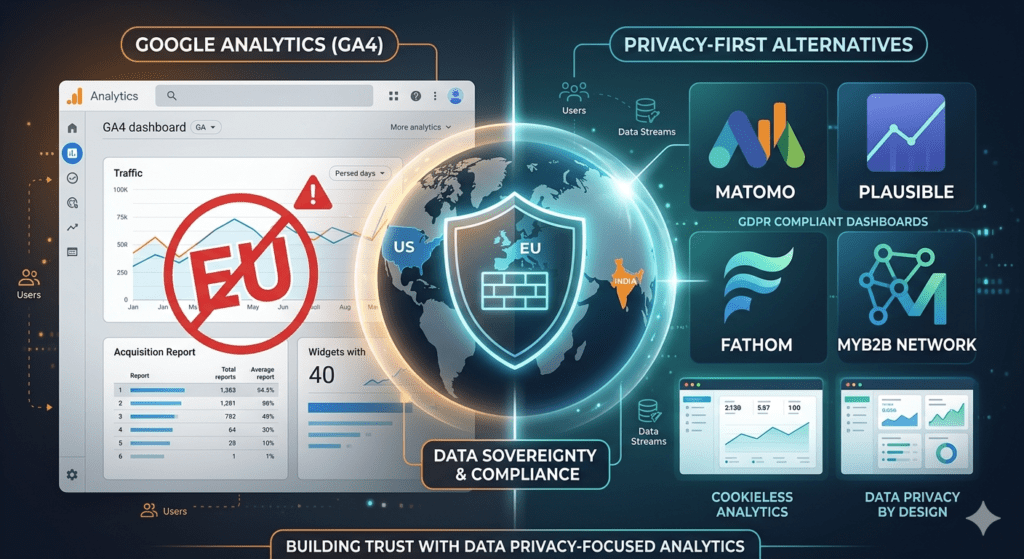
That is exactly why Google Analytics alternatives beyond the EU bans and UA shutdown have become one of the most important decisions for modern marketers. The issue is no longer only about tracking pageviews. It is about choosing a system you can trust for privacy, compliance, customer journey visibility, and long-term business intelligence.
According to StatCounter, Google still powers the vast majority of web analytics usage through its ecosystem, but the market has shifted sharply toward privacy-first and first-party data tools. In practical terms, that means more teams in India, the US, and the UK are now looking for tools that can do what GA4 cannot do cleanly: unify compliance, attribution, and actionable customer insights.
Why The Shift Happened So Fast
The move away from Google Analytics did not happen because marketers suddenly disliked dashboards. It happened because the rules around data, consent, and ownership changed.
Europe’s privacy regulators challenged Google Analytics because of how data can be transferred and processed across borders, especially when data ends up linked to advertising systems. At the same time, Google’s move from Universal Analytics to GA4 forced teams to rethink workflows, reporting, and historical comparisons.
For B2B companies, the bigger issue is structural. Long sales cycles, multiple stakeholders, and CRM-linked lead journeys make simple pageview reporting too shallow. B2B teams need tools that identify companies, track intent, and connect web behavior to revenue.
B2C teams also feel the impact, but for a different reason. They need reliable conversion tracking, funnel analytics, and privacy-safe event measurement that does not depend on older cookie-based assumptions.
The result is a new buying question: not “What is the cheapest analytics tool?” but “What is the right analytics stack for how my business actually sells?”
The Hidden Difference Between B2B And B2C Needs
The same analytics platform can serve both B2B and B2C, but the priorities are not identical.
B2C businesses usually care about high-volume behavior, cart abandonment, checkout paths, and product conversion. B2B businesses care more about company identification, content influence, pipeline attribution, and account journeys across multiple visits.
That difference changes the tool selection.
A consumer brand may prefer fast event tracking, heatmaps, and e-commerce reporting. A B2B brand may need website visitor identification, CRM sync, lead scoring, and intent-based notifications for sales teams. The wrong tool can still show traffic, but it cannot tell you which account is moving toward a deal.
This is why a true Google Analytics alternatives for B2B often looks different from one for B2C. The analytics problem is similar, but the business question is not.
What To Look For Before You Switch
Before comparing tools, define the job the tool must do.
If your goal is simple traffic reporting, many privacy-first tools will work. If your goal is attribution and lead generation, you need first-party data, CRM connectivity, and account-level intelligence. Your goal is regulatory safety in the EU or UK, you need clear consent handling and data sovereignty.
Look for these essentials:
- First-party data collection.
- Privacy and GDPR-friendly architecture.
- CRM and marketing automation integration.
- Event tracking and funnel visibility.
- Account identification for B2B use cases.
- Flexible dashboards for stakeholders in sales and marketing.
When a vendor talks mostly about “easy reporting” but not data ownership or compliance, that is a warning sign. For companies in India, the US, and the UK, the safest approach is to choose tools that are aligned with the privacy-first direction of the market.