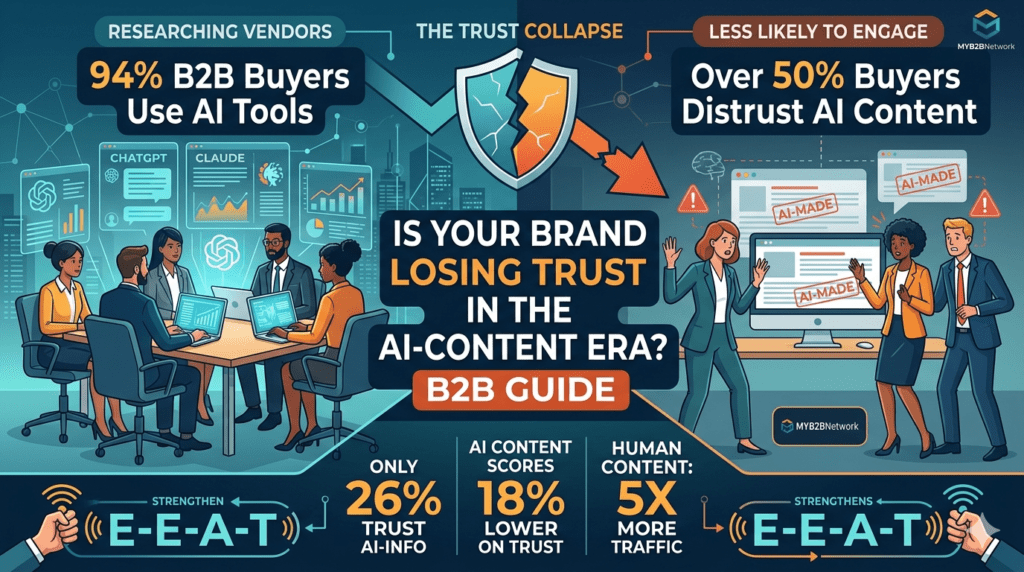
94% of B2B buyers now use AI tools like ChatGPT or Claude to research vendors before making purchasing decisions. Yet over half of those same buyers say they’re less likely to engage with AI content . This creates a paradox that’s costing brands credibility every single day.
The trust collapse is real and measurable. Only 26% of consumers trust AI-generated information, while 68% actively distrust it. AI-generated content scores 18% lower on consumer trust than human-made content, and nearly half of audiences (42%) say they distrust content if they suspect a machine made it.
Gartner found that 50% of U.S. consumers prefer to give their business to brands that avoid using GenAI in consumer-facing messages, advertising, and content. This isn’t a minor trend—it’s a fundamental shift in how B2B buyers evaluate what they read, watch, and believe.
For content teams, brand managers, and CEOs, the question isn’t whether to use AI. It’s how to use AI without losing the one asset you can’t afford to lose:
What Is AI Content Trust in the B2B Era
AI content trust refers to the degree of credibility buyers assign to content based on their perception of human involvement, originality, and transparency about AI use. In the B2B context, it’s the gap between buyers using AI for research (94%) and their skepticism toward AI-generated brand content (over 50%).
This trust gap directly impacts E-E-A-T (Experience, Expertise, Authoritativeness, Trustworthiness)—Google’s core quality framework. AI-generated content without human oversight typically ranks 40% lower in E-E-A-T signals.
Why AI Content Trust Matters for Businesses
Human-created content generates five times more traffic than AI content, with session durations 40-60% longer and bounce rates 20-30% lower. When 23% of audiences actively avoid sites that over-use AI, you’re not dealing with fringe skeptics—you’re dealing with a measurable market shift.
61% of consumers frequently question whether information they use for decisions is reliable, and 68% frequently wonder if content they see is real. By the end of 2025, only 27% of consumers determined truth using intuition—everyone now independently checks and verifies.
The Human Review Framework: 3 Layers That Restore Trust
Layer 1: Human Expertise Injection
Your content must include original insights from real people with documented expertise. This means named experts, real case studies with specific metrics, and firsthand experience that AI cannot fabricate.
82.1% of audiences can now spot AI-written content, and among adults aged 22-34, that number jumps to 88.4%. They detect the oddly generic tone, lack of real voice, and emotional flatness that no polish can hide.
Layer 2: Transparent AI Disclosure
Brands using AI need openness strategies, not hiding strategies. Research from Yahoo and Publicis Media found that AI-generated ads with proper disclosure achieved 47% lift in ad appeal, 73% lift in trustworthiness, and 96% lift in overall company trust.
The key is proactive transparency—framing AI use as innovation, not admission. Say “We use AI here, and here’s why” instead of hoping audiences won’t notice.
Layer 3: Proof-Based Content With Named Sources
Every claim must be named and attributable. Instead of “studies show,” use “Gartner’s October 2025 survey of 1,539 U.S. consumers found…”. Name real tools, standards, platforms, and regulations.
AI vs Human Content: Performance Comparison
The efficiency trap is real: 64% of marketers continue using AI for efficiency despite the glaring performance gap. While most brands chase automation, a minority doubling down on human creativity are actually winning.
Tools and Standards That Validate Content Quality
Essential AI Governance Standards
ISO/IEC 42001:2023 is the world’s first international standard for AI Management Systems (AIMS), specifying requirements for ethical AI deployment with transparency and fairness.
ISO/IEC 27001:2022 focuses on information security management—essential when AI processes customer data. Organizations certified to the 2013 version must transition before October 2025.
SOC 2 Type II evaluates security, availability, processing integrity, confidentiality, and privacy controls over 6-12 months—not just at a point in time.
U.S. Regulatory Frameworks
NIST’s Cyber AI Profile (NISTIR 8596) helps organizations secure AI systems and thwart AI-enabled attacks using the NIST Cybersecurity Framework CSF 2.0.
FTC AI guidelines emphasize transparency, accountability, and public benefit—requiring honest disclosure about AI use in marketing.
CCPA/CPRA (California) and emerging state privacy laws require disclosure when AI processes personal data.
How to Choose a Vendor Within Budget
Practical Filtering Criteria
When sourcing content vendors in the U.S., prioritize these cost tiers:
| Budget Tier | Monthly Range | What You Get | Best For |
| Entry-Level | $1,500–$3,000 | 2-4 blog posts, basic SEO | Startups testing content |
| Mid-Market | $5,000–$12,000 | 8-12 pieces, human review, strategy | Growing SaaS firms |
| Enterprise | $15,000–$35,000+ | Full content ops, original research, multi-channel | Series B+ companies |
Mid-five-figures annually ($50,000–$80,000) is typical for comprehensive B2B content programs with human oversight. MyB2BNetwork can get accurate quotations tailored to your specific needs.
What to Prioritize
- Human review guarantee—vendor must commit to expert human editing
- Named expert contributors—real people with credentials, not generic authors
- Original research access—vendor should have proprietary data or research capabilities
- Transparency about AI use—clear disclosure policies, not hidden automation
Checks Needed Before Outsourcing
Due Diligence Checklist
Before engaging a content vendor, verify:
- Portfolio review: Request 3-5 live samples with traffic data and engagement metrics
- Past client references: Contact 2-3 current clients in your industry (SaaS startups in Austin, healthcare in Chicago, fintech in New York, manufacturing in Ohio, logistics in Atlanta, or B2B firms in San Francisco)
- Compliance verification: Confirm SOC 2 Type II, ISO 27001, or ISO 42001 certification
- SLAs: Define turnaround times, revision cycles, and quality benchmarks in writing
- Contract terms: Look for 3-6 month minimums with clear exit clauses
- Red flags: Vendors who won’t disclose AI use, can’t name expert contributors, or promise “100% AI-free” without human expertise
Pre-Engagement Question Checklist
Ask these questions before signing:
- What percentage of your content is AI-assisted vs. human-written?
- Who are the named experts reviewing our content, and what are their credentials?
- How do you verify factual accuracy and cite sources?
- What’s your E-E-A-T optimization process?
- Can you provide traffic/engagement data from past client work?
How Long Outsourcing Typically Takes
Realistic timelines for B2B content programs:
- Initial strategy + audit: 2–4 weeks
- First content batch (4-6 pieces): 4–6 weeks from kickoff
- Full program ramp-up: 8–12 weeks to establish cadence
- Original research studies: 3–6 months including data collection
Most vendors require 4–8 weeks for initial deliverables, with full program maturity at 3–6 months. Rushing this process sacrifices quality and trust.
FAQ Section
What is AI content trust and why does it matter for B2B businesses?
AI content trust is the credibility buyers assign based on perceived human involvement and transparency. It matters because 94% of B2B buyers use AI to research vendors, yet over 50% distrust AI-generated content—creating a credibility crisis that erodes loyalty and traffic.
How do I choose the right vendor for AI content trust within my budget?
Prioritize vendors with human review guarantees, named expert contributors, SOC 2/ISO certification, and transparent AI disclosure policies. Budget tiers range from $1,500–$3,000/month (entry) to $15,000–$35,000+/month (enterprise), with mid-five-figures annually typical for comprehensive programs.
What checks should I do before outsourcing AI content trust work?
Verify portfolio samples with traffic data, contact 2-3 past clients, confirm SOC 2 Type II or ISO 42001 certification, review SLAs and contract terms, and ask about AI disclosure policies and expert reviewer credentials.
How long does AI content trust outsourcing typically take and what does it cost?
Initial strategy takes 2–4 weeks, first content batch 4–6 weeks, full program ramp-up 8–12 weeks, and original research 3–6 months. Costs range from $1,500–$35,000+/month depending on scope, with mid-five-figures ($50,000–$80,000) annually for comprehensive B2B programs.
Ready to Restore Trust in Your Brand Content?
MyB2BNetwork connects you with vetted content vendors who prioritize human expertise, transparent AI use, and proof-based storytelling. We handle vendor comparison, compliance checks, and contract negotiations so you get summarized quotations for your exact needs—one form, multiple options.
Whether you’re a SaaS startup in Austin scaling content or a healthcare firm in Chicago rebuilding credibility, MyB2BNetwork matches you with vendors who understand E-E-A-T, ISO 42001 governance, and FTC transparency requirements.
Submit your requirement today and receive 3–5 tailored quotations within 48 hours. Stop losing trust to AI-generated blandness—start winning with human-made credibility.