A prospect opens ChatGPT before they open your homepage. They ask it what your company does, how you compare to two competitors, and whether anyone’s had complaints. They form an opinion from that answer — and then they show up to the discovery call already anchored to whatever the model said, right or wrong. This is happening whether or not a company has done anything about it. No CMO opted in. No brand manager approved the summary. An AI brand perception audit — the practice of checking what tools like ChatGPT, Perplexity, and Gemini actually say about a company before a buyer asks them — has quietly become as necessary as checking your own website for broken links.
The uncomfortable part is that these answers are often wrong, outdated, or missing entirely, and a company usually finds out the hard way: a prospect mentions something inaccurate on a call, or worse, never books the call because the AI answer didn’t inspire confidence. There’s no notification when this happens. The deal just gets quieter.
This piece explains what an AI brand perception audit actually involves, why it’s now a due-diligence item rather than a nice-to-have, what tends to go wrong in how AI tools describe B2B companies, and gives five exact prompts you can run today to see where you currently stand.
What Is an AI Brand Perception Audit?
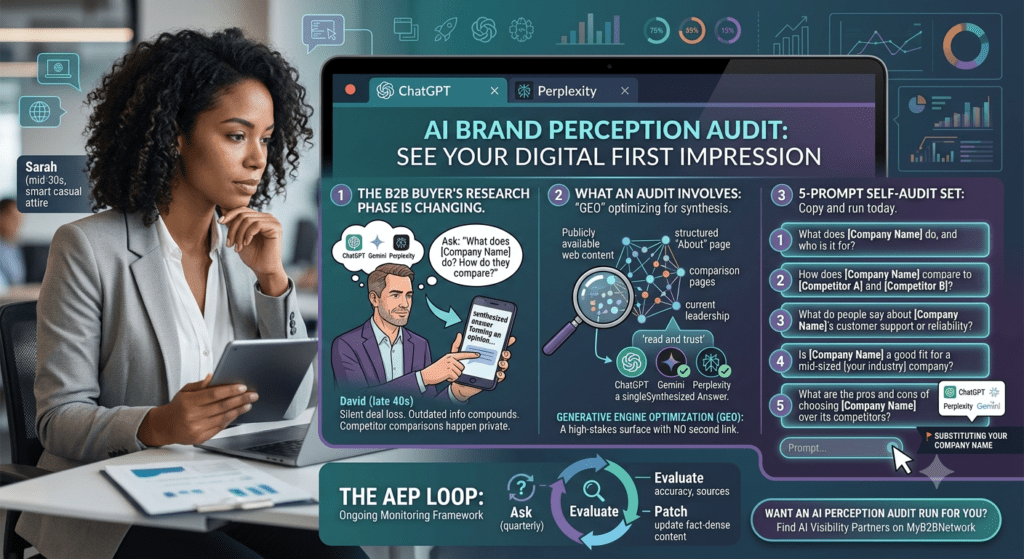
An AI brand perception audit is a structured check of how large language model tools describe a company, its products, and its reputation when a prospective buyer asks them directly. It treats the outputs of ChatGPT, Perplexity, Gemini, and similar tools as a first-impression surface a company can and should manage, the same way it manages its website or LinkedIn page.
Unlike traditional SEO, which optimizes for a search results page a person scans and clicks through, this discipline — often called generative engine optimization, or GEO — optimizes for a single synthesized answer the buyer reads and trusts without necessarily visiting the source. That’s a meaningfully higher-stakes surface, because there’s no second link to click if the first answer misrepresents you.
Why This Matters for B2B Businesses
It matters because the research phase of B2B buying has quietly moved earlier and gone more private. A prospect can now form a working opinion of a vendor before a single marketing-qualified lead is ever logged in the CRM.
A few reasons this deserves board-level attention, not just a marketing side project:
- Silent deal loss. A buyer who gets an unflattering or thin AI answer often doesn’t reach out to correct it — they just move to the next option on the list.
- Outdated information compounds. AI tools trained or grounded on older web content may describe a company’s positioning, pricing model, or leadership from years ago, and there’s no automatic correction mechanism.
- Competitor comparisons happen without your input. When a buyer asks an AI tool to compare you to two competitors, the model synthesizes an answer from whatever it can find — which may favor a competitor simply because they’ve published more structured, quotable content.
Gartner’s research into buyer behavior has flagged the growing role of self-directed digital research in B2B purchasing, and generative AI tools are now a visible part of that self-directed research, not a fringe channel.
Why AI-Generated Answers Now Shape First Impressions
Direct answer: AI tools shape first impressions because buyers increasingly treat a synthesized answer as a faster, seemingly more neutral substitute for reading five vendor websites themselves.
This shift has a few clear drivers:
- Speed. A buyer can get a comparative overview of three vendors in one prompt instead of ten browser tabs.
- Perceived objectivity. Buyers often assume an AI-generated summary is less biased than a vendor’s own marketing copy, even when the underlying sources are limited or outdated.
- Habit transfer. Professionals who use these tools daily for other research tasks default to the same behavior when evaluating vendors, without necessarily treating it as a formal step.
IDC’s research on enterprise buyer behavior has similarly noted that AI-assisted research tools are increasingly part of how technical and business buyers narrow a vendor shortlist before ever engaging a sales team directly.
The 5-Prompt Self-Audit: What to Ask AI Tools About Your Brand
Direct answer: the fastest way to see your current exposure is to run the same five prompts a curious buyer would, across ChatGPT, Perplexity, and Gemini, and compare the answers side by side.
Run each of the following exactly as written, substituting your company name:
- “What does [Company Name] do, and who is it for?”
- “How does [Company Name] compare to [Competitor A] and [Competitor B]?”
- “What do people say about [Company Name]’s customer support or reliability?”
- “Is [Company Name] a good fit for a mid-sized [your industry] company?”
- “What are the pros and cons of choosing [Company Name] over its competitors?”
Save the answers verbatim, note which sources the tool cites (when it cites any), and flag anything inaccurate, outdated, or missing entirely — a wrong pricing model, an old product name, a leadership change that hasn’t registered. That list becomes the starting point for what to fix.
Common Ways AI Tools Get Brand Information Wrong
Direct answer: most inaccuracies trace back to thin or outdated source material online, not to the AI tool inventing information out of nowhere.
Patterns worth watching for:
- Stale positioning. If a company rebranded, repositioned, or changed its ideal customer profile, older web content describing the previous version often still dominates what the model retrieves.
- Missing differentiation. When a company’s own site doesn’t clearly state what makes it different, the model fills the gap with whatever comparative content exists elsewhere — sometimes written by a competitor or a review site with its own bias.
- Confusing similarly named companies. Smaller B2B brands are especially prone to being merged or confused with a same-named company in an unrelated industry.
- Thin structured content. Companies with sparse, unstructured “About” pages give the model less reliable material to work from than companies with clear, fact-dense pages.
A Framework for Ongoing Monitoring: The AEP Loop
Rather than treating this as a one-time check, it helps to run it as a repeatable cycle — what we’ll call the AEP Loop: Ask, Evaluate, Patch.
- Ask — Run the five-prompt audit above across at least three major AI tools on a recurring basis, ideally quarterly.
- Evaluate — Compare each answer against what’s actually true today, and note whether the tool cited a source, and if so, which one.
- Patch — Update or publish clear, fact-dense content addressing the specific gaps found — accurate positioning, a real comparison page, a current leadership page — since these tools generally pull from what’s publicly available and well-structured, not from a private feed a company can edit directly.
The loop doesn’t guarantee a perfect answer next quarter, since these tools update on their own schedules and draw from many sources at once. It does turn an invisible risk into something a team can actually track and improve over time.
FAQ
What is an AI brand perception audit and why does it matter for B2B businesses?
It’s a structured check of how tools like ChatGPT and Perplexity describe a company when a buyer asks directly, and it matters because a growing share of buyer research now happens inside these tools before a sales conversation ever starts.
How do I choose the right vendor for this kind of audit within my budget?
Look for a vendor who can show a sample audit report with more than screenshots — one that traces inaccuracies back to specific source content and proposes concrete fixes, not just a general “AI visibility score.”
What checks should I do before outsourcing this work?
Ask for a reference client in a comparable industry, confirm what tools and prompt sets they actually test against, and get clarity on whether they touch your published content directly or only advise on it.
How long does this kind of audit and monitoring typically take, and what does it cost?
An initial audit usually takes one to two weeks to complete and document, while an ongoing quarterly monitoring and content-patching program typically runs three to six months before measurable shifts in AI-generated answers appear.
Want Someone to Run This Audit for You?
Checking what AI tools say about your brand takes time most marketing teams don’t have free between campaigns. MyB2BNetwork connects CMOs, founders, and brand managers with vetted GEO and brand-visibility specialists who run this exact audit and fix what it finds. Find AI visibility and GEO partners on MyB2BNetwork.
Hiring or Outsourcing an AI Perception Audit in the U.S.
Two things matter most when a U.S. company brings in outside help for this work: vendor evaluation and realistic budgeting.
When evaluating a vendor, ask which specific AI tools they test against, whether they can show before-and-after examples of an answer changing after content updates, and how they handle sensitive claims in regulated industries — a healthcare company in Chicago or a fintech firm in New York needs a vendor who understands HIPAA and FTC disclosure rules well enough not to overcorrect into misleading claims while fixing an inaccurate one.
On budget, a focused one-time audit across three to five AI tools typically runs $1,500–$4,000, while an ongoing quarterly monitoring and content-patching retainer tends to land in the low-to-mid five-figures annually. MyB2BNetwork can help source accurate, vetted quotations rather than relying on a single vendor’s estimate. This applies across company types, from SaaS startups in Austin to manufacturing firms in Ohio, since the underlying content gaps AI tools expose look similar industry to industry even when the fixes differ.