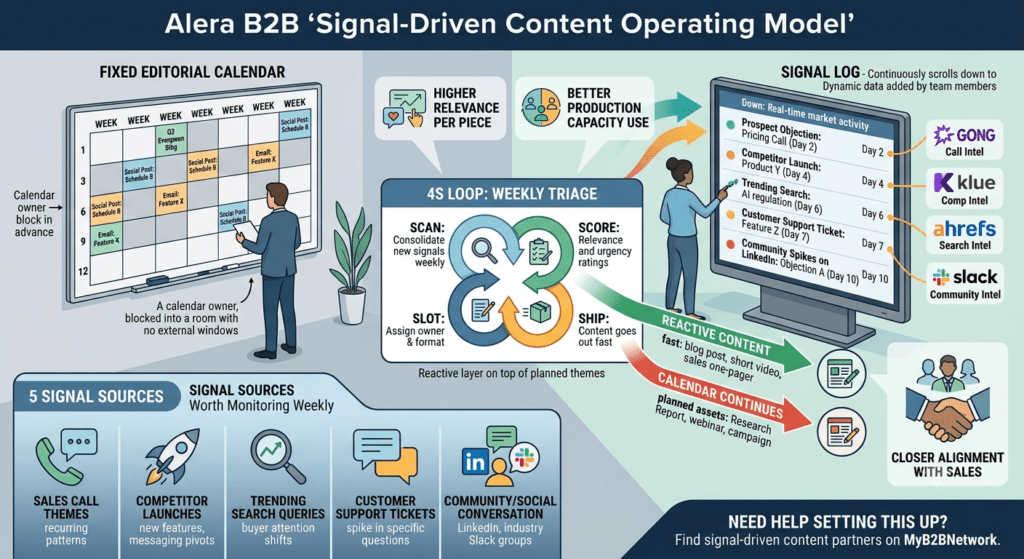
Most content calendars are built in a room with no live data in it. Someone blocks out twelve weeks of blog topics, social posts, and email sends based on what seemed important at the time — and then the market moves. A competitor ships a feature. A prospect says the same objection on eleven sales calls in a row. None of that gets reflected until the next planning cycle, by which point the moment has usually passed. That gap is why a growing number of B2B content teams have started treating the calendar as a starting draft rather than a fixed schedule. Signal-driven publishing is the practice of letting real, observable market activity — not a pre-set date — decide what gets published and when. The calendar still exists; it just stops being the thing in charge.
This isn’t a rejection of planning. Teams still need themes, campaigns, and long-lead assets like reports or webinars that require weeks of production time. What’s changing is the layer sitting on top of that plan: a lighter, faster mechanism for catching what’s happening right now and getting content out while it’s still relevant.
This piece defines signal-driven publishing, explains why static calendars are losing ground in 2026, walks through the “signal log” model replacing them, names five concrete sources worth monitoring weekly, and covers what it takes to build or outsource this capability.
What Is Signal-Driven Publishing?
Signal-driven publishing is a content operating model where topics, formats, and publish timing are determined by real-time market signals — competitor moves, recurring sales conversations, spikes in search behavior — rather than by a fixed editorial calendar set weeks or months in advance. The calendar still holds planned, long-lead content; the signal layer fills the gaps with timely, reactive pieces.
The core difference from traditional planning isn’t speed for its own sake. It’s relevance timing — publishing content while the market condition that makes it useful is still active, instead of publishing it once the moment has cooled and the content reads as a delayed reaction.
Why Signal-Driven Publishing Matters for Businesses
It matters because buyers now form opinions faster than most editorial calendars can respond. A competitor’s product announcement, a regulatory update, or a shift in what prospects are asking about on discovery calls creates a short window where relevant content earns outsized attention — and that window closes well before most quarterly plans get revisited.
The practical upside for content and marketing teams:
- Higher relevance per piece. Content tied to an active market condition tends to earn more engagement than evergreen content published on a generic schedule, simply because it answers a question people are already asking right now.
- Better use of limited production capacity. Teams stop spending cycles on planned topics that quietly lost relevance between the planning meeting and the publish date.
- Closer alignment with sales. When content responds to what reps are actually hearing on calls, sales is more likely to trust and use it, rather than treating marketing content as disconnected from real conversations.
The Reactive Content Model: From Calendar to Signal Log
Direct answer: the reactive content model replaces a fixed publishing schedule with a running “signal log” — a shared, continuously updated list of market signals that content teams triage weekly and turn into content when a signal is strong enough to act on.
A signal log works differently from a calendar in three ways. First, entries are added continuously by anyone on the team who spots something, not just by whoever owns the calendar. Second, each entry gets scored for relevance and urgency rather than slotted into a pre-set date. Third, most entries never become content at all — the log is a filter, not a backlog everyone feels obligated to clear.
This doesn’t eliminate planning. Long-lead assets (research reports, major campaigns, gated content) still need a traditional calendar because they require weeks of production. The signal log runs alongside that calendar, handling the faster-moving layer of blog posts, social commentary. And short-form content that benefits from timing more than polish.
Five Signal Sources Worth Monitoring Weekly
Direct answer: five sources consistently surface usable signals for B2B content teams, sales call themes, competitor launches, trending search queries, customer support patterns, and community or social conversation.
- Sales call themes. Recurring objections, questions, or language patterns across a week of sales calls often point directly to a content gap that’s actively costing pipeline.
- Competitor launches and announcements. A competitor’s new feature, pricing change. Or messaging pivot creates a short window where a response or comparison piece gets disproportionate attention.
- Trending search queries. Sudden movement in search volume around a term related to your category signals a shift in buyer attention worth addressing quickly.
- Customer support and success tickets. A spike in a specific support question often means existing customers and likely prospects need clearer public content on that exact topic.
- Community and social conversation. Discussion threads on LinkedIn, industry Slack groups, or forums surface language and concerns before they show up anywhere else in the funnel.
Weekly monitoring is deliberate. Daily checks tend to overreact to noise; monthly checks let real signals go stale before anyone notices them.
Tools That Support a Signal Log
Direct answer: most teams build a signal log with tools they already own — call intelligence platforms, competitive intelligence tools, and search or social listening dashboards — rather than a single new piece of software.
- Call intelligence platforms like Gong or Chorus surface recurring language and objection patterns across sales calls automatically, removing the need to manually review call recordings.
- Competitive intelligence tools like Klue or Crayon track competitor announcements, pricing changes, and messaging shifts in near real time.
- Search and SEO platforms like Ahrefs or Semrush flag sudden movement in query volume for category-relevant terms.
- Social and community listening tools track conversation volume and sentiment around specific topics across LinkedIn and relevant forums.
None of these tools replace human judgment about which signals are worth acting on. IDC’s research on B2B content operations has consistently found that teams with clear ownership. And triage processes get more value from these tools than teams that simply collect more data without a decision layer on top of it.
A Framework for Running a Signal Log: The 4S Loop
Rather than letting a signal log turn into an unmanaged pile of half-considered ideas. It helps to run it through a consistent weekly rhythm what we’ll call the 4S Loop:
- Scan — Once a week, someone consolidates new entries from all five signal sources into the shared log.
- Score — Each signal gets a quick relevance and urgency rating; low scores get archived. Not deleted, in case they resurface later.
- Slot — High-scoring signals get assigned an owner and a format based on how much production time the moment can afford.
- Ship — Content goes out while the signal is still active, with a hard internal rule that reactive content moves faster through review than planned content does.
Teams that skip the “Score” step tend to burn out chasing every signal. Teams that skip “Ship” speed tend to publish reactive content that no longer feels reactive by the time it’s live which defeats the purpose entirely.
FAQ
What is signal-driven publishing and why does it matter for B2B businesses?
It’s a content model where real market signals not a fixed calendar determine what gets published and when. So content stays tied to what buyers are actually experiencing right now. It matters because relevance has a short shelf life, and static calendars often miss that window entirely.
How do I choose the right partner for building a signal-driven content process within my budget?
Look for a partner who can show you an actual triage process, not just a list of monitoring tools. Since the value is in the judgment layer that decides what’s worth publishing. Match the engagement to your gap — some teams need help setting up the monitoring. Others need ongoing production capacity to act on signals fast enough.
What checks should I do before outsourcing this kind of content operation?
Confirm the vendor has direct experience integrating with sales and customer success teams. Snce sales call themes and support tickets are core signal sources they’ll need access to. Ask for a sample signal log or workflow document from a past client. Not just a strategy deck, to see how triage actually happens week to week.
How long does it typically take to build a working signal-driven process, and what does it cost?
Most teams need four to six weeks to set up monitoring sources and a working triage rhythm. With three to six months before the process runs smoothly without heavy oversight. Ongoing support is usually priced as a monthly retainer rather than a one-time project, given the continuous monitoring involved.
Want Help Setting This Up?
Standing up a signal log takes coordination across sales, support, and content that most marketing teams don’t have spare hours for. MyB2BNetwork connects content strategists and marketing leaders with vetted agencies and consultants who specialize in reactive, signal-based content operations. Find signal-driven content partners on MyB2BNetwork.
Hiring or Outsourcing Signal-Driven Content Operations in the U.S.
Two things matter most when a U.S. company brings in outside help to build this process: budget fit and due diligence on cross-team access.
On budget, a lean engagement covering monitoring setup plus a light monthly triage process typically runs $2,000–$5,000 per month. While a fuller service that includes both monitoring and reactive content production can land in the mid-five-figures annually. MyB2BNetwork can help source accurate, vetted quotations rather than relying on a generic rate card.
On due diligence, confirm how the vendor handles access to sensitive internal data like sales call recordings or support tickets. And check that any data handling aligns with your company’s existing privacy and security posture including SOC 2 or ISO 27001 commitments. If your business has made them to customers. This applies whether you’re a SaaS startup in Austin, a healthcare company in Chicago handling HIPAA-adjacent customer data. Or a manufacturing firm in Ohio where support ticket content may include sensitive operational details.