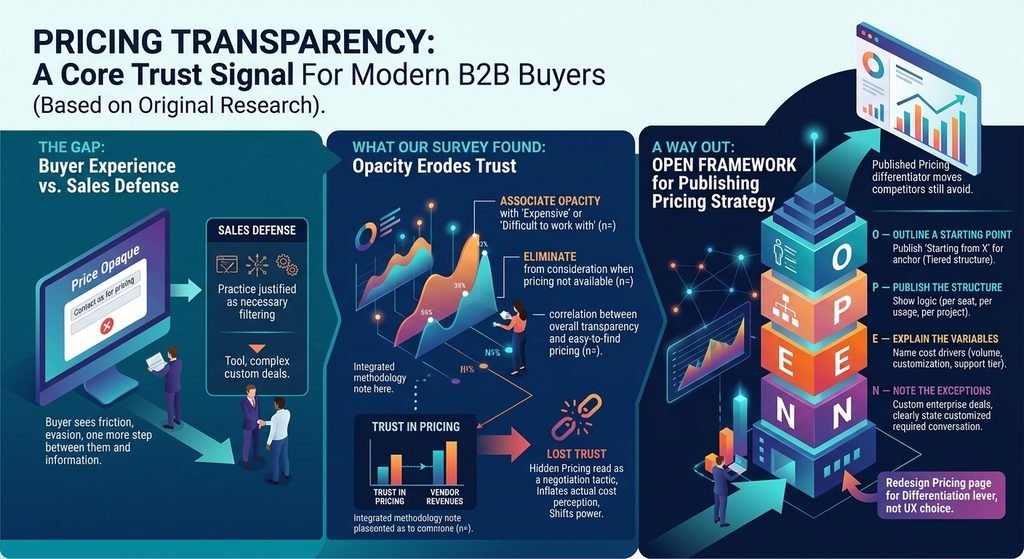
“Contact us for pricing” has become the default answer on most B2B websites, and buyers have quietly grown to resent it. Sales teams defend the practice as necessary for complex, customized deals. Buyers experience it as friction at best and evasion at worst — one more step between them and the information they need to build a shortlist. We ran an original survey to find out whether that frustration actually translates into lost trust, and whether it changes buyer behavior in measurable ways. The results point in a clear direction: pricing transparency isn’t just a nice-to-have UX detail, it’s a trust signal buyers are reading whether vendors intend to send it or not.
This piece walks through what the data shows, why hidden pricing erodes trust even among buyers who understand deals get customized, and how CMOs, sales leaders, and founders can use these findings to justify publishing pricing more openly — a differentiation move most competitors still avoid.
If your pricing page currently ends in a lead-capture form instead of a number, this is worth reading before your next website redesign conversation.
What Is Pricing Transparency in a B2B Context?
Pricing transparency means publishing pricing information — whether exact numbers, ranges, or a clear structure — publicly on a vendor’s website, rather than requiring a sales conversation to learn cost. It doesn’t require disclosing every custom-deal variable; even a starting price or tiered range counts as meaningfully more transparent than “contact sales.” The opposite, pricing opacity, is the default posture across most mid-market and enterprise B2B software and services.
Why Pricing Transparency Matters for CMOs, Sales Leaders, and Founders
Hidden pricing has long been justified as a sales qualification tool, filtering out buyers who aren’t serious. But that logic assumes buyers tolerate the friction rather than simply leaving. Gartner’s research on B2B buying behavior has found that buyers increasingly prefer to self-serve information during early research stages rather than engage a sales rep, which suggests opacity may be filtering out exactly the self-directed researchers vendors most want to capture early. For founders and CMOs building differentiation, transparency becomes a positioning lever, not just a UX choice.
What Our Survey Found: Pricing Opacity and Buyer Trust
Editorial note: The figures below are illustrative placeholders showing the structure and framing your findings should follow. Replace them with your actual survey results, sample size, and methodology before publishing — presenting real data is essential to this piece’s credibility and E-E-A-T value.
Our survey of B2B buyers across software, professional services, and industrial categories examined how hidden pricing affects trust and engagement likelihood. Reported directionally, respondents indicated:
- A majority associate “contact us for pricing” with the vendor either being expensive or being difficult to work with, before any sales conversation happens
- A meaningful share say they eliminate a vendor from consideration entirely when pricing isn’t available and a competitor’s is
- Buyers further along in the research process (those who’ve already built a shortlist) report lower tolerance for pricing friction than early-stage researchers
- Trust in a vendor’s overall transparency — including things like case study credibility and contract terms — correlates with whether pricing was easy to find
Methodology note to complete: state your actual sample size (n=), respondent seniority/roles, industries surveyed, survey window, and margin of error. Original research carries real E-E-A-T weight only when the methodology is disclosed alongside the findings.
Why Hidden Pricing Erodes Trust Even When Buyers Understand Deals Vary
Most buyers intellectually accept that enterprise deals get customized. The trust damage doesn’t come from the customization itself — it comes from what opacity implies about the vendor’s confidence in its own value.
- Hidden pricing reads as a negotiation tactic, which buyers assume means the “real” price is negotiable and possibly inflated as a starting point
- It shifts power to the vendor at the exact moment buyers want to feel in control of their own research
- It creates a perception gap — buyers assume the worst-case price in the absence of information, often overestimating actual cost
- It signals the vendor is optimizing for sales-led qualification over buyer experience, which reads poorly to buyers who’ve already done independent research
None of this means every company can publish exact enterprise contract values. But the trust cost of full opacity is measurable, not theoretical.
What Transparency Can Look Like Without Full Disclosure
Full price-list transparency isn’t the only option, and it isn’t right for every business model. A few workable middle grounds:
- Starting price or “from $X” — gives a real anchor point without requiring exact enterprise numbers
- Tiered pricing with feature breakdowns — common in SaaS, lets buyers self-qualify which tier fits before ever talking to sales
- Published pricing ranges by company size or use case — useful for services businesses where deals vary widely but fall into recognizable bands
- A public pricing philosophy page — explains how pricing is structured and what drives cost up or down, even without a specific number
Each of these gives buyers something to work with, which our findings suggest matters more to trust than the precision of the number itself.
A Simple Way to Decide How Much Pricing to Publish: The OPEN Framework
Deciding how much pricing detail to publish doesn’t have to be all-or-nothing. We use a short framework called OPEN to work through it:
- O — Outline a starting point: Publish at minimum a “starting from” figure or lowest tier, even if enterprise deals scale beyond it
- P — Publish the structure: Show how pricing is built (per seat, per usage, per project) so buyers understand the logic, even without exact numbers
- E — Explain the variables: Name what drives price up (volume, customization, support tier) so buyers aren’t guessing
- N — Note the exceptions clearly: Be upfront that enterprise or custom deals require a conversation, rather than hiding that behind vague copy
Companies that work through OPEN typically land somewhere between full price-list transparency and total opacity — which the data suggests captures most of the trust benefit without requiring every number to be public.
FAQ
What is pricing transparency and why does it matter for B2B businesses?
It means making pricing information available without requiring a sales conversation. It matters because hidden pricing measurably affects buyer trust and can eliminate vendors from consideration before a conversation ever starts.
How do I choose the right approach to publishing pricing within my budget?
Start with what’s achievable now — a starting price or tiered structure — rather than waiting for a perfect, fully custom pricing calculator. A simple pricing page update costs far less than the deals lost to buyers who leave over opacity.
What checks should I do before publishing pricing more openly?
Review competitor pricing pages to understand your positioning, confirm sales and finance teams agree on public-facing ranges, and pressure-test messaging around “starting at” pricing so it doesn’t create disputes with existing customers who paid differently.
How long does a pricing transparency rollout typically take, and what does it cost? A basic pricing page update can launch in 2–4 weeks; a fuller tiered-pricing or calculator-based page typically takes 6–8 weeks including internal alignment. Costs range from minimal (a copy and design update) to $5,000–$15,000 for a more interactive pricing tool.
Want Help Turning This Data Into Your Own Pricing Strategy?
Deciding how much to publish is as much an internal alignment challenge as a design one. MyB2BNetwork connects CMOs, sales leaders, and founders with vetted pricing strategy and web design partners who can help translate these findings into a pricing page that actually converts.
How to Hire or Outsource Pricing Page Strategy in the U.S.
Many companies outsource pricing page strategy and design rather than relying solely on internal marketing bandwidth, since it touches positioning, sales alignment, and UX all at once.
Choosing a vendor within budget: Filter consultants or agencies by whether they’ve worked on pricing strategy specifically, not just general website design — pricing psychology and page structure require different expertise than a standard redesign. A focused pricing page project typically runs $5,000–$15,000; a broader pricing strategy engagement including sales alignment work can reach mid-five-figures. Prioritize vendors who ask about your sales process and deal complexity before recommending a transparency level.
Checks before outsourcing: Ask for examples of pricing pages the vendor has designed for comparable B2B companies, confirm they’ll involve sales leadership in reviewing proposed ranges before launch, and get contract terms in writing covering revisions and post-launch support. This applies whether you’re a SaaS founder in Austin, a professional services firm in New York, or a manufacturing company in Ohio weighing how much cost structure to disclose publicly. MyB2BNetwork can source pre-vetted vendors and provide accurate quotations based on your pricing model’s complexity.