Q: You bought intent data. Why isn’t anything different?
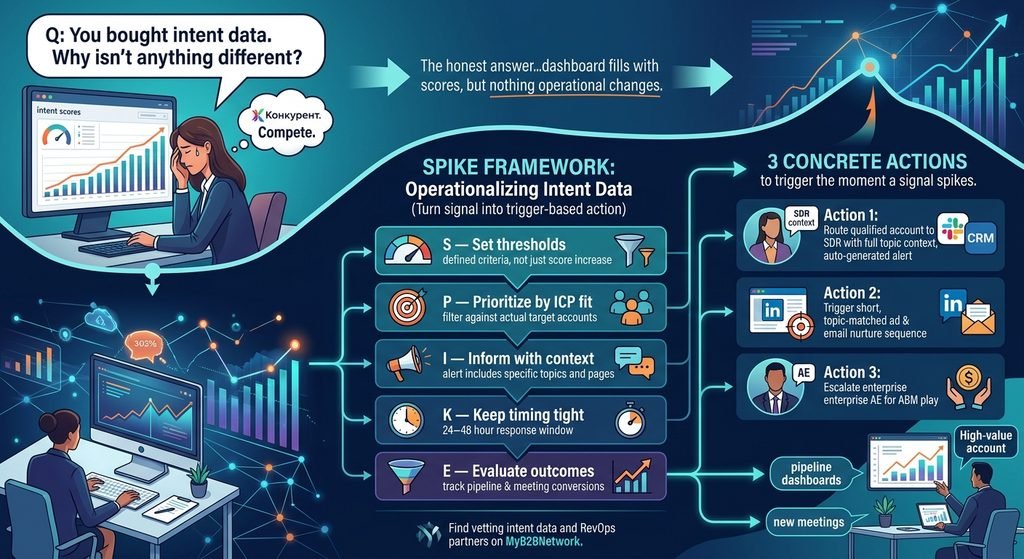
A: This is the question most marketing ops and SDR leaders eventually ask, usually six to nine months after signing the contract. The dashboard fills with account names and rising “intent scores,” someone screenshots it for a QBR once, and then nothing operational actually changes. The data was real. The action never followed. B2B Intent data gets sold as a crystal ball and used like a vanity metric. Most teams buy it because a competitor has it, plug it into a dashboard, and stop there — no threshold for what counts as “high intent,” no owner responsible for acting on a spike, no defined next step when one shows up.
This piece answers the questions that actually matter: what intent data shows (and doesn’t), why it’s so often misused, and three specific actions to trigger the moment a signal spikes — not just admire it in a report.
If your team has intent data sitting in a tool nobody checks daily, this is written for you.
Q: What Is B2B Intent Data, Exactly?
A: Intent data is behavioral signal — usually aggregated from content consumption, search activity, or review-site research — that indicates a company or its employees are actively researching a topic related to your product. It’s typically sourced from third-party co-op networks (like Bombora or G2) or first-party signals from your own website and content. The key word is “indicates,” not “confirms” — intent data shows research activity, not purchase intent, and the two aren’t the same thing.
Q: Why Does Intent Data Matter for B2B Teams?
A: It matters because it can shrink the gap between when a company starts researching a problem and when your sales team finds out. Gartner’s research on B2B buying has found that buyers now complete a significant portion of their purchase journey independently before ever engaging a sales rep. Which means the research phase — the phase intent data is built to catch — is where a lot of influence now happens. For marketing ops, that’s a chance to route the right accounts to the right reps earlier. For SDR leaders, it’s a chance to prioritize outbound effort instead of spreading it evenly across a flat account list.
Q: What Does Intent Data Actually Show — vs. What Marketers Assume It Shows?
A: This is where most of the disappointment starts. Marketers often assume a rising intent score means a company is close to buying; in reality. It usually just means more content matching certain topics is being consumed, by someone, at that company.
- What it shows: Increased research activity around topics related to your category, often aggregated across multiple people at an account
- What it doesn’t show: Who specifically is researching, what stage of the buying process they’re in. Or whether the activity reflects genuine interest versus a student, a competitor, or unrelated research
- What it’s good for: Prioritization and timing signals across a large account list
- What it’s bad for: Treating as a standalone reason to run a full outbound sequence with no other context
Teams that treat intent data as a precise buying signal instead of a directional prioritization tool are usually the ones who eventually decide “intent data doesn’t work” — when the real issue was how it was interpreted.
Q: What Should Teams Check Before Trusting an Intent Signal?
A: Not every spike deserves the same response, so it’s worth a quick filter before acting.
- Is the spike coming from multiple contacts at the account, or a single anonymous visit?
- Are the topics genuinely relevant to your product category, or adjacent-but-unrelated terms?
- Has this account shown any first-party engagement (website visits, email opens) alongside the third-party signal?
- Is the account within your defined ICP, or outside your target firmographics entirely?
A spike that clears these four checks is worth acting on quickly. A spike that fails two or more is often noise.
Q: What Should Teams Actually Do When Intent Signals Spike? (3 Concrete Actions)
A: This is the step most programs skip. Here are three specific, trigger-based actions worth building into your workflow instead of just watching the dashboard:
- Route to SDR with pre-built context, not a cold task. When a qualified account spikes, auto-generate a Slack or CRM alert that includes the specific topics driving the signal, so the SDR’s first outreach references something real instead of a generic template.
- Trigger a targeted ad and content sequence, not a mass outbound blast. Use the spike to activate a short, topic-matched LinkedIn ad sequence or a 2–3 email nurture specifically referencing the research theme, rather than adding the account to a generic list.
- Escalate enterprise accounts to the AE for account-based follow-up. For accounts above a defined deal-size threshold, route the signal directly to the assigned account executive to consider a more senior-level outreach or a targeted account-based play, rather than routing it through standard SDR cadence.
The common thread across all three: the action is specific to the signal, time-bound (ideally triggered within 24–48 hours). And owned by a named role — not left to whoever happens to check the dashboard that week.
A Simple Way to Operationalize Intent Data: The SPIKE Framework
We use a short framework called SPIKE to keep intent data from turning into another ignored dashboard:
- S — Set thresholds: Define in advance what counts as a real spike, not just any score increase
- P — Prioritize by ICP fit: Filter spikes against your actual target account list before routing anything
- I — Inform with context: Every alert includes the specific topics or pages driving the signal
- K — Keep timing tight: Build a 24–48 hour response window into the workflow, not a weekly check-in
- E — Evaluate outcomes: Track which triggered actions actually led to meetings or pipeline, and adjust thresholds quarterly
Platforms like 6sense, Bombora, and HubSpot’s native intent tracking can all support this kind of threshold-and-routing setup without heavy custom engineering.
FAQ
What is intent data and why does it matter for B2B businesses?
It’s behavioral signal showing that a company is researching topics related to your product. It matters because it can help teams prioritize outreach earlier in the buying process. Before a prospect ever fills out a form.
How do I choose the right intent data vendor within my budget?
Compare vendors based on data source transparency (first-party vs. third-party co-op networks) and integration depth with your CRM, not just the size of their account coverage claims. Request a sample dataset before committing to a full contract.
What checks should I do before outsourcing intent data setup or management?
Confirm how the vendor sources and verifies signal data, ask for references from companies with a similar ICP, and clarify data privacy compliance. Especially if any first-party data crosses into CCPA or GDPR/UK-GDPR-covered regions.
How long does intent data implementation typically take, and what does it cost?
Basic setup and CRM integration usually takes 4–6 weeks. Building out full trigger-based routing workflows typically takes 2–3 months. Costs commonly range from $1,500–$5,000 monthly for mid-market intent platforms, up to mid-five-figures annually for enterprise-scale coverage.
Ready to Turn Intent Data Into Action, Not Just a Dashboard?
Buying the data is the easy part — building the routing, thresholds. And follow-up workflow around it is where most teams stall. MyB2BNetwork connects marketing ops and SDR leaders with vetted intent data and RevOps partners who can help set up the SPIKE-style workflow, not just the software license.
How to Hire or Outsource Intent Data Setup in the U.S.
Many marketing ops teams outsource the initial setup and workflow design for intent data. Since it touches data pipelines, CRM logic, and sales process all at once.
Choosing a vendor within budget: Filter RevOps or MOps consultants by whether they’ve built trigger-based routing before. Not just dashboard reporting — the value is in the workflow, not the data feed itself. Setup engagements with a specialized consultant typically run $3,000–$10,000 as a one-time project. Or mid-five-figures annually for ongoing management and threshold tuning. Prioritize vendors who ask about your ICP and sales process before recommending a data source. Since the wrong source for your buyer profile wastes the whole investment.
Checks before outsourcing: Request examples of routing workflows built for comparable B2B companies, confirm SOC 2 or ISO 27001 alignment for any vendor handling account and contact data, and get SLAs in writing covering data refresh frequency and support response times. This applies whether you’re a SaaS company in San Francisco, a manufacturing firm in Ohio, or a healthcare technology team in Chicago managing intent data under HIPAA-adjacent privacy expectations. MyB2BNetwork can source pre-vetted vendors and provide accurate quotations based on your account volume and existing tech stack.