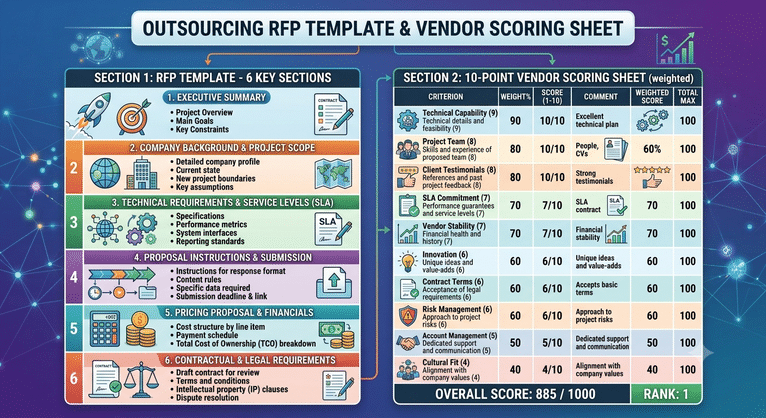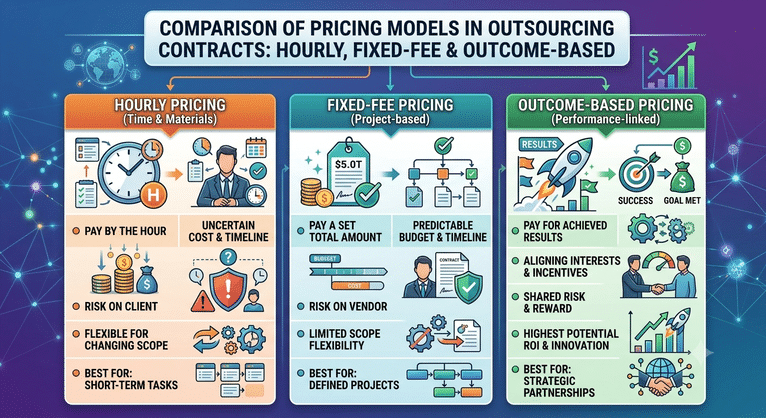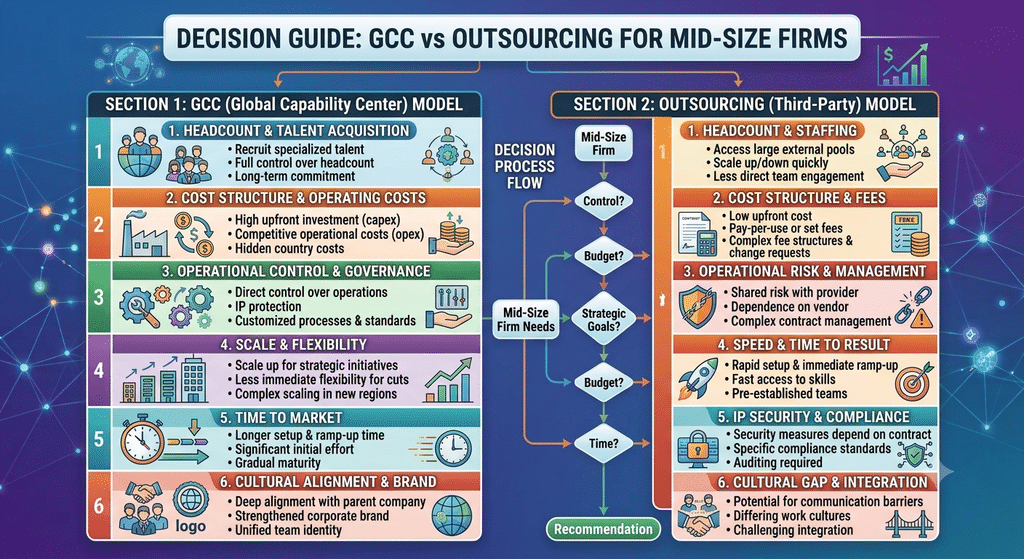
GCC vs outsourcing is the offshore question more mid-size CEOs and CFOs are asking in 2026, and most of the advice they find was written for Fortune 500 budgets. A Global Capability Center (GCC) is a captive team you own in another country. Outsourcing means renting a vendor’s team. The right choice depends less on ideology and more on three numbers: how many people you need, how long you need them, and how much control you must keep.
The scale of the shift is hard to ignore. The Nasscom-Zinnov India GCC Landscape Report for FY26 counts 2,117 GCCs in India, employing about 2.36 million professionals and generating roughly $98.4 billion in revenue. That is up from about 1.9 million people and $64.6 billion in FY24. Mid-size firms are part of that wave: Zinnov-Nasscom’s mid-market research puts 480+ mid-market centers at roughly 27% of India’s GCC landscape.
Yet most coverage still assumes a thousand-seat center. If you run a company with 200 to 2,000 employees, you need a different answer: when does owning beat renting, where does the math flip, and what sits in between?
This guide gives you a plain-language definition, a break-even view, and a simple headcount and cost threshold you can take into your next board or budget meeting.
What Is a Global Capability Center (GCC)?
A GCC is a company-owned offshore unit, usually set up as a subsidiary, that performs engineering, finance, analytics, support, or other functions for the parent company. You hire the staff, you own the processes and IP, and the team works as an extension of your business rather than a vendor’s.
A GCC differs from outsourcing in one key way: the employees are yours. A vendor team is billed by the hour or by the head, and the vendor keeps the margin, the HR burden, and often the institutional knowledge. In a GCC you carry the setup cost and the management load, and you keep the compounding value.
Why Does GCC vs Outsourcing Matter for Mid-Size Businesses?
It matters because the wrong model is expensive in both directions. Build too early and you carry fixed costs without enough people to spread them across. Outsource too long and you keep paying a vendor margin on work that has become core to your product.
Wisemonk’s analysis of India operating models describes vendor margin as a recurring 25% to 45% on every engineer, while a GCC’s setup cost (cited at $500,000 to $3 million) is spent once. That is why the decision turns on headcount and time horizon, not on the rate card. For a CFO, the question is when the one-time cost beats the recurring margin.
How Do a GCC, a Hybrid, and a Vendor Compare?
A vendor is fastest and most flexible, a GCC gives the most control and the best long-run unit cost, and a hybrid trades some of each. The hybrid most firms use is Build-Operate-Transfer (BOT), where a partner sets up and runs the center for an agreed period, then hands it over to you. Alvarez & Marsal’s operating-model paper notes BOT has become increasingly common for small and mid-size entities.
| Factor | Vendor (outsourcing) | Hybrid (BOT / managed GCC) | Own GCC |
|---|---|---|---|
| Time to start | Weeks | 2–4 months | 3–6 months for the build phase |
| Upfront cost | Low | Moderate (setup fee) | Highest |
| Cost per head over time | Highest (vendor margin) | Falls after transfer | Lowest at scale |
| IP and knowledge control | Limited | Growing | Full |
| Flexibility to scale down | High | Medium | Low |
| Management burden | Low | Medium | High |
Each model carries real risk. Keep these in mind before you choose:
- Vendor risk: knowledge walks out with attrition, and switching costs rise over time.
- Hybrid risk: the transfer terms can be vague, so contract them carefully.
- GCC risk: you inherit local hiring, attrition, entity compliance, and management.
What Is the Break-Even Point for a GCC?
There is no single number, and anyone quoting one without caveats is oversimplifying. Published estimates vary with function, city, and how lean the setup is, so treat them as a range.
- Advisor guidance: As reported by Opsio, Everest Group data suggests GCCs under 100 employees carry about 40% higher per-head costs than equivalent outsourcing, and Deloitte estimates a 150-person GCC reaches cost parity with outsourcing by year three.
- GCC-builder estimates: ANSR says most GCCs reach cost parity with outsourcing within 18 to 24 months.
- Phased-model estimates: Some India advisory firms say break-even is possible at 25 to 50 engineers using phased models, though these sources sell GCC setup, so read them with that in mind.
Reading across these, a realistic planning range is roughly 50 to 150 sustained heads and a 2 to 3 year horizon. Below that, fixed costs dominate. Above it, the vendor margin starts to cost you more than the center does.
Which Model Fits Your Size? The Three-Gate Threshold Guide
The Three-Gate Guide is a simple test: your plan must pass three gates, Headcount, Horizon, and Control, before owning a center makes sense. Fail a gate and you step down to a hybrid or a vendor.
- Gate 1, Headcount: Will you need at least 50 stable offshore roles in the next 12 months, and 150 or more within three years?
- Gate 2, Horizon: Is this work core to your business for at least three years, not a project that ends?
- Gate 3, Control: Is IP, data sensitivity, or product knowledge important enough that you want these people on your own payroll?
Use the results this way. These thresholds are indicative rules of thumb synthesized from the sources above, not guarantees, and they vary by role type and city.
| Your situation | Planned offshore headcount | Indicative annual offshore spend | Suggested model |
|---|---|---|---|
| Passes 0–1 gates | Under 50 | Under about $1.5M | Vendor |
| Passes 2 gates | 50–150 | About $1.5M–$4M | Hybrid (BOT or managed GCC) |
| Passes all 3 gates | 150+ | About $4M and above | Own GCC |
The spend bands trace to published cost figures: one India advisory firm cites roughly $1.5–2M a year for a 50-person GCC and $6–8M for 200 people, and a mid-size GCC example puts 150 people at about $3.75–4.5M annually at $25,000–$30,000 fully loaded per head. Your own quotes will differ, so validate against real bids before committing.
FAQ
What is a GCC and why does it matter for B2B businesses?
A GCC is a company-owned offshore center that performs work for the parent company. It matters because India alone now hosts 2,117 of them, and owning one can lower long-run cost per head and keep knowledge in-house once you reach sufficient scale.
How do I choose between GCC vs outsourcing within my budget?
Run the Three-Gate test. Under about 50 planned heads or about $1.5M in annual spend, a vendor usually wins. Between 50 and 150 heads, a hybrid BOT is often the safest middle path. Above that, price an own GCC against your real vendor quotes.
What checks should I do before outsourcing or building a GCC?
Confirm the vendor’s security certifications, review the transfer terms in any BOT contract, and test attrition and knowledge-transfer practices with references. Also verify entity, tax, and data-protection obligations in the host country with local counsel.
How long does a GCC vs outsourcing decision take to execute, and what does it cost?
A vendor can start in weeks. A GCC build phase commonly takes 3 to 6 months and does not include the operate and transfer phases that follow. BOT operate phases typically run 18 to 36 months, and setup costs are cited from about $500,000 up to $3 million depending on scale.
Compare Your Options With MyB2BNetwork
Choosing between GCC vs outsourcing is easier when you can see real quotes side by side. MyB2BNetwork connects mid-size firms with vetted outsourcing, BOT, and managed-GCC partners, so you can test the numbers above against actual proposals instead of estimates.
Browse our vetted offshore delivery partners, read our guide on protecting your IP when outsourcing, and see how vendor response time can be a useful early filter when comparing providers.
How to Hire, Source, or Outsource a GCC or Vendor Team in the U.S.
U.S. mid-size firms exploring GCC vs outsourcing are common across SaaS startups in Austin, fintech in New York, healthcare in Chicago, and logistics in Atlanta. Two topics matter most before you commit.
How to choose a vendor or partner within budget. Match the model to your headcount first, then compare partners on references from firms your size, transfer terms, and attrition record. As a rough, indicative guide, a small vendor team often runs from the mid-five figures to low-six figures per month, a 50-person managed or BOT setup can land in the low-to-mid seven figures annually, and a GCC build adds a one-time setup of roughly $500,000 to $3 million. Expect 4 to 8 weeks to start with a vendor and 3 to 6 months or more to stand up a BOT or GCC. MyB2BNetwork can get accurate quotations for your specific scope.
Checks needed before you sign. Ask for SOC 2 reports and ISO 27001 certification, and map their controls to the NIST Cybersecurity Framework. If you handle health or consumer data, confirm how the partner supports HIPAA and CCPA obligations, and check how data protection is handled under India’s data-protection law and, for EU data, GDPR. Get SLAs, exit and transfer terms, and IP assignment written into the contract, and watch for red flags such as vague transfer clauses or no references from firms your size.