Outcome-based pricing in outsourcing means you pay a vendor for a measurable result, such as a resolved ticket or a processed invoice, instead of for the hours their team logs. It sounds obvious, and it is getting harder to ignore as AI shrinks the effort behind many delivery tasks. If a tool can draft in minutes what used to take a day, billing by the hour starts to reward the wrong thing.
The catch is that few buyers have actually done it. Gartner VP analyst Tom Coshow told CIO Dive that only 19% of services buyers, and 13% of service agreements on the seller side, use outcome-based arrangements today. Coshow has also called the surge in outcome pricing “more buzz than reality,” and Gartner does not expect it to dominate services contracts through 2031.
So the honest picture is mixed. The model can align incentives better than hourly billing, but it fails quickly when the contract is vague. This guide explains how outcome-based pricing in outsourcing works, compares it with hourly and fixed-fee deals, and gives three clause examples you can adapt. It is written for procurement teams, founders, and project managers.
What Is Outcome-Based Pricing in Outsourcing?
Outcome-based pricing in outsourcing is a contract model where payment depends on a defined, verified business result rather than time spent or a fixed scope delivered. The vendor takes on part of the delivery risk, and the buyer pays when the agreed result is met.
Familiar examples exist outside outsourcing. Rolls-Royce has long sold engine uptime by the hour instead of selling engines. In software, Zendesk began charging per “Automated Resolution” in August 2024, counting a ticket as resolved only if the customer did not come back within a 72-hour window.
Why Does Outcome-Based Pricing Matter Now?
It matters because AI is breaking the link between hours worked and value delivered. When effort falls but billing stays hourly, the buyer captures none of the savings.
The pressure is visible among large providers. Digital Today reports that three quarters of Boston Consulting Group’s largest AI projects use variable fees, and McKinsey ties roughly a quarter of its global fees to performance. Gartner also predicts that at least 40% of enterprise SaaS spend will shift toward usage-, agent-, or outcome-based pricing by 2030.
How Do Hourly, Fixed-Fee and Outcome-Based Models Compare?
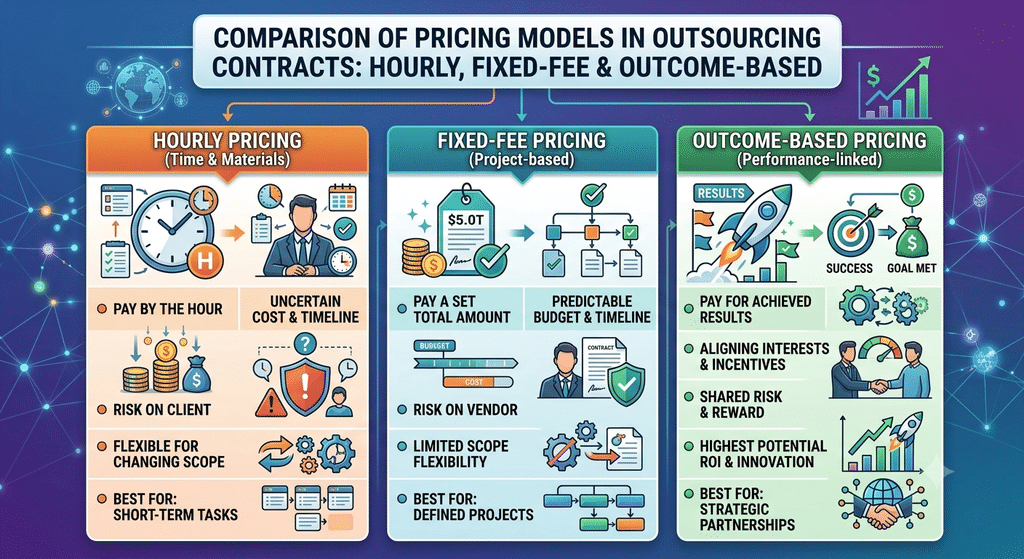
Each model puts the risk in a different place, and none is best everywhere. Hourly suits uncertain work, fixed-fee suits well-defined scope, and outcome-based suits work with a clear, countable result.
| Hourly (T&M) | Fixed-fee | Outcome-based | |
|---|---|---|---|
| What you pay for | Time logged | Agreed scope | Verified result |
| Who carries delivery risk | Buyer | Mostly vendor, until scope changes | Shared, often mostly vendor |
| Best fit | Exploratory or changing work | Defined projects | Repeatable work with a measurable result |
| Main weakness | Rewards slower delivery | Change-order fights | Metric and attribution disputes |
| Cost predictability | Low | High | Medium (depends on volume) |
Many real contracts are hybrids: a smaller base fee that covers the vendor’s costs, plus a variable fee tied to results. Cognizant-focused analysis from mybusinessfuture.com likewise notes outcome models tend to complement hourly contracts, not fully replace them.
What Risks Come With Outcome-Based Pricing in Outsourcing?
The biggest risks are unclear metrics, disputed attribution, and misaligned risk. Most failures trace back to the contract, not the vendor.
- Unclear metrics: “Improve customer satisfaction” cannot be invoiced. A result needs a unit, a data source, and a counting rule.
- Attribution: If sales rise, was it the vendor’s campaign or your new pricing? Without a baseline, both sides can argue forever.
- Gaming: A vendor paid per closed ticket may close tickets early. Add a quality or reopen window.
- Risk theater: Gartner’s guidance to CIOs is blunt: if the vendor is not taking on risk, why bother with outcome-based pricing?
- Data control: If only the vendor can measure the result, you cannot verify the invoice.
How Do You Define an Outcome? The MBT Check
Write every outcome clause so it passes the MBT Check: a Metric everyone can count, a Baseline everyone agrees on, and a Trigger that releases payment. If any of the three is missing, you are signing a hope, not a contract.
The three examples below use an illustrative support-ticket scenario. The figures are examples only, and any real clause should be reviewed by your legal counsel.
1. Measurable outcome (the Metric) “A ‘Resolved Ticket’ means a customer support ticket that Vendor marks closed in Client’s helpdesk system and that receives no customer reply or reopen within 72 hours. Tickets tagged spam, duplicate, or out-of-scope are excluded. Client’s helpdesk system is the sole system of record.”
2. Baseline “The Baseline is the 90 calendar days ending on the Effective Date, as documented in Schedule B: 4,200 tickets per month, a 61% first-contact resolution rate, and an average cost of $11.80 per resolved ticket. Baseline figures may be revised only by written agreement of both parties.”
3. Payment trigger “Client shall pay a monthly base fee of $18,000 plus an Outcome Fee of $6.50 for each Resolved Ticket above 4,200 in that month, capped at $12,000 per month. Vendor delivers the Outcome Report by the 5th business day. Client has 10 business days to dispute specific tickets with evidence; undisputed amounts are payable net 30. Unresolved disputes go to named executives, then to mediation.”
Notice what these clauses do: they name the system of record, freeze the baseline, cap the upside, and set a dispute clock. Those four details prevent most fights.
FAQ
What is outcome-based pricing in outsourcing and why does it matter for B2B businesses?
It is a payment model tied to a verified result instead of hours. It matters because AI is reducing delivery effort, which makes hourly billing a weaker proxy for value, though Gartner data suggests adoption is still limited.
How do I choose the right vendor for outcome-based pricing within my budget?
Choose vendors who already track their own results and will accept a hybrid structure with a modest base fee. A vendor unwilling to put any fees at risk is not really offering an outcome model.
What checks should I do before outsourcing under an outcome-based model?
Confirm the metric can be measured from your own systems, agree a baseline in writing, test the vendor’s reporting, and set a dispute process before work starts. Ask for references on past outcome-based contracts, not just hourly ones.
How long does outcome-based outsourcing typically take to set up and what does it cost?
Plan on roughly 6–10 weeks, including a 30–90 day baseline period. Costs vary widely, but expect a base fee plus a variable component rather than a single price.
Get Outcome-Based Quotes Through MyB2BNetwork
Comparing outcome-based proposals is harder than comparing hourly rates, because each vendor defines results differently. MyB2BNetwork helps procurement teams and founders compare vetted outsourcing partners side by side and request quotes built on the same metric, baseline, and payment trigger.
Browse our vetted outsourcing partners to start, read our vendor response time study to see which partners reply fast enough to be worth shortlisting, and review our guide on how to protect your IP when outsourcing before you share data.
How to Hire or Outsource Under Outcome-Based Pricing in the U.S.
Outcome-based pricing in outsourcing is most common for repeatable functions such as support, back-office processing, and lead qualification, which suits SaaS startups in Austin, fintech teams in New York, and logistics firms in Atlanta. Two things matter most.
Choosing a vendor within budget. Expect most outcome-based deals to be hybrids: a base fee often in the mid four to low five figures per month, plus a variable fee tied to volume. Treat these as rough planning ranges, not quotes, and ask MyB2BNetwork for accurate quotations for your scope. Prioritize vendors with existing measurement dashboards and a willingness to share risk.
Checks before you sign. Verify security posture against SOC 2 and ISO 27001, and reference NIST frameworks if you handle sensitive data. If the work touches personal data, confirm alignment with CCPA, and with HIPAA for health data. Review past clients, written SLAs, audit rights over the reporting data, and the dispute clock. Allow about 6–10 weeks to set up, including the baseline period.