An outsourcing RFP template is the fastest way to turn a vague idea (“we need a vendor for this”) into a document vendors can answer consistently and you can score fairly. Without one, every proposal arrives in a different format, with different assumptions, and you end up comparing polish instead of substance.
Most failed outsourcing deals trace back to the same root: unclear requirements at the start. Gartner’s survey of executives, reported in 2003, found that only about half of outsourcing deals met expectations. That study is old, but the pattern it describes is familiar to any procurement team that has inherited a contract with fuzzy scope and no measurable service levels.
This guide gives you a section-by-section outsourcing RFP template you can copy, a comparison of RFP, RFI, and RFQ, and a 10-point scoring sheet for ranking vendor responses. It is written for procurement teams, founders, and project managers who need a working document, not a theory lecture.
What Is an Outsourcing RFP Template?
An outsourcing RFP template is a reusable Request for Proposal structure that tells vendors what you need, how you will judge them, and what format to answer in. It standardizes six things: goals, scope, security requirements, service levels, pricing format, and evaluation criteria.
The template is not the final RFP. It is the skeleton you fill in per project, so each new sourcing effort starts from a tested structure instead of a blank page.
Why Does an Outsourcing RFP Template Matter for Businesses?
It matters because it makes vendor responses comparable, which is the whole point of running a competitive process. When every vendor answers the same questions in the same order, differences in price, risk, and capability become visible instead of buried in sales language.
It also protects you later. The requirements, SLAs, and security terms you put in the RFP usually flow into the contract, so a precise RFP reduces renegotiation. A reusable template also speeds up the next project, since legal and security reviewers only have to re-approve the changes.
RFP, RFI, or RFQ: Which Document Do You Need?
Use an RFI to learn what the market offers, an RFQ to compare prices on a well-defined commodity, and an RFP when the solution, approach, and price all need to be evaluated together. Most outsourcing decisions with real service or technical complexity need an RFP.
| Document | Best used when | What vendors return |
|---|---|---|
| RFI (Request for Information) | You are still exploring options and vendors | Capabilities, company background, general approach |
| RFQ (Request for Quotation) | Scope is fixed and price is the main variable | Itemized price quotes |
| RFP (Request for Proposal) | Approach, risk, and price must be weighed together | Solution design, team, SLAs, pricing, references |
A common sequence is RFI to build a shortlist, then RFP to the shortlist only. That keeps the response burden reasonable for vendors and your evaluators.
What Should an Outsourcing RFP Template Include?
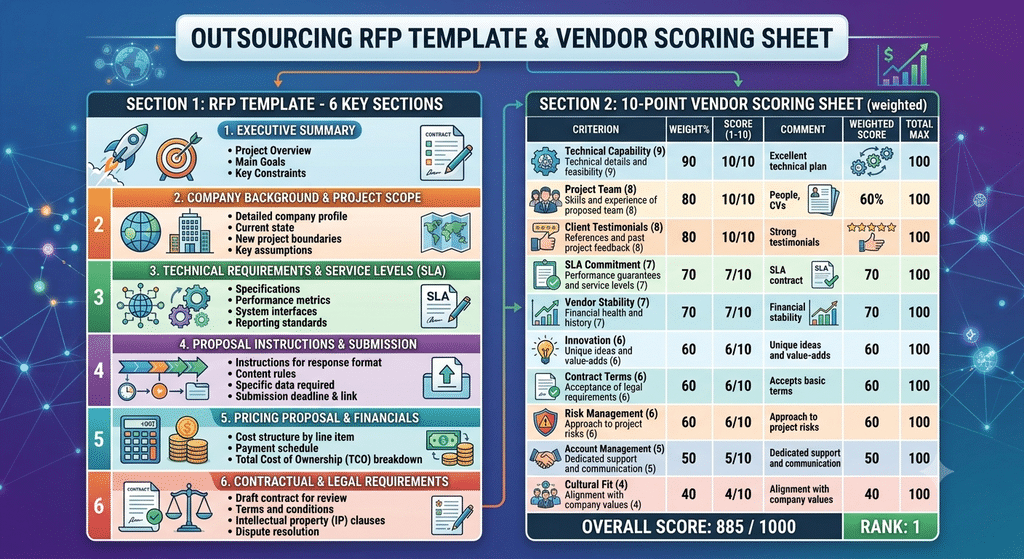
A complete outsourcing RFP template covers six blocks, which we call the Six-Block RFP Framework: Goals, Scope, Security, Service levels, Pricing, and Evaluation. Copy the structure below and replace the bracketed fields.
1: Goals and background
- Company overview: [company, industry, size]
- Business objective: [what outcome the outsourcing must achieve]
- Success metrics: [e.g., cost reduction target, cycle-time target, quality target]
- Timeline: [RFP issue date, question deadline, response deadline, decision date, desired start date]
2: Scope of work
- Services in scope: [list tasks, volumes, and systems]
- Explicitly out of scope: [list exclusions]
- Tools and platforms the vendor must work in: [e.g., your CRM, ticketing, or code repository]
- Location, language, and working-hour requirements: [details]
3: Security and compliance
- Required certifications: [e.g., ISO/IEC 27001, SOC 2 Type II]
- Data handled: [personal data, financial data, source code, none]
- Access model: [least-privilege access, VPN, device policy]
- Incident notification window: [e.g., within 72 hours]
- Subcontractor rules: [approval required, same terms flow down]
4: Service levels (SLAs)
- Response time target: [e.g., first reply within X hours]
- Quality or accuracy target: [measurable percentage]
- Reporting cadence: [weekly, monthly]
- Remedies for missed SLAs: [service credits, escalation, termination rights]
5: Pricing format
- Required model: [fixed fee, time and materials, per-unit, retainer]
- Required breakdown: [rate card, team composition, one-time vs recurring costs]
- Assumptions to state: [volume bands, travel, tooling, change-request rates]
- Payment terms: [net days, milestones]
6: Evaluation and submission
- Evaluation criteria and weights: [reference the scoring sheet below]
- Required references: [number and similarity to your use case]
- Submission format and contact: [file type, page limit, single point of contact]
- Vendor questions: [how and when they may ask]
How Do You Score Vendor Responses With a 10-Point Sheet?
Score each vendor from 0 to 10 on ten criteria, for a total out of 100. Decide the weights and criteria before you open any proposal, so you are not tempted to adjust them toward a favorite.
Scoring guide: 0 to 3 means weak or missing, 4 to 6 means acceptable with gaps, 7 to 10 means strong and evidenced.
| # | Criterion | What to look for | Score (0–10) |
|---|---|---|---|
| 1 | Goal alignment | Response addresses your stated outcome, not a generic pitch | |
| 2 | Scope understanding | Restates scope accurately, flags risks and assumptions | |
| 3 | Relevant experience | Comparable projects with named, reachable references | |
| 4 | Security and compliance | Current certifications, clear data-handling controls | |
| 5 | SLA commitments | Measurable targets with remedies, not “best efforts” | |
| 6 | Pricing clarity | Complete breakdown, stated assumptions, no hidden fees | |
| 7 | Team and continuity | Named roles, seniority mix, plan for staff turnover | |
| 8 | Delivery and communication | Clear process, reporting cadence, escalation path | |
| 9 | Transition and exit terms | Onboarding plan, knowledge transfer, data return | |
| 10 | Commercial and financial fit | Reasonable terms, stability, flexibility to scale |
Have two or three evaluators score independently, then compare. Large gaps between evaluators usually point to an ambiguous requirement worth clarifying with the vendor.
Which Mistakes Weaken an Outsourcing RFP?
The most common mistakes are vague scope, no measurable SLAs, and unweighted evaluation criteria. Each one pushes the decision toward whoever presents best rather than whoever delivers best.
- Vague scope: “Support our marketing” invites ten different interpretations and ten incomparable prices.
- Unmeasured service levels: If a target cannot be measured, it cannot be enforced.
- Pricing without assumptions: A low headline number often depends on volumes or exclusions you did not notice.
- Skipping security questions: Adding them after shortlisting delays the process and surprises vendors.
FAQ
What is an outsourcing RFP template and why does it matter for B2B businesses?
It is a reusable structure for requesting proposals from outsourcing vendors, covering goals, scope, security, SLAs, pricing, and evaluation. It matters because it makes responses comparable and carries clear requirements into the final contract.
How do I choose the right vendor with an outsourcing RFP template within my budget?
State your budget range or pricing model in the RFP so vendors respond to a realistic frame. Then score on total value, including SLAs and risk, rather than the lowest price alone.
What checks should I do before outsourcing using this template?
Verify certifications, call at least two references of similar scale, and review sample reports or contracts. Confirm security, subcontractor, and exit terms in writing before award.
How long does the RFP process take and what does it cost?
Expect roughly 1–2 weeks to prepare, 2–3 weeks for vendor responses, and 2–3 weeks to evaluate and negotiate, so about 5–8 weeks end to end. The template itself is free; the cost is mostly internal time, plus legal review if you need it.
Get Your Outsourcing RFP Template and Vendor Shortlist With MyB2BNetwork
A good outsourcing RFP template only works if the right vendors receive it. MyB2BNetwork helps procurement teams, founders, and project managers find vetted outsourcing partners, compare them on the same criteria, and request accurate quotations without chasing vendors one by one.
Download the fill-in template and scoring sheet above, then browse our vetted outsourcing vendors to build a shortlist. If you are weighing IP risk in the same decision, read our guide on how to protect your IP when outsourcing, and use our vendor response time study to benchmark how quickly shortlisted vendors actually reply.
How to Hire, Source, or Outsource Using an Outsourcing RFP Template in the U.S.
U.S. buyers use an outsourcing RFP template across very different contexts: SaaS startups in Austin sourcing development, healthcare groups in Chicago sourcing billing or support, and logistics firms in Atlanta sourcing back-office operations. Two areas matter most.
Choosing a vendor within budget. Set a pricing format in the RFP and ask for a rate card plus a total first-year cost. As a rough, non-guaranteed range, scoped outsourcing engagements often land in the mid-five to low-six figures annually, and larger multi-team programs go higher. MyB2BNetwork can help you get accurate quotations for your specific scope.
Checks before outsourcing. Ask for SOC 2 Type II reports and ISO/IEC 27001 certification where vendors handle sensitive data. NIST’s supply chain guidance, SP 800-161, is a useful reference for structuring third-party risk questions. If you handle health data, require HIPAA business associate terms; for California residents’ data, confirm CCPA obligations and flow-down to subcontractors. Write SLAs, audit rights, and exit terms into the contract, and treat vendors that resist measurable SLAs as a red flag.