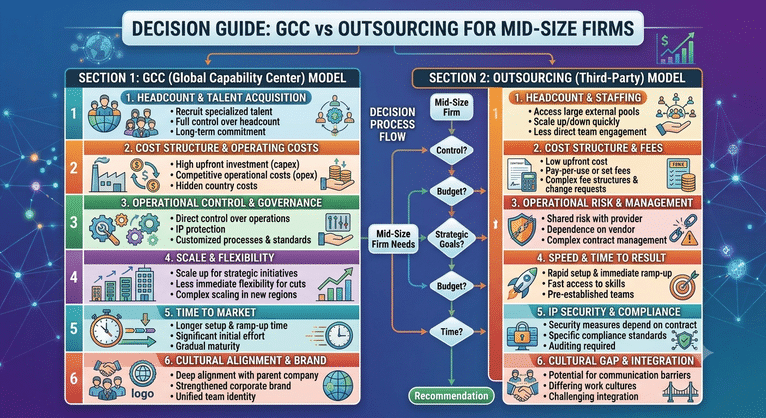
The biggest risks of outsourcing are data and security exposure, IP and legal gaps, uneven quality, vendor dependency, and costs that creep past the quote. Each one can be reduced, but only if the control is built into the contract and the project plan before work starts, not added after something goes wrong.
For CTOs, legal teams, and founders, the useful question isn’t whether to outsource but which risks you’re taking on and what you’ll do about each. Outsourcing moves work outside your walls without moving the accountability. If a vendor leaks data or misses a deadline, your customers hold you responsible.
The numbers show why this matters now. Verizon’s 2026 Data Breach Investigations Report found that third parties were involved in 48% of breaches, up 60% from the 30% in the prior edition, which had itself doubled from 15%. That figure covers vendors, suppliers, and partners broadly, not only outsourcing firms, but it points the same direction as every vendor-risk review.
This guide answers the question in the order a risk review would: what each risk looks like, how to reduce it, and what to ask for in the contract.
What Are the Risks of Outsourcing?
The risks of outsourcing are the ways a vendor relationship can cost you money, data, control, or customers that an in-house team wouldn’t. They fall into five groups: security, IP and legal, quality and delivery, dependency and continuity, and cost.
Not every risk applies to every engagement. A short marketing project carries little continuity risk. An outsourced engineering team with access to your production systems carries all five. Start by naming which ones apply to you.
Why Does Managing the Risks of Outsourcing Matter?
It matters because the risks compound when nobody owns them. A vendor with weak security, vague IP terms, and no exit plan is cheap until the first incident, and then the cost lands on you.
It also affects speed. Investors, enterprise customers, and auditors increasingly ask how you vet and monitor vendors. A documented risk process shortens those reviews, while “we trusted them” lengthens them.
The Five-Lens Risk Register: How Do You Spot Each Risk?
The Five-Lens Risk Register is an original framework for this article. It checks every outsourcing deal through five lenses, each with a warning sign, a control, and a contract clause to ask for.
| Lens | Warning sign | Main control | Contract clause to ask for |
|---|---|---|---|
| Security | No independent audit report; shared logins | Least-privilege access; certified vendor | Security standards, breach notice window, audit rights |
| IP and legal | Ownership transfers only at final payment | IP assigned as work is created | IP assignment, subcontractor flow-down |
| Quality and delivery | No defined acceptance criteria; slow replies | Pilot first; milestone reviews | SLAs, acceptance tests, remedies for misses |
| Dependency and continuity | Knowledge sits with one or two people | Documentation; backup plan | Transition assistance, escrow, exit terms |
| Cost | Open-ended hours; unclear change process | Fixed milestones; spend caps | Change-order process, rate locks, itemized billing |
Score each lens as low, medium, or high before signing. Any lens scored high needs a named control and an owner.
How Do You Reduce Security and Data Risks?
Limit what the vendor can touch and verify how they protect it. Give each engineer only the access their task needs, remove it the day the task ends, and never share credentials.
Ask for evidence, not promises. A SOC 2 report or an ISO 27001 certificate shows an independent party tested the vendor’s controls. NIST’s SP 800-161 guidance on supply chain risk management is a useful reference for what to assess and how often.
Get a breach-notification window in writing, such as 24 to 72 hours, and the right to review access logs. Verizon’s data also shows that fixing issues quickly matters, so ask how fast the vendor patches and rotates exposed credentials.
How Do You Reduce IP and Legal Risks?
Make ownership automatic and enforceable. Sign the NDA before any technical discussion, assign IP to your company as it’s created rather than at final payment, and require subcontractors to accept the same terms.
Our guide to protecting IP when outsourcing covers the full clause checklist. For legal teams, also check governing law, dispute resolution, and whether liability caps are high enough to matter for a real incident.
How Do You Reduce Quality, Dependency, and Cost Risks?
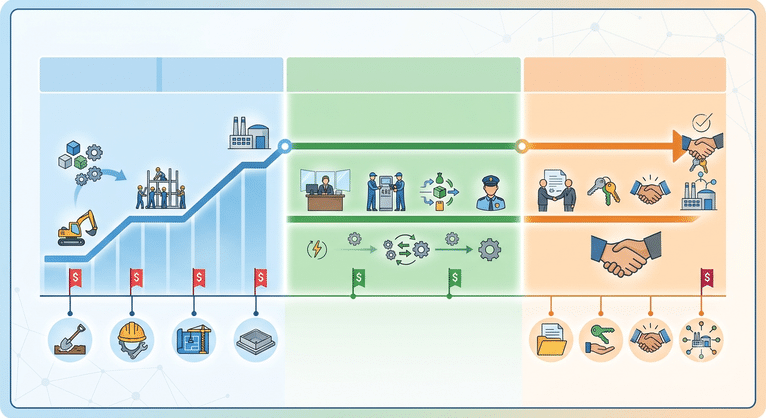
Start small, define “done,” and plan the exit on day one. These three habits address most of the remaining risks.
- Run a paid pilot. A 4 to 8 week pilot on a real task shows quality and communication before you commit to a long contract.
- Write acceptance criteria. Each milestone needs a test you can run, so “done” isn’t a matter of opinion.
- Test responsiveness. Our vendor response time study shows how often vendors reply slowly or not at all, so measure it before signing.
- Document continuously. Require architecture notes, runbooks, and code in your repositories, so no single vendor engineer holds the knowledge.
- Cap and itemize spend. Use fixed milestones or monthly caps, a written change-order process, and itemized invoices.
- Plan the exit. Include transition assistance, data return, and deletion certification. If the team will eventually become yours, see our guide to the build-operate-transfer model.
For continuity, ISO 22301 sets out business continuity management practices worth asking critical vendors about.
FAQ
What are the risks of outsourcing and why do they matter for B2B businesses?
They are the security, IP, quality, dependency, and cost exposures that come from moving work to an outside vendor. They matter because you keep the accountability to customers and regulators even when the vendor causes the problem.
How do I choose the right outsourcing vendor within my budget while limiting risk?
Filter by evidence first: independent security reports, references from similar clients, and willingness to accept your IP and exit terms. Then compare price, and be wary of a quote far below the others, since it often hides gaps in security, staffing, or scope.
What checks should I do before outsourcing?
Review security certifications, test responsiveness, call two or three past clients, and read the subcontractor policy. Confirm IP assignment, audit rights, SLAs, and exit terms are in the contract before any access is granted.
How long does it take to reduce the risks of outsourcing, and what does it cost?
Due diligence and contracting usually take 4 to 8 weeks, followed by a pilot. Legal review and a security assessment commonly cost a few thousand dollars to low five figures for a significant engagement, which is small next to the cost of an incident.
Reduce the Risks of Outsourcing With MyB2BNetwork
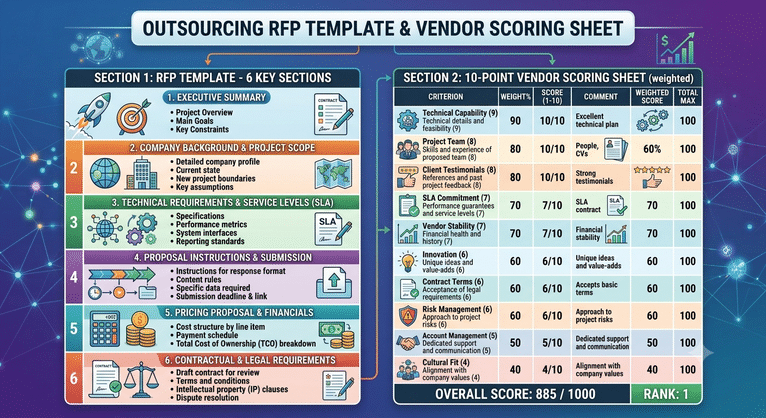
A risk register is easier to run when you start with vendors that already meet it. MyB2BNetwork connects CTOs, legal teams, and founders with vetted outsourcing partners and can get you comparable quotes, so you can judge security, IP terms, and pricing side by side instead of from separate sales decks.
Browse our vetted outsourcing partners to compare providers against the five lenses above.
How to Hire, Source, or Outsource Safely in the U.S.
U.S. companies across SaaS in Austin, fintech in New York, healthcare in Chicago, and logistics in Atlanta outsource technical and operational work, and the risks of outsourcing change with the regulations each industry faces. Two topics matter most.
How to choose a vendor within budget. Sort vendors into tiers by risk you’re handing over, not only by price. Basic, low-access work such as content or design support may cost a few thousand dollars per month. Engineering or operations teams with system access commonly run from the mid-four figures to the low-to-mid five figures per month, depending on team size and seniority. These are estimates, not quotes, and MyB2BNetwork can get accurate quotations for your scope. Prioritize vendors who show audit reports and accept your contract terms over those who only offer the lowest rate.
Checks needed before outsourcing. Ask for a current SOC 2 Type II report or ISO 27001 certificate, and map the vendor’s controls to the NIST Cybersecurity Framework if you operate in a regulated sector. Confirm HIPAA business associate terms for healthcare data, CCPA service-provider terms for California consumer data, and GDPR or UK-GDPR terms if you handle EU or UK residents’ data. Put SLAs, breach-notification timing, audit rights, and exit terms in the contract. Red flags include refusing audits, vague subcontractor lists, and pressure to skip the pilot. Budget 4 to 8 weeks for diligence and contracting.