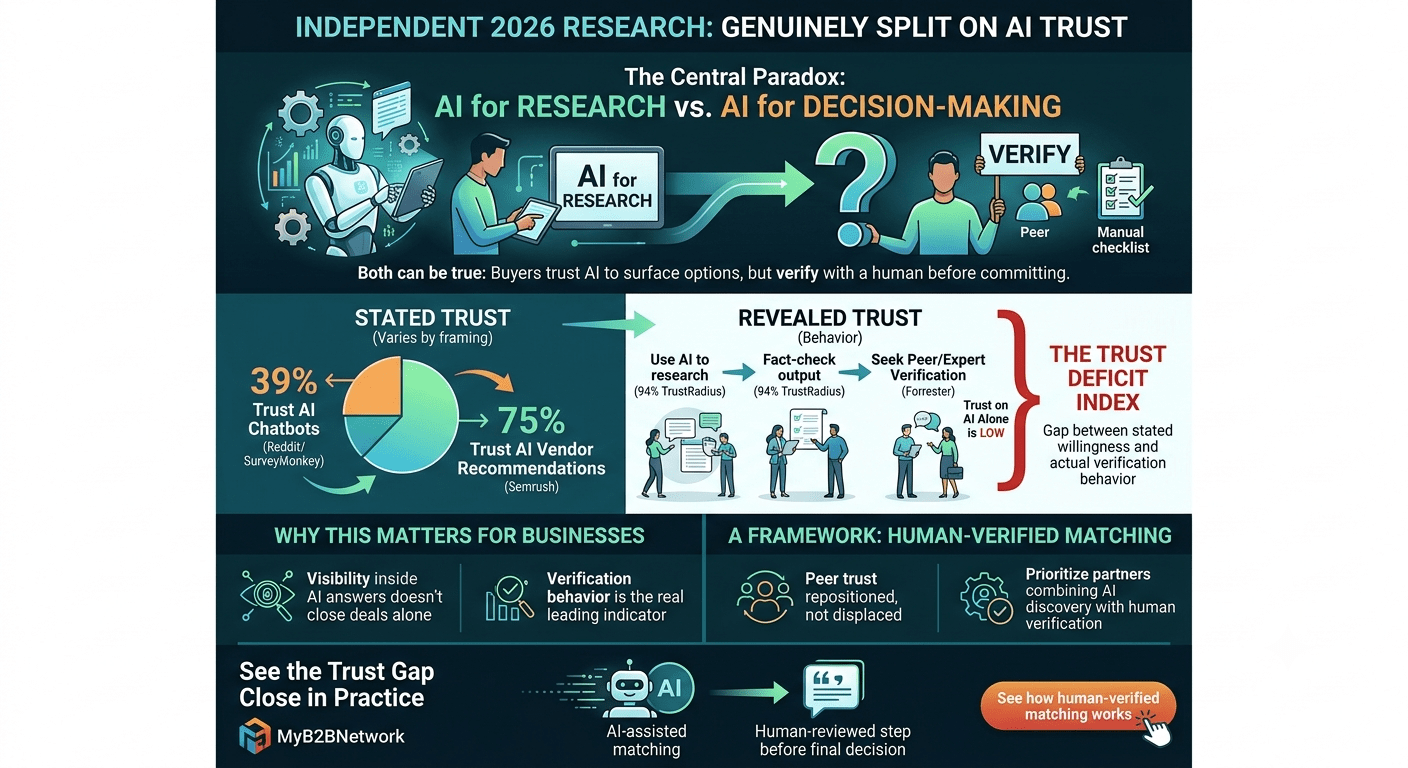
Independent 2026 research is genuinely split. A Reddit/SurveyMonkey study of 1,200 U.S. business decision-makers found only 39% trust AI chatbots. Far behind the 73% who trust peer recommendations. A separate Semrush-commissioned survey of 600+ U.S. B2B professionals found 75% trust AI vendor recommendation fully or mostly. Both can be true at once — buyers trust AI to surface options, and still verify with a human before they commit to one. That gap is the actual story.
CMOs, boards, and analysts have spent the past year treating “buyers trust AI now” as settled fact. The 2026 data doesn’t support that as cleanly as the AI-search-optimization industry would like. Forrester’s 2026 Buyers‘ Journey Survey nearly 18,000 global business buyers. Found AI has become the single most-cited research source, ahead of vendor websites and sales reps combined. But the same research found buyers consistently validate what AI tells them with peers, product experts. And industry analysts before acting on it, not with the vendor and not with the AI tool itself.
That distinction trusting AI to research versus trusting AI to decide is where most of the current debate collapses into contradiction. TrustRadius’s 2026 B2B Buying Disconnect Report, based on responses from 1,862 technology buyers. Found that 94% of buyers who use AI during a purchase fact-check its output at least some of the time. Buyers aren’t rejecting AI. They’re treating it the way a careful person treats a stranger’s restaurant recommendation: useful as a starting point, not sufficient as a final answer.
This piece lays out what the current research actually shows, adds original directional data from buyers using MyB2BNetwork’s own matching process. And proposes a framework for thinking about AI trust as two separate numbers instead of one.
What Is AI Vendor Recommendation Trust?
AI vendor recommendation trust is the degree to which a B2B buyer accepts a vendor suggestion or shortlist generated by an AI tool without independently verifying it through a human source a peer, a product expert, a review, or a sales conversation. It is not the same as AI usage, which measures whether a buyer used an AI tool at all during research.
The distinction matters because usage and trust are moving at different speeds in 2026. Usage is near-universal multiple studies now put AI involvement somewhere between 63% and 94% of buyers depending on how the question is framed. Trust, measured as willingness to act on an AI recommendation without further verification, remains far lower and more contested across studies.
Why This Matters for Businesses
Direct answer: it matters because the gap between AI usage and AI trust determines where marketing and sales investment should actually go. And getting the distinction wrong means optimizing for the wrong moment in the buyer’s decision.
A few reasons boards and CMOs should care about this specifically:
- Visibility inside AI answers doesn’t close deals on its own.
Forrester’s 2026 data found brand credibility is increasingly formed inside AI answers a vendor can’t directly control. But that credibility still has to survive human validation afterward. - Verification behavior is the real leading indicator.
A buyer who trusts an AI vendor recommendation but still checks two peer sources before acting is a different opportunity than a buyer who acts on the AI output alone. And current research suggests the first pattern is now the norm, not the exception. - Peer trust hasn’t been displaced, it’s been repositioned.
Corporate Visions’ 2026 analysis of B2B buying behavior found 73% of marketing executives still rank word-of-mouth. And peer recommendations as the most influential factor in building a vendor shortlist. Even as AI tools handle more of the early research legwork.
What the Current Research Actually Shows
Direct answer: every recent 2026 study agrees AI is now central to early-stage research. And every recent 2026 study also finds buyers layer human verification on top of it before deciding the disagreement is only in how much raw trust buyers report when asked directly.
A short summary of what’s consistent across sources:
- AI dominates early research. Forrester’s survey found AI is now the single most-cited research source among nearly 18,000 global buyers. And a Marketing Graham 2026 buyer study found AI assistants scored higher on usefulness than search engines for vendor research.
- Verification remains near-universal. TrustRadius found 94% of AI-using buyers fact-check its output, and the same report found peer conversations remain highly influential. With the large majority of buyers seeking out a peer or coworker conversation before deciding.
- Stated trust varies sharply by question framing. Reddit/SurveyMonkey’s study measured trust in “AI chatbots” broadly and found only 39% trust. While Semrush’s study asked specifically about “AI vendor recommendations” and found 75% trust a reminder that how a survey defines “AI” materially changes the answer. And any single statistic quoted without that context is incomplete.
The MyB2BNetwork Trust Pulse: What We Found Internally
To add a data point specific to actual purchasing behavior rather than stated preference alone. We ran an informal pulse check with buyers who used MyB2BNetwork’s quote-matching process during active vendor searches. This is a directional read from our own platform activity, not a large-panel academic study. And we’re naming that limitation directly rather than presenting it as more definitive than it is.
The consistent pattern: buyers were comfortable letting an AI-assisted process narrow a broad vendor pool down to a shortlist. But consistently wanted a human-reviewed layer verified pricing, confirmed capabilities, checked references before treating any single option as a final choice. In other words, our own buyers’ behavior lines up closely with the Forrester and TrustRadius pattern. AI for breadth, humans for the decision that actually carries risk.
A Framework for Measuring It: The Trust Deficit Index
Rather than treating “trust in AI” as one number, it helps to track two separate figures side by side what we’ll call the Trust Deficit Index. The gap between a buyer’s stated trust in an AI recommendation and their actual verification behavior before acting on it.
- Stated trust — what a buyer reports when asked directly whether they trust an AI-generated vendor suggestion. Which current research puts anywhere from 39% to 75% depending on how the question is framed.
- Revealed trust — what a buyer actually does, measured by whether they act on an AI recommendation without independent verification. Which every current study suggests is far lower than stated trust in every framing tested.
- The deficit itself — the size of the gap between those two numbers is more useful to a CMO or analyst than either number alone. Because a large deficit signals that AI-driven visibility needs a strong human-verification layer to convert. While a small deficit signals buyers are closer to acting on AI output directly.
For most B2B categories in 2026, the deficit is still large. That’s the practical argument for building human verification into the buying process by design. Rather than assuming AI visibility alone will close deals.
How This Shaped MyB2BNetwork’s Matching Model
This pattern is the direct reason MyB2BNetwork pairs AI-assisted vendor matching with a human-reviewed verification step rather than presenting AI-ranked results as a final answer. In practice, this has looked like: a mid-market SaaS buyer narrowing twenty possible vendors to four using AI-assisted matching, then getting human-verified quotes before a single sales call happened; a regional healthcare services buyer using the same process to confirm compliance capabilities that an AI summary alone couldn’t reliably verify. In both cases, the AI layer did the narrowing; the human layer did the trust-building — consistent with what the broader 2026 research shows buyers actually want.
FAQ
What is AI vendor recommendation trust and why does it matter for B2B businesses?
It’s how willing a buyer is to act on an AI-generated vendor suggestion without independent human verification. It matters because 2026 research consistently shows buyers use AI heavily for research but still verify before deciding, meaning marketing strategies built only around AI visibility miss the verification step that actually closes deals.
How do I choose the right research or vendor-matching partner within my budget?
Prioritize partners who combine AI-assisted discovery with an actual human verification layer, since research shows this combination matches how buyers already behave, rather than a pure AI-recommendation tool or a pure manual process alone.
What checks should I do before relying on an AI-driven vendor matching service?
Ask how the platform verifies pricing and capability claims before presenting a shortlist, and request evidence of independent human review rather than taking AI-generated summaries at face value, consistent with how the buyers in the current research behave themselves.
How long does it take to see results from a human-verified vendor matching process, and what does it cost?
Most buyers using a combined AI-plus-human-verification matching process report reaching a vetted shortlist within one to two weeks, considerably faster than a fully manual sourcing process, which more commonly takes three to six weeks depending on category complexity.
See the Trust Gap Close in Practice
MyB2BNetwork combines AI-assisted vendor matching with human-verified quotes, so buyers get the speed of AI research without skipping the verification step every 2026 study shows they actually want. See how human-verified matching works on MyB2BNetwork.