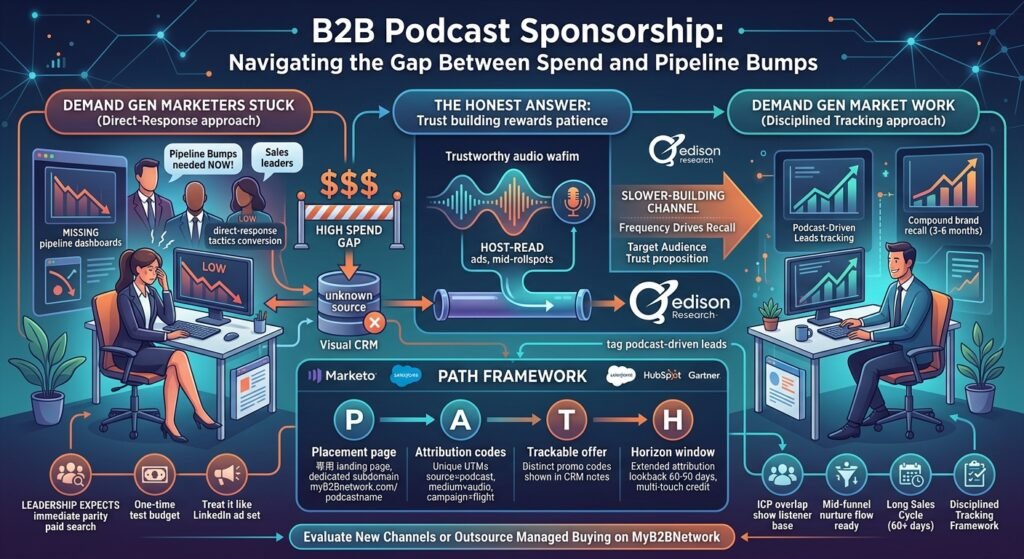
Podcast ad budgets keep climbing, and B2B marketers are getting pulled into the conversation whether they’re ready or not. Sales leaders hear a competitor sponsored a popular show and want to know why the pipeline dashboard doesn’t show a matching bump. That gap between spend and provable return is exactly where most demand gen teams get stuck. The honest answer is: B2B podcast sponsorship can work, but it works differently than a paid search campaign or a LinkedIn ad set. It’s a slower-building channel that rewards patience, niche targeting, and disciplined tracking — and it punishes teams that treat it like a direct-response tactic.
This piece breaks down when podcast sponsorship earns its budget line, when it doesn’t, and how to set up tracking that actually tells you the truth. No hype, no absolutes — just a practical framework demand gen marketers can use before the next budget conversation.
By the end, you’ll have a simple way to tag podcast-driven leads so they don’t vanish into an “unknown source” bucket in your CRM.
What Is B2B Podcast Sponsorship?
B2B podcast sponsorship is when a company pays to have its brand, offer, or message read or featured within an episode of a business-focused podcast, typically through host-read ads, pre-roll/mid-roll spots, or ongoing show partnerships. Unlike display or search ads, the message is delivered by a trusted voice the audience already listens to regularly. That trust is the entire value proposition — and also why it’s hard to measure with standard attribution models.
Why Podcast Sponsorship Matters for Demand Gen Teams
Podcast listening among B2B decision-makers keeps growing because it fits into commute time, gym time, and other moments where scrolling isn’t practical. Edison Research’s long-running Infinite Dial study has tracked podcast listening becoming a mainstream habit among working professionals, not a niche one. For demand gen, that means a channel where your buyer is genuinely paying attention, not skimming past a banner ad.
The catch: podcasts sit high in the funnel. They build familiarity and trust over weeks or months, not clicks in a single session. Teams that expect a podcast spot to behave like a Google Ads campaign usually walk away disappointed and cut the channel before it had time to work.
When Podcast Sponsorship Makes Sense
Podcast sponsorship tends to pay off when it’s matched to a narrow, well-defined audience rather than used as a mass-reach play. A few signals it’s worth testing:
- Your ideal customer profile overlaps clearly with a show’s known listener base (job title, industry, seniority)
- You have a 3–6 month runway to let brand recall compound before judging results
- You already have a mid-funnel nurture flow ready to catch listeners who visit your site but don’t convert immediately
- Your sales cycle is long enough (60+ days) that a trust-building channel fits naturally
- You can commit to a recurring slot rather than a single one-off read, since frequency drives recall
If most of these don’t apply yet, the budget is often better spent proving out a lower-funnel channel first.
When Podcast Sponsorship Doesn’t Make Sense
It’s just as important to name when this channel isn’t the right fit. Podcast sponsorship struggles when demand gen teams need fast, provable pipeline in the current quarter. A few red flags:
- Leadership expects last-click attribution parity with paid search
- The show’s audience is broad or consumer-leaning rather than matched to your ICP
- There’s no landing page or offer built specifically for podcast listeners
- Budget is a one-time test with no plan to repeat the placement
- The internal team has no bandwidth to build or monitor tracking codes
Running the channel without solving for measurement first is the single most common reason B2B podcast sponsorship gets labeled “not worth it” — often incorrectly.
A Simple Framework for Tracking Podcast-Driven Leads
Most attribution problems in podcast sponsorship come down to one thing: nobody set up clean tracking before the episode aired. Here’s a lightweight system, which we call the PATH Framework, built specifically for this channel:
- P — Placement page: Build a dedicated landing page or subdomain just for the show (e.g., yourcompany.com/podastname)
- A — Attribution codes: Assign a unique UTM parameter set (source = podcast name, medium = audio, campaign = episode or flight date) to every mention
- T — Trackable offer: Give listeners a distinct promo code or offer name only mentioned on that show, so it shows up cleanly in CRM notes even without a click
- H — Horizon window: Extend your attribution lookback window to 60–90 days in your CRM or marketing automation platform, since podcast-driven visits often return later via direct or organic search
Platforms like HubSpot, Marketo, and Salesforce can all support custom UTM fields and promo-code tagging without added tooling. Gartner’s research on marketing measurement consistently pushes marketers toward multi-touch attribution over single-touch models for exactly this reason — channels like podcasts rarely get proper credit under last-click reporting.
FAQ
What is B2B podcast sponsorship and why does it matter for B2B businesses?
It’s paid placement within a business podcast, usually a host-read ad or ongoing partnership. It matters because it reaches decision-makers in a high-trust, high-attention format that most paid channels can’t replicate.
How do I choose the right podcast sponsorship vendor within my budget?
Start by matching the show’s listener demographics to your ICP, then compare cost-per-flight against your existing cost-per-lead benchmarks. Prioritize shows with transparent download data over vague “reach” claims.
What checks should I do before outsourcing podcast sponsorship?
Ask for recent download numbers, listener demographic breakdowns, past sponsor case studies, and contract terms around make-goods if numbers underperform. Review sample host-read ads for tone fit before committing.
How long does podcast sponsorship outsourcing typically take, and what does it cost?
Setup and first placement usually take 4–8 weeks; meaningful brand-recall results take 3–6 months of consistent presence. Budgets commonly range from low five figures per quarter for niche shows to mid-five-figures monthly for larger, well-established ones.
Not Sure If Podcast Sponsorship Fits Your Mix? Let MyB2BNetwork Help
Evaluating a new channel while managing existing campaigns is hard to do alone. MyB2BNetwork connects demand gen teams with vetted podcast sponsorship partners. Plus support setting up the tracking infrastructure covered above, so you’re not guessing at attribution three months in.
How to Hire or Outsource Podcast Sponsorship Management in the U.S.
Most demand gen teams outsource podcast sponsorship buying and tracking setup rather than managing it in-house. Since it touches media buying, analytics, and creative all at once.
Choosing a vendor within budget: Start by filtering agencies or freelance media buyers by category expertise. A vendor who’s placed SaaS brands on business podcasts understands CPMs and listener overlap far better than a general ad agency. Budgets typically fall between $3,000–$8,000 per month for a single-show flight managed end-to-end. Rising into mid-five-figures annually for multi-show, always-on programs. Prioritize vendors who share raw download and completion-rate data rather than only summary reports, and confirm they’ll build the UTM and promo-code tracking described in the PATH framework above as part of the engagement.
Checks before outsourcing: Review the vendor’s past sponsor placements, request references from at least two prior B2B clients, and confirm data-handling practices align with standards like SOC 2 or ISO 27001 if listener or lead data will pass through their systems. Get SLAs in writing covering reporting cadence, make-goods for underperformance, and data ownership. This due diligence matters whether you’re a SaaS startup in Austin, a fintech firm in New York, or a healthcare marketing team in Chicago handling data governed by HIPAA. MyB2BNetwork can source pre-vetted vendors and provide accurate quotations tailored to your budget and industry.