Referred leads close faster and stick around longer, and most growth and customer success teams already know this instinctively. Yet ask to see the referral program dashboard at most B2B companies and you’ll find either nothing, or a static “refer a friend” page nobody has touched since it launched. The gap between what referrals can do and what most programs actually deliver is where the real opportunity sits. B2B referral and loyalty programs don’t fail because the underlying idea is weak. Warm introductions from a trusted peer will always outperform cold outreach. They fail because they’re built once, launched quietly, and never given the structure or incentives that make customers actually want to participate.
This piece breaks down what separates a referral program that generates real pipeline from one that quietly dies in a forgotten corner of your website. You’ll also get three incentive structures you can adapt this quarter, without waiting on a big budget approval.
By the end, you’ll have a clear way to evaluate whether your current program — or the one you’re about to build — is set up to convert.
What Are B2B Referral Programs?
A B2B loyalty and referral program is a structured system that rewards existing customers, partners. Or users for introducing new business, and often also rewards continued engagement or renewal. Unlike consumer referral programs built around simple discount codes. B2B versions need to account for longer sales cycles, multiple stakeholders, and higher-value deals. The reward, the timing, and the ask all need to reflect that complexity.
Why Referral Programs Matter for Growth and CS Teams
Referred customers tend to convert at meaningfully higher rates than leads sourced through paid or outbound channels, largely because trust is transferred from the referrer. Forrester’s research on B2B buying behavior has repeatedly found that peer recommendations carry more weight with buyers than vendor-supplied content or direct sales outreach. For growth teams, that translates into lower cost-per-acquisition; for customer success teams. A referral often signals a genuinely satisfied account worth prioritizing for expansion.
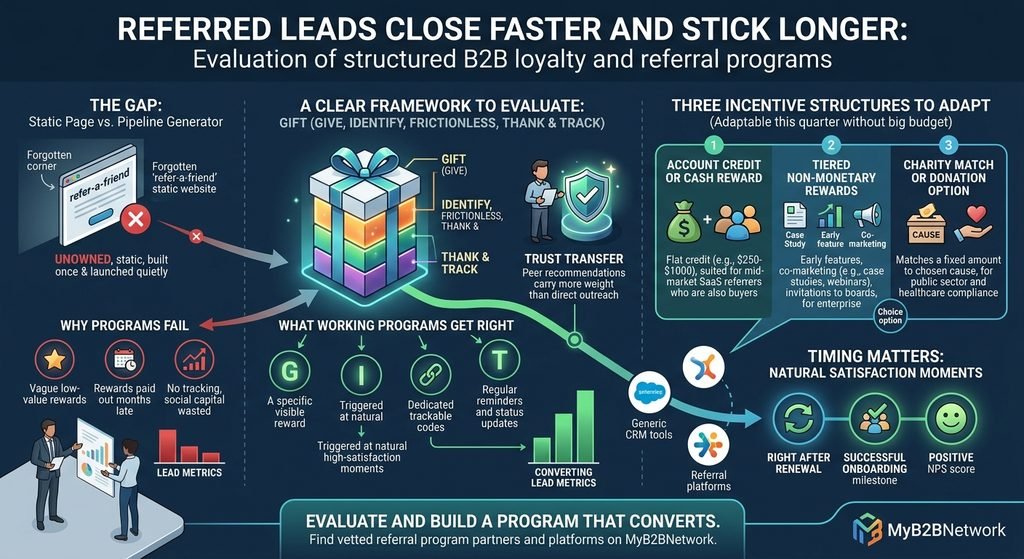
The catch is timing. A referral ask dropped into a generic email blast rarely lands. The strongest programs trigger the ask at natural high-satisfaction moments. Right after a renewal, a positive NPS score, or a successful onboarding milestone.
What Makes a Referral Program Work vs. Fail
Programs that convert share a few structural traits, while the ones that quietly die usually skip these basics.
What working programs get right:
- A specific, visible reward tied to a specific, easy action (not “refer and earn rewards”)
- Referral requests triggered by CS or account teams at moments of proven satisfaction, not blasted to the full customer base
- A dedicated, trackable referral link or code so credit never gets disputed
- Regular reminders that the program exists — most churn in referral programs comes from simple forgetting, not disinterest
What causes programs to fail:
- Vague, low-value rewards that don’t justify the social capital of a warm intro
- No clear owner inside the company, so nobody follows up on submitted referrals
- Rewards paid out only after a deal fully closes, months after the referral was made
- No tracking, so referrers never see whether their intro went anywhere
Three Incentive Structures You Can Adapt
Not every incentive works for every customer base. Here are three real structures growth and CS teams use, each suited to a different type of relationship.
- Account credit or cash reward — A flat credit (commonly $250–$1,000) applied to the referrer’s account once the referred deal closes. Works best for mid-market SaaS where the referrer is also the buyer, so the reward benefits them directly.
- Tiered non-monetary rewards — Early access to new features, co-marketing opportunities (case studies, joint webinars), or invitations to executive advisory boards. Works well for enterprise accounts where a cash reward can feel transactional or even create procurement complications.
- Charity match or donation option — The company matches a fixed amount to a cause of the referrer’s choice instead of paying them directly. This suits industries like healthcare or public sector where individual cash incentives may raise compliance questions.
Letting the referrer choose between two of these options — say, credit or a donation — tends to outperform offering only one, since it accounts for differing motivations across a customer base.
A Simple Way to Structure Your Program: The GIFT Framework
Most referral programs stall for the same handful of reasons, so we built a simple check we call the GIFT Framework:
- G — Give a clear reward: State the exact reward and exact trigger up front; ambiguity kills participation
- I — Identify the right moment: Trigger the ask after a renewal, positive support interaction, or high NPS score, not on a fixed calendar schedule
- F — Frictionless path: One trackable link, one form, no multi-step approval process for the referrer
- T — Thank and track: Confirm receipt immediately and update the referrer on status, even if the deal doesn’t close
Tools like HubSpot, Salesforce, and dedicated referral platforms such as Referral Rock or PartnerStack can automate most of the tracking and reward logic here, so it doesn’t fall on a single team member to manage manually.
FAQ
What are B2B referral programs and why do they matter for B2B businesses?
They’re structured systems that reward customers or partners for introducing new business. They matter because referred leads convert at higher rates and typically cost less to acquire than outbound or paid channels.
How do I choose the right referral program vendor within my budget?
Compare platforms based on your existing CRM integration, reward automation capabilities, and reporting depth rather than feature count alone. Many mid-market teams start with a CRM’s native referral tracking before adding a dedicated tool.
What checks should I do before outsourcing referral program setup?
Ask any agency or platform vendor for case studies with comparable deal sizes, confirm data-handling practices for customer contact information, and get clarity on how reward payouts and disputes are handled contractually.
How long does referral program setup typically take, and what does it cost?
A basic program can launch in 4–6 weeks; a fully integrated, CS-triggered program with automated tracking typically takes 3–4 months. Costs range from a few hundred dollars monthly for a lightweight tool to $2,000–$5,000 monthly for a managed, full-service program.
Want Help Building a Program That Actually Gets Used?
Designing incentives is one thing — getting CS and sales teams to consistently trigger referral asks is another. MyB2BNetwork connects growth and customer success teams with vetted referral program partners and platforms, so the program launches with the tracking and workflows built in from day one.
How to Hire or Outsource Referral Program Management in the U.S.
Many growth teams outsource the platform setup and ongoing management of referral programs rather than building tracking and automation in-house from scratch.
Choosing a vendor within budget: Filter vendors first by CRM compatibility, since a referral platform that doesn’t sync cleanly with HubSpot or Salesforce creates manual reconciliation work down the line. Lightweight, self-serve tools run $200–$800 per month; fully managed programs with dedicated account support typically land in the $2,000–$5,000 monthly range. Or mid-five-figures annually for enterprise-scale programs. Prioritize vendors offering transparent reward-payout reporting over ones promising vague “engagement lift,” and confirm the GIFT framework’s tracking and thank-you steps are supported natively.
Checks before outsourcing: Request references from at least two comparable B2B clients. Confirm compliance with data privacy standards like CCPA and GDPR/UK-GDPR if referrer or referee contact data crosses borders. And get SLAs in writing covering payout timelines and dispute resolution. This diligence applies whether you’re a SaaS company in Austin. A logistics firm in Atlanta, or a fintech team in New York handling referrer data under state privacy rules. MyB2BNetwork can source pre-vetted vendors and provide accurate quotations based on your program’s scale.